Watch anime 1–37, then optional Relight 1 → 2. Read standard manga 1–12 or six Black Editions/All-in-One, then optional Short Stories and How to Read 13. Another Note is optional prose; alternative continuities stay separate.
Reviewed 3 October 2026 · Opening premise and adaptation relationships. Major endings withheld; linked catalog summaries and discussions may contain spoilers. · Licensed access varies by country.
The source and screen branches

The manga packages cover the same core. Reference material and short stories are optional; alternative-continuity prose is labelled separately, never a mandatory sequel.
- WATCH · anime: Television ·episodes 1–37 → Optional Relight 1 → Optional Relight 2
- READ · main manga: Standard 1–12 / Black 1–6 / All-in-One → Optional Short Stories · Optional How to Read 13
- READ · prose: Main story first ·editorial recommendation → Another Note ·NISIOISIN · L, Change the WorLd ·alternative; outside core
One complete main story, several ways to package it
Death Note begins with an unusually direct fantasy: a student finds a notebook that can kill a person whose name is written inside it. Light Yagami decides to use that power against criminals, while an investigator known as L tries to identify the person behind the deaths. The tension comes from concealment, inference and competing definitions of justice, rather than from collecting increasingly powerful attacks. A first encounter benefits from keeping the investigation’s discoveries in order.
Nippon TV identifies the Madhouse television adaptation as thirty-seven episodes, originally broadcast from October 2006. Watch episodes 1–37 in order. Relight 1 and Relight 2 are additional special presentations of material from the television story; they are not episodes 38 and 39 or a second regular season. For a first viewing we recommend the full series before the specials, so a condensed presentation does not replace the gradual development of the investigation.
The manga’s main narrative occupies twelve standard volumes. That route is complete as a main story, although later short stories explore additional situations. If you finish the television anime, reading from manga volume one is the most dependable way to examine the source’s dialogue and reasoning. We do not advertise an exact “continue after this chapter” shortcut, because a shared conclusion does not make the preceding versions interchangeable.
| Route | Order | Relationship |
|---|---|---|
| Television anime | Episodes 1–37 | Complete first-entry screen route |
| Relight specials | Relight 1 → Relight 2 | Optional reworked summaries after television |
| Main manga | Standard volumes 1–12 | Complete source route |
| Short Stories | After main manga | Separate collection, including a pilot |
| Another Note | Optional after the main story | NISIOISIN prose mystery |
| How to Read 13 | After the main story | Reference guide; not main volume 13 |
A guide numbered thirteen is not a thirteenth main volume
Tsugumi Ohba writes the manga and Takeshi Obata draws it. VIZ’s full-series digital bundle identifies the core as twelve volumes. The numbered How to Read 13 is a different kind of publication: character information, story summaries, creator interviews, production material and a bonus chapter. Its number can confuse a buyer who expects a straightforward continuation. Treat it as a spoiler-bearing reference book to consult after the main manga, rather than the missing final part of a twelve-volume set.
The separate Short Stories collection includes C-Kira, a-Kira, the pilot chapter and vignettes concerning L. These are not all consecutive episodes from one new arc. In particular, the presence of an earlier pilot does not make the collection a chronological prequel to the final published series. Its varied contents deserve their own labels; reading it after the main manga avoids asking a first-time reader to solve continuity questions before meeting the central investigation.
Another Note: The Los Angeles BB Murder Cases is prose by NISIOISIN, with the original manga creators credited as the source. Shueisha lists the Japanese publication in August 2006, and VIZ lists the English hardcover in February 2008. The English synopsis identifies L and Naomi Misora’s Los Angeles investigation. We recommend it after the main story for context, without turning that recommendation into an invented episode or chapter placement. The author credit distinguishes it from Ohba and Obata’s manga work.
Visual case: public rules and private faces
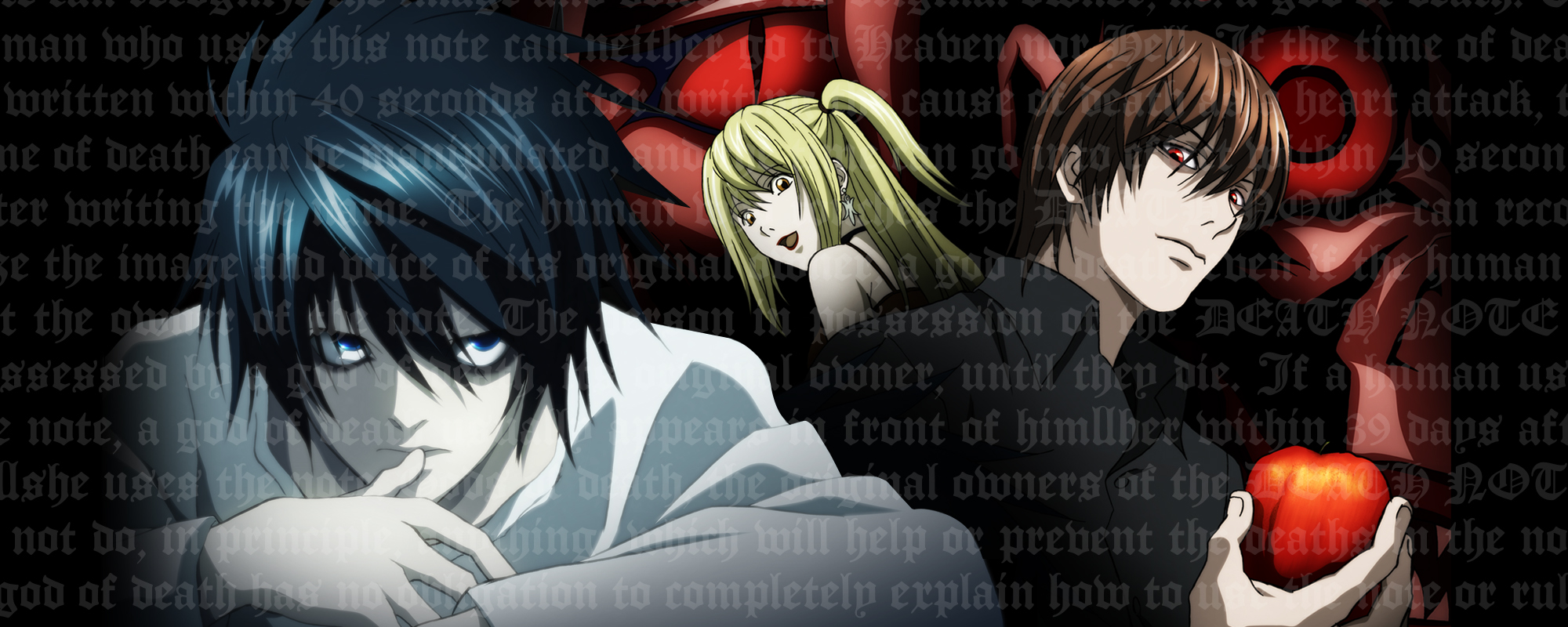
The supplied VIZ series image arranges L prominently at the left, Misa near the center and Light at the right. L’s pale clothing and blue-lit eyes contrast with Light’s dark clothing and red-lit eyes. Light holds a bright red apple near the lower-right corner. Behind and across the figures, gray Gothic lettering reproduces fragments of the notebook’s rules. The text is not merely a caption beneath the image; it becomes part of the space through which the faces are viewed.
Our interpretation is that this layout makes the rules seem impersonal while the people remain sharply divided. The red apple is immediately readable as a physical object, whereas the layered writing asks the viewer to look more slowly. We do not infer a particular plot outcome from those colors or claim that this promotional composition is a frame from an episode. It is an illustration of how the series can advertise reasoning and personality together.
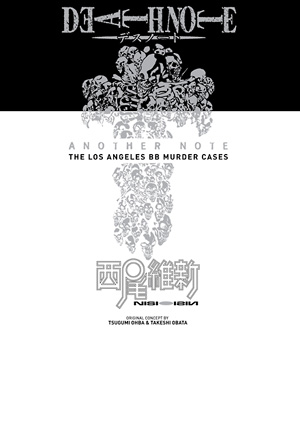
The official Another Note cover takes a markedly different approach. A black upper field carries the Death Note lettering and a decorative gray emblem; a broad white lower field contains the English title, Japanese author lettering and source credits. The ornament continues across the boundary rather than presenting a cast portrait. This makes the prose title and author identity especially important when selecting the book. Both original images retain their lettering and framing; neither is replaced by a generated recreation.
Original visual reference
Suspense depends on who knows a rule, and when
Our reading of the premise is that Death Note turns power into an information problem. A hidden action can become evidence when it happens at a particular time or in response to a particular challenge. The viewer is invited to distinguish a character’s confident explanation from what an opponent can actually observe. This is why apparently quiet conversations matter: information can narrow a possibility even when no physical confrontation occurs.
The justice question also changes when Light makes himself the person who decides. Punishment, deterrence and personal authority are related concerns, but they are not identical. The opening setup allows a viewer to understand his stated ambition without accepting that his private decisions amount to a fair institution. Our editorial interpretation is that his desire to be recognized makes concealment unstable: acting anonymously and demanding public acknowledgment pull against each other.
For adaptation comparison, ask how a version presents an inference. A manga reader can pause over a speech balloon or return to an earlier panel; a television viewer receives speech, cutting, performance and sound at a chosen tempo. A shorter explanation may feel decisive on screen while removing a step that a reader valued on the page. This is a useful comparison framework, rather than proof that every omission is an error or that the anime creators intended a particular audience response.
Separate the source partnership from the television team
Nippon TV’s credits name Tetsuro Araki as director, Toshiki Inoue for series structure, Masaru Kitao for character design and Madhouse for animation production. Mio Isshiki handles art direction, Satoshi Hashimoto color settings and Chiaki Yamada sound direction. These roles identify different decisions in the screen adaptation. A manga panel’s expression, a television character model and an edited performance belong to related but distinct stages of production.
Ohba and Obata’s division between writing and drawing also makes attribution more precise. The underlying scenario and a particular line’s drawn expression should not both be casually credited to an unnamed single “author.” How to Read 13 offers official interviews and production material for readers who want to investigate that partnership further. We link the guide rather than borrowing fan statements about what the creators supposedly planned as established production history.
The television series and the Relight specials should be compared by edition as well as title. Nippon TV’s international catalog gives approximate special runtimes, while its domestic DVD product listings give the durations of their own supplied versions. Those entries differ. We therefore identify the specials by name and purpose instead of claiming one universal runtime for every release. The second DVD description explicitly mentions new cuts and reconstructed material; a summary presentation can still contain newly made pieces.
A pacing dispute is more useful than a verdict on all versions
The displayed external score is AniList’s named 2006 television entry:84/100, normalized to 8.4/10 and observed October 3,2026. It covers the thirty-seven-episode anime. It is not a manga rating, an average of the novels, or a vote collected by Animeteor. Readers comparing different formats should keep that scope visible rather than treating a recognizable franchise name as one universally rated object.
A selected r/deathnote discussion compares how much screen time different manga volumes receive. Some commenters argue that later material loses important reasoning; another prefers the anime’s trimming of dense dialogue and values its music, style and performances. The thread author describes manually matching volume endpoints to moments in the anime. That is a community comparison, not an official production schedule, so we do not turn its fractional episode allocations into our route map.
The useful choice is whether you want more time with the reasoning or a controlled audiovisual tempo. Try the complete anime for performance and tension, then read the manga from the beginning if you want to examine the explanation in another medium. That recommendation does not require reproducing the thread’s major ending spoilers here. Death, coercion and psychological distress are central to the premise, so suitability matters alongside pace.
Count story coverage before comparing the number of books
VIZ’s Black Edition is a two-in-one format; its first book contains standard volumes one and two, and the catalog lists six Black Edition volumes. The All-in-One edition contains the twelve main volumes in a single book, with a bonus short story. One physical book is therefore not one standard story volume, and six Black Edition books do not mean half the narrative is missing. Choose the reading format by handling, availability and legibility rather than by cover count alone.
The All-in-One’s bonus does not make it identical to the separately cataloged Short Stories collection or How to Read 13. If those are the extras you want, inspect their named contents before assuming a main-series package includes everything. This distinction also prevents an update from manufacturing a “new volume” when a publisher releases another binding of the same completed core. The principal change may be packaging or access rather than narrative continuation.
VIZ’s current series page also promotes a twentieth-anniversary digital anime offer. That demonstrates active licensed distribution, not a newly produced television season. Promotional prices and regional access can change, so verify the purchase page when buying. No audited anime production budget, title-specific streaming revenue or franchise profit was established in the sources used here. Audience scores and continued catalog availability cannot supply those missing financial figures.
Keep alternative continuities visibly separate
For a first screen route, complete the thirty-seven episodes before the two optional Relight presentations. For manga, choose standard 1–12, Black Edition 1–6 or the All-in-One as alternative packages of the same core; then consider Short Stories and the reference guide separately. Another Note is an optional prose investigation by a different writer. Those instructions distinguish reading purpose from a supposed single chronological ladder through every branded product.
VIZ identifies L, Change the WorLd, credited to M, as an alternative continuity. It should not be inserted as the next necessary step after the main manga or Another Note. The live-action and game branches likewise remain outside this anime/manga/prose roadmap under our site rule. Separate adaptation coverage can link back here without turning those products into required chapters of the main investigation.
For another treatment of private judgment and moral cost, compare Hell Girl; for a broader fear moving through different cases, compare Paranoia Agent. Neither shares Death Note’s continuity. Updates to this guide should name the particular medium and edition: a new short story, another collected format and an anniversary sale affect different parts of the page. Reliable sources can contain spoilers, so consult linked summaries and community threads according to how much of the story you have completed.
Primary sources and useful navigation
- Nippon TV ·37 episodes, staff and Relight special catalog
- Nippon TV shop ·Relight 1 domestic DVD edition
- Nippon TV shop ·Relight 2 new cuts and DVD edition
- VIZ ·complete twelve-volume digital bundle
- VIZ shop ·Black Edition 1 contains standard 1–2
- VIZ shop ·six Black Edition volumes
- VIZ ·All-in-One main manga coverage
- VIZ ·All-in-One bonus publication description
- VIZ ·Short Stories named contents
- VIZ ·How to Read 13 reference guide
- Shueisha ·Another Note authorship and Japanese edition
- VIZ ·Another Note English novel and cover
- VIZ ·L, Change the WorLd alternative continuity
- VIZ ·series imagery and licensed anime offers
- AniList · named anime audience score
Community and catalog routes
- MyAnimeList · named anime catalog
- Reddit ·selected dialogue and adaptation pacing discussion; spoilers
- Death Note Wiki ·edition navigation; spoilers
- Wikipedia ·franchise navigation; spoilers
The production and publisher links support project facts. Catalog and community pages are secondary navigation and may reveal later events.
Explore related story guides
Original series imagery is reproduced under permission asserted by the site owner; the source and rights credits are retained. The route diagram is Animeteor’s own explanatory graphic.
Games and live-action adaptations
- Death Note and Death Note: The Last Name — Live action: Two films · 2006
- Death Note: the 2015 drama — Live action: Series · 2015
- Death Note: Light up the NEW world — Live action: Film · 2016
- Death Note — Netflix film (2017) — Live action: Film · 2017
- L change the WorLd (2008) — Live action: Film · 2008
- DEATH NOTE Killer Within — Game: Online social deduction · four to ten players
- DEATH NOTE Kira Game — Game: Communication and deduction game
- DEATH NOTE: L’s Successors — Game: Pursuit and psychological deduction adventure
- L the proLogue to DEATH NOTE: Rasen no Wana — Game: Single-player deduction and escape adventure
- Death Note: NEW GENERATION — Live action: Three-part Japanese web drama · 2016
Separate games and live-action branches
Killer Within is a released online deduction game requiring four to ten players; it is separate from the three older Japanese Nintendo DS games now linked below. Historical local DS wireless modes are not modern online matchmaking.
Hulu’s official NEW GENERATION catalog identifies a separate 2016 three-part drama centered on Mishima, Ryuzaki and Shien, leading into Light up the NEW world. It is not the 2015 television remake or the 2017 Netflix film.
Netflix’s 16 July 2024 company notice separately documented an Upside Down Pictures live-action Death Note series in development. That historical notice provides no verified current premiere or cast, and should not be converted into a claim that it has aired.