Original 2004 anime: episodes 1–13. Optional Japanese prose: Umezu’s separate story, not an anime-source novel. Kon’s production essays and disc extras may reveal endings.
Reviewed 3 October 2026 · Opening premise and adaptation relationships. Major endings withheld; linked catalog summaries and discussions may contain spoilers. · Licensed access varies by country.
The source and screen branches

Start the anime at episode one. The related Japanese book is another story; no manga source, post-anime chapter shortcut or new season is claimed.
- WATCH · anime: 2004 original television project → Episodes 1–13 · supplied order → Complete-series discs are editions
- READ · prose: Optional Yuichi Umezu book → Kon credited for original work → Separate related story · not anime source
- EXPLORE · making: Kon production essays · spoilers → Disc commentary / storyboards → Commentary, not extra episodes
Start the thirteen-episode television series at episode one
Paranoia Agent is a complete thirteen-episode 2004 television route created by Satoshi Kon and animated by MADHOUSE. Begin at episode one and retain the supplied order through thirteen. The licensed complete-series editions confirm that coverage. A changing viewpoint does not mean you have opened the wrong season, and a collection date years later does not make the collection a new adaptation.
The initial premise follows an assault reported by Tsukiko and an investigation into a boy with a bat and golden inline skates. The licensed Japanese catalog emphasizes uncertainty around her account before another attack changes the situation. Our entry recommendation preserves that uncertainty. Reordering material around an explanation found online would sacrifice the very process by which the story asks viewers to assess evidence.
There is also a Japanese prose book by Yuichi Umezu, published by KADOKAWA in 2004 with Kon credited for the original work. The publisher describes it as another story behind the television project. It is optional related reading, not a source novel you must finish before watching or a verified episode-fourteen continuation. No confirmed manga route is inserted simply to fill a format slot.
| Choice | Recommended sequence | Boundary |
|---|---|---|
| 2004 television anime | Episodes 1–13 in supplied order | One complete screen route |
| 2020 North American Blu-ray | Same episodes 1–13 | Named Region A edition, not another season |
| 2025 UK Steelbook | Same episodes 1–13 | Named Region B edition with language details |
| Umezu Japanese prose book | Optional separate reading after the anime | Another story; not the original anime source |
| Kon production essays | After viewing, with spoiler caution | Production commentary, not additional story episodes |
The prose connection points away from an anime-source assumption
KADOKAWA’s book record names Kon for the original work and Umezu as the prose author. It gives May 8, 2004 for its Japanese publication and describes a separate household narrative affected by the threat of the bat-wielding attacker. That description establishes a related book, without certifying that it retells every episode or resolves the television ending.
Japan’s National Diet Library independently catalogs the same book as Japanese fiction and confirms the Kon/Umezu author roles. Its physical pagination record differs from the publisher’s product-page total. We do not turn that small catalog difference into an invented extra chapter or a claim of different narrative continuity. For acquisition, use the ISBN and named edition rather than relying only on the English franchise title.
Our map therefore begins with the original television project and branches to optional prose, instead of drawing a novel-to-anime source arrow. This is a useful exception to a common assumption about anime. A site that automatically fills anime, manga and novel boxes would misrepresent the work; a guide should display the formats actually verified and the direction of their relationship.
Visual case: gold objects make comfort and danger share the frame
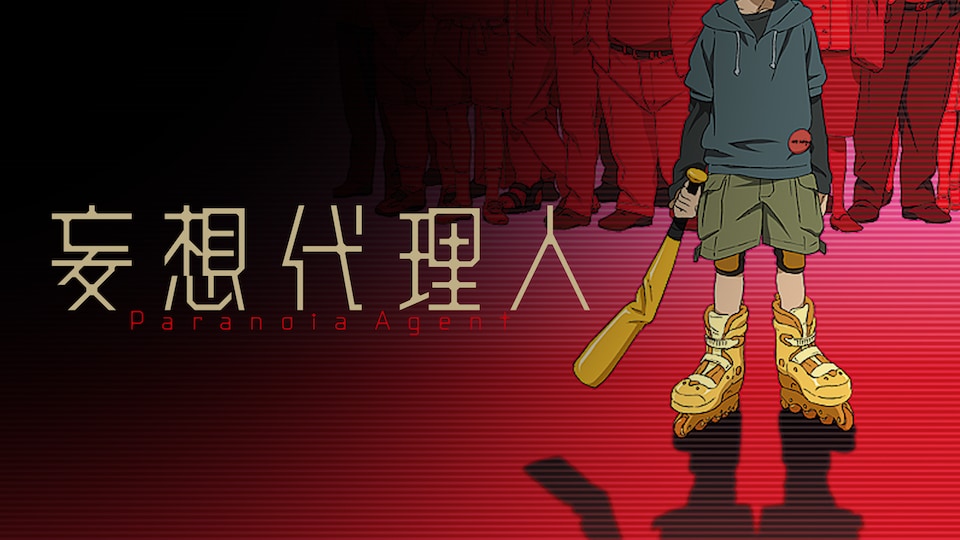
The licensed anime artwork isolates the lower body of a boy at the right of a red-black field. His head is outside the composition, while golden skates and a bent gold bat remain clearly visible. Outlined adult figures stand behind him. The identifying objects occupy the viewer’s attention even though the image withholds the face that might usually anchor recognition.
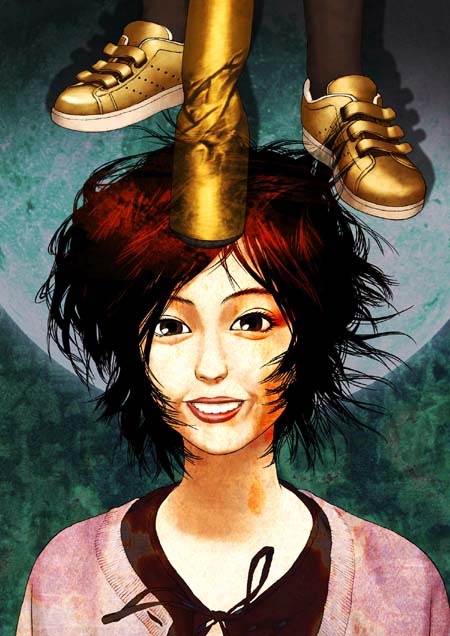
Kon’s own illustration accompanying his production essay places a smiling young woman below golden shoes and a bat descending near her head. Teal surroundings, pink clothing and the metallic gold create an unusually attractive color arrangement for a threatening placement. The smile does not make the weapon harmless. The composition asks the viewer to hold friendliness and unease together rather than choosing one from the outset.
Our reading compares how a repeated object can become more recognizable than its bearer. The red promotional image produces a threatening emblem; the creator’s illustration lets that emblem intrude upon an approachable face. Neither image supplies an ending explanation. They demonstrate how visual recognition can encourage an immediate interpretation before the story has provided enough evidence to justify it.
Original visual reference
The investigation is also a study of how an explanation becomes useful
A reported attacker gives a community a concrete name for anxiety that was previously dispersed across work, reputation and personal relationships. Our analytical question is not only who committed an assault. It is why a particular account becomes persuasive or convenient to someone at a particular moment, and what kinds of pressure become easier to avoid after that account is accepted.
The opening investigation makes testimony important without making every observer reliable in the same way. Someone can withhold information out of fear, misread what happened or repeat a story received from another person. Keep those possibilities distinct. Treating uncertainty as a blanket permission to dismiss every statement would be as careless as accepting a familiar rumor as complete evidence.
The work’s frightening situations and strained characters invite interpretation, but they do not justify diagnosing real viewers or reducing real harm to a failure of responsibility. Our reading examines the gap between social expectations and the stories people use to survive them. An apparent explanation may relieve pressure while carrying a cost that other people must bear. That tension offers more than a conventional culprit puzzle.
Kon’s own notes complicate the image of a single-person production
Kon’s origin essay describes using ideas that had not fitted into his earlier films, while also wanting continuity for a working group after Tokyo Godfathers. He discusses a relay of viewpoints rather than an unchanged protagonist carrying every encounter. These are the creator’s retrospective explanations, not a guarantee that a viewer must interpret every scene exactly as he describes it.
His separate account of the chief-director credit explains the relationship between his supervision and individual episode direction. It credits Seishi Minakami with eleven scripts and Tomomi Yoshino with two. That record is useful because calling the entire series one director’s vision can otherwise erase the people who shaped its different installments. Kon’s overall authorship and an episode contributor’s actual work can both matter.
The licensed Japanese staff catalog names Masashi Ando for character design, and composer Susumu Hirasawa’s official discography lists the soundtrack. The soundtrack is another way to study how emotional cues work beside an image, without treating a shared composer as shared story continuity. A design, a musical gesture and a cut may cooperate to make a confident-looking surface feel unstable.
An unsettled first response can be part of the appeal or a genuine obstacle
The selected February 2024 opening-episode rewatch includes a first-time viewer drawn to uncertainty and distinctive compositions, a rewatcher comparing the experience with Lain, and another first-time viewer irritated by withheld information. Those individual responses are worth presenting together. A useful discussion does not require pretending that everyone finds ambiguity rewarding or that frustration proves someone watched incorrectly.
Our recommendation is to finish the supplied route before seeking a total explanation if the premise and presentation interest you. Keep notes on who says something and what actually appears onscreen, rather than deciding immediately that every unusual image is literal or imaginary. If the experience remains unpleasant, acknowledging that preference is more useful than promising that one final answer will erase every difficulty.
The displayed external 7.6/10 is AniList’s audience snapshot for the thirteen-episode television entry, normalized from a 100-point average. It does not rate Umezu’s book, an individual episode or the creator’s essay. We do not combine a disc retailer’s customer reviews with that number. The broader series-discussion thread is linked separately with a clear warning that it discusses endings.
Production continuity has evidence; a profit estimate does not
Kon’s origin account identifies the practical wish to keep part of a production team together between projects. That is direct evidence of a creator thinking about the working environment, rather than just an abstract desire to tell another story. It is not an audited budget, a studio staffing ledger or a measured claim about the financial outcome of the finished program.
The North American 2020 complete-series Blu-ray lists English and Japanese audio, English subtitles and Region A. Its extras include a Kon/Hirasawa talk show, radio commentaries and episode-one storyboards. The UK distributor’s 2025 Steelbook separately lists all thirteen episodes, English and Japanese audio, English subtitles and Region B. Choose the actual edition your player and language needs support.
These later releases provide evidence of continued catalog treatment; they do not constitute a second season or a new television production. Retail prices and stock change, so this guide links the official listings without promising permanent availability or reproducing a sale price as the cost everywhere. No reliable profit calculation follows from a premium box, a current audience score or the creator’s reputation.
After episode thirteen, choose comparison or commentary rather than a fabricated sequel
Complete the television route from episode one to thirteen. On a rewatch, compare how an account changes when you know who is speaking and what that person needs from the explanation. A chronology diagram can be a later analytical tool, but this first-entry map is deliberately limited to releases and relationships so that it does not explain the mystery before the work does.
Choose Umezu’s Japanese prose book as optional related fiction if its language and separate premise interest you. Choose Kon’s production essays for the making of the series, recognizing that those pages reveal story decisions and endings. Disc extras provide another documented route into production commentary; they should not be listed as extra episodes required to finish the narrative.
Our Boogiepop Phantom and Serial Experiments Lain guides extend questions about rumor, identity and unreliable knowledge without creating shared canon. A future update should add a route only if a real new production or verified related publication changes what readers can select. New commentary about an old ending is a reason to revisit an interpretation, rather than a reason to advertise an unannounced continuation.
Primary sources and useful navigation
- Bandai Channel · original-anime catalog and licensed artwork
- Kon’s Tone · creator’s origin essay; major spoilers
- Kon’s Tone · chief-director credit and writing teams; spoilers
- KADOKAWA · optional Umezu prose book and original-work credit
- National Diet Library · independent Japanese book record
- Susumu Hirasawa · official soundtrack discography
- Rakuten PLAY · licensed-service staff record
- Crunchyroll Store · 2020 Region A edition and extras
- Anime Limited · 2025 Region B Steelbook specifications
- Crunchyroll · licensed series availability by territory
- AniList · named anime audience score
Community and catalog routes
- MyAnimeList · named anime catalog
- Wikipedia · series navigation; spoilers
- Reddit · selected February 2024 opening-episode rewatch; spoilers
- Reddit · selected February 2024 whole-series discussion; ending spoilers
The production and publisher links support project facts. Catalog and community pages are secondary navigation and may reveal later events.
Explore related story guides
Original series imagery is reproduced under permission asserted by the site owner; the source and rights credits are retained. The route diagram is Animeteor’s own explanatory graphic.