Death Note: the 2015 drama — live-action guide
LIVE-ACTION GUIDE · Sources checked 3 October 2026 · Opening-premise spoilers; publicity and linked summaries may reveal later material.
Masataka Kubota and Kento Yamazaki lead the 2015 Death Note television drama. Eleven episodes form a separate performed adaptation.
- Format / edition
- Live-action television drama · 2015
- Episodes
- 11, as cataloged by Nippon TV
- Catalog slot duration
- 60 minutes; a slot description, not a promise of every episode's exact runtime
- Leads
- Masataka Kubota and Kento Yamazaki
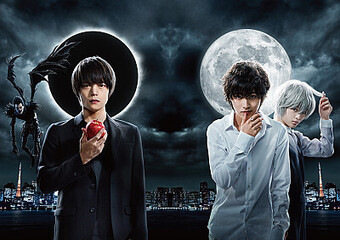
Production and edition
The 2015 drama revisits the notebook premise with its own cast and eleven-episode television format. It is separate from the 2006 theatrical pair and the 2017 American film.
An adaptation lens
A serial format can return repeatedly to the difference between a public identity and a private action. The useful question is what each return adds to the audience's understanding, rather than assuming extra episodes necessarily produce more faithful coverage. Identify the particular observation or decision a scene contributes.
Light and L's contest involves how people present information as well as what they know. A performed exchange can place a confident statement beside an uncertain reaction. Compare the relationship between those two signals before treating a familiar line as proof of an identical characterization.
Choosing this route
Use Masataka Kubota and Kento Yamazaki's cast identity to select this version. Its television ending is not automatically a chapter marker for the manga or an extension of the 2006 films. The main Work guide supplies the broader source context.
Release and access
Nippon TV's international record is a product and licensing catalog. Check the 2015 cast in an authorized local service. Shared English titles in a search result are insufficient to identify the intended edition.
Sources and credits
The production facts above come from the identified official records. The adaptation lens is Animeteor editorial interpretation, not a scored review or an exhaustive scene comparison.