DEATH NOTE Kira Game — Nintendo DS guide
GAME GUIDE · Sources checked 04 October 2026 · Opening-premise spoilers; original promotional screenshots can reveal creatures and environments.
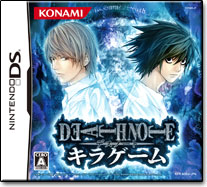
Nintendo identifies the 2007 Konami product as a communication deduction game for one or two players, with two-player DS wireless play.
- Product
- DEATH NOTE Kira Game
- Publisher
- Konami
- Japanese release
- 15 February 2007
- Platform
- Nintendo DS
- Players
- One to two; local DS wireless two-player mode
Product and edition
Nintendo identifies the 2007 Konami product as a communication deduction game for one or two players, with two-player DS wireless play. Its story mode consists of eleven chapters. The L side seeks to identify Kira, while Kira tries to discover and defeat L; winning other investigators’ trust is part of the publisher’s description. This exact cartridge is distinct from the later DS pursuit game and the modern Killer Within online product.
Gameplay and story
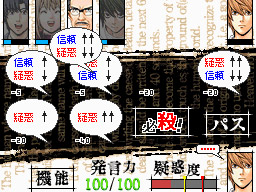
The communication screen makes trust and suspicion visible beside character portraits. For an audience, the source’s competing deductions arrive as selected dramatic information; here, the supplied interface organizes possible responses and relationships into things a player can inspect. That is a useful way to compare adaptation form without assuming that the numerical trust indicator measures the manga characters in a canonical way. The full image matters because it keeps portraits and available actions together.
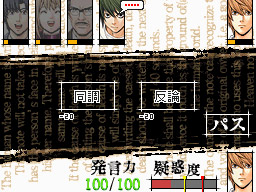
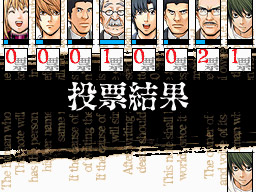
The decision and vote-result frames show two different stages in the visible information process. One screen offers responses, while another summarizes the group’s choices. The source’s investigation is therefore presented through a repeatable interface, rather than solely through sequential panels or timed television cuts. These original images establish what is visible, without showing how reliably a particular tactic succeeds. They also distinguish this cartridge’s communication model from a contemporary multiplayer lobby; similar deduction themes do not make the products interchangeable.
Choosing this route
Treat this as an optional interactive branch after choosing your manga or television route. Shared characters do not make a game screen an omitted manga chapter, and a product’s release date is not a recommended story chronology. The original low-resolution display frames are retained whole and shown at their native size; they have not been reconstructed, translated, cropped out of hardware photography or enlarged to suggest detail that the archive does not contain. Our comparison concerns how the visible interface organizes information, not an exhaustive correspondence between source scenes and game events.
Platforms and access
This guide identifies the historical Japanese Nintendo DS edition, not a current download offer, official English translation or modern port. Use a legitimate original edition and check the required hardware and cartridge language. Where the archive lists two-player DS wireless play, that is a local wireless feature description and not a guarantee of a currently operated internet service. No price, game profit, tested input sequence, completion score or current player population is claimed. The store’s historical text remains evidence of this edition’s design rather than a promise that every old distribution channel still exists.
Sources and credits
- Nintendo official exact product record and publisher description
- Original full display 1
- Original full display 2
- Original full display 3
Facts are drawn from the identified publisher and developer records. The story lens is editorial interpretation, not a hands-on review, performance test or audience rating.