DEATH NOTE: L’s Successors — Nintendo DS guide
GAME GUIDE · Sources checked 04 October 2026 · Opening-premise spoilers; original promotional screenshots can reveal creatures and environments.
Nintendo identifies DEATH NOTE: L o Tsugu Mono as the second Konami DS game, released in Japan on 12 July 2007.
- Product
- DEATH NOTE: L’s Successors
- Publisher
- Konami
- Japanese release
- 12 July 2007
- Platform
- Nintendo DS
- Players
- One to two; local DS wireless two-player mode
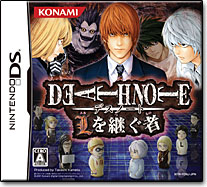
Product and edition
Nintendo identifies DEATH NOTE: L o Tsugu Mono as the second Konami DS game, released in Japan on 12 July 2007. It supports one or two players, with local DS wireless confrontation between a pursuing investigator and an escaping Kira. The publisher describes asymmetric information: investigators infer an unseen opponent, while Kira can see investigators and place traps. This is its own pursuit game, not the eleven-chapter communication product or an episode of the Relight television compilation.
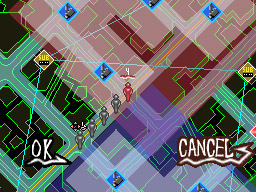
Gameplay and story
The city map turns the conflict into a spatial information problem. The complete lower-screen image retains confirmation controls and possible positions rather than isolating one portrait. A pursuit can make incomplete knowledge visible as a place the player must interpret. This offers a concrete adaptation question: how does knowing where someone might be differ from reading an internal monologue selected by a manga author? The promotional interface alone cannot establish a winning route or the balance between roles.
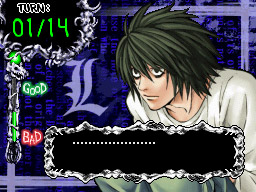
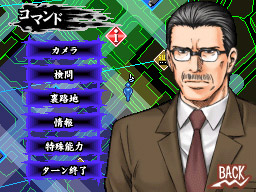
The L deduction frame and investigator command display supply different views of the same product’s emphasis. Turn information, a statement area and map commands make reasoning legible as a sequence of player decisions. Their combination is materially different from simply borrowing a familiar face for a puzzle icon. That comparison remains an interpretation of supplied images and the publisher’s mode description. No particular trap outcome or completed case is claimed, and the archived local two-player feature should not be described as a modern online matchmaking service.
Choosing this route
Treat this as an optional interactive branch after choosing your manga or television route. Shared characters do not make a game screen an omitted manga chapter, and a product’s release date is not a recommended story chronology. The original low-resolution display frames are retained whole and shown at their native size; they have not been reconstructed, translated, cropped out of hardware photography or enlarged to suggest detail that the archive does not contain. Our comparison concerns how the visible interface organizes information, not an exhaustive correspondence between source scenes and game events.
Platforms and access
This guide identifies the historical Japanese Nintendo DS edition, not a current download offer, official English translation or modern port. Use a legitimate original edition and check the required hardware and cartridge language. Where the archive lists two-player DS wireless play, that is a local wireless feature description and not a guarantee of a currently operated internet service. No price, game profit, tested input sequence, completion score or current player population is claimed. The store’s historical text remains evidence of this edition’s design rather than a promise that every old distribution channel still exists.
Sources and credits
- Nintendo official exact product record and publisher description
- Original full display 1
- Original full display 2
- Original full display 3
Facts are drawn from the identified publisher and developer records. The story lens is editorial interpretation, not a hands-on review, performance test or audience rating.