Space crews, work and survival: five anime with different destinations
A stranded class, a debris-recovery department, bounty hunters, aspiring astronauts and a ship defending its people. Five space anime selected for what brings a crew together and what it needs to keep going.
Reviewed 2026-10-01 · Premise-level spoilers · Editorial selections, without a universal ranking.
The shelf includes preparation on Earth as well as travel through space. These are different experiences of crews and responsibility: a job, a qualification process, a rescue route and collective survival. It is not a list of five lost-in-space stories or a realism ranking.
Choose your starting point
Follow the branch that sounds most appealing. This is a selection map, not a shared universe or a chronology.
How we chose these five
Each selection needs a theme that shapes its premise, a distinct reason to choose it and a verifiable anime project. We distinguish films from television, explain tone differences and use official production, studio, publisher or licensed-distributor pages for project identity. The order groups viewing experiences; it is not a score based on popularity or a claim that one work is objectively better.
Astra Lost in Space
TV anime · Students forced to become a crew

A planetary school excursion goes wrong when a mysterious phenomenon carries nine students into distant space. The licensed manga opening describes their discovery of an empty spaceship.
Why choose it?
Choose this when teamwork must be improvised by people who did not set out as a professional crew. The departure is a school outing; the ship becomes a practical possibility after the situation changes. That makes it the rescue-and-return branch of this collection. Compare it with Planetes, whose characters begin with an established job, or Space Brothers, where becoming qualified for the work is itself part of the journey. Our editorial attraction is that a shared destination is not enough: a group needs to turn available people and resources into a way forward. The mystery can develop alongside those needs without requiring us to disclose why the excursion went wrong.
Where to start
Begin the television series with episode one and continue in its original sequence. VIZ’s Astra Lost in Space manga begins at volume one and has its own complete volume route. Avoid character explanations or later cover summaries if preserving the return mystery matters.
Tone & scope: Peril, isolation and mystery. This is the stranded-group choice; the other four are not all stories about students lost in space.
Read the full Astra Lost in Space guide & visual adaptation map →
Planetes
TV anime · Orbital debris as a working life

Hachimaki is a professional astronaut employed to collect orbital debris. The official anime synopsis names coworkers Fee and Yuri and newcomer Tanabe, placing the work in a future of routine travel between Earth, stations and the Moon.
Why choose it?
Select this when space should be a workplace with ordinary aspirations as well as extraordinary surroundings. The collection’s distinctive practical question is what keeps travel possible after the exciting launch: debris and maintenance cannot disappear just because other people have a destination. A job gives the characters colleagues, experience and competing ambitions before the plot asks for a grand mission. Compare it with Cowboy Bebop’s precarious bounty work, or Space Brothers’ path into the profession. This is our choice for an existing workplace rather than an accidental crew or a ship defending the remaining human population. The attraction is the relationship between useful daily labor and a person’s idea of a future.
Where to start
Begin the original television adaptation at its first episode. Makoto Yukimura’s manga is a separate reading route. The anime’s old production page contains historical manga-publication details; use a current licensed edition catalog for books rather than treating that archive as today’s volume count.
Tone & scope: Occupational danger and social conflict. Its work-centered premise is not a practical orbital-safety manual or proof of present-day space economics.
Cowboy Bebop
TV anime · Bounty jobs and an uneasy shared home
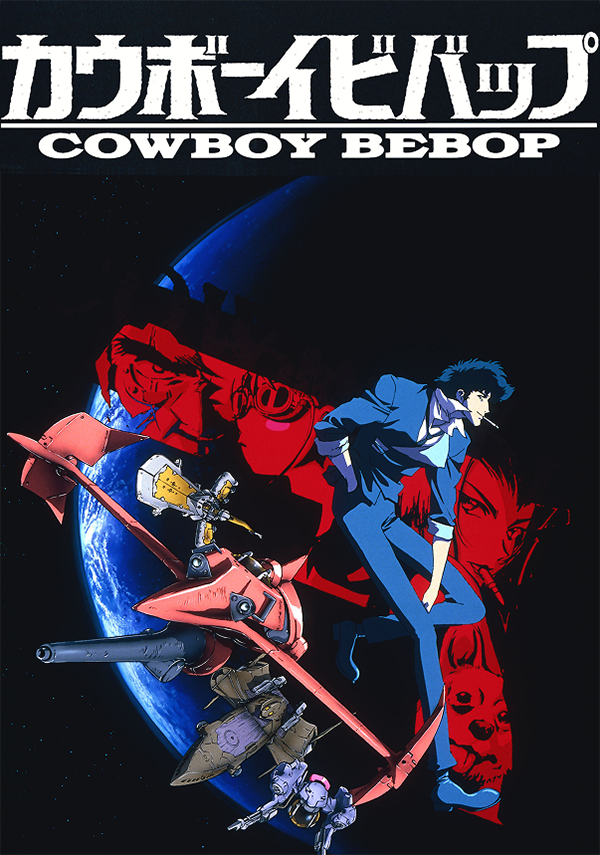
Spike and Jet travel as bounty hunters in a future solar system. The official television description introduces a wider group sharing the Bebop, with different backgrounds and obligations.
Why choose it?
Choose this when a crew should feel like people whose lives overlap without becoming a perfectly organized institution. A job supplies a reason to travel, but it does not guarantee financial security or agreement about what to do next. That is a different working experience from Planetes’ debris-recovery department and Space Brothers’ effort to enter a formal profession. Our shelf includes it for the combination of movement, uncertain work and an inhabited ship. If you want a single survival goal from the opening, Astra is a clearer fit; if you prefer a series of encounters shaped by the people aboard, begin here. This is a fictional livelihood, not a budget analysis of profitable bounty hunting.
Where to start
Begin the original television series and follow its episode sequence. The official world page places the animated film between TV episodes 22 and 23, but a first viewing can keep release discovery as its starting approach. The live-action adaptation is a separate format.
Tone & scope: Crime, violence, loss and adult material. Official biographies and late-episode summaries disclose past relationships and outcomes.
Space Brothers
TV anime · Learning how to become an astronaut
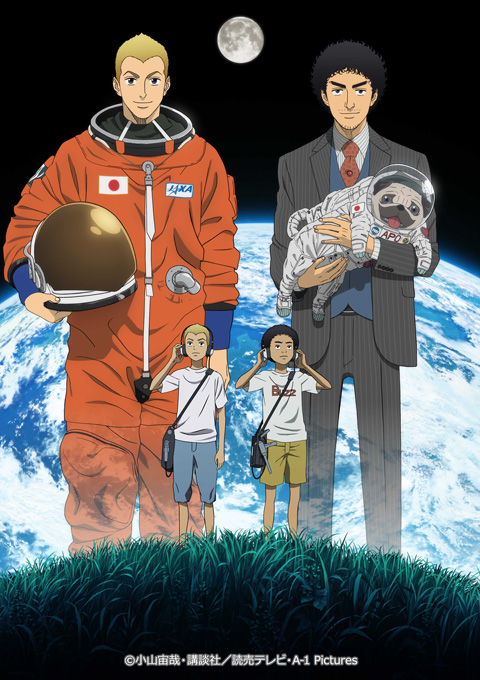
Brothers Mutta and Hibito share a childhood ambition. The licensed manga description places Hibito on an astronaut path while the unemployed Mutta applies to pursue the same profession; A-1 Pictures identifies the television adaptation.
Why choose it?
Choose this when the route into a space crew is as interesting as the mission itself. The useful difference from a stranded adventure is that desire has to meet selection, preparation and other people’s standards. It also supplies a second-chance perspective through Mutta’s change in employment. We include it beside Planetes because both make space work more than a spectacular backdrop, while their starting positions differ: one character already has an orbital job, another is trying to qualify. Compared with Knights of Sidonia, the central invitation is professional aspiration rather than the immediate defense of a surviving ship. The shelf therefore includes preparation on Earth, not only stories already underway in deep space.
Where to start
Begin the television series at its first episode. Space Brothers #0 is a separately labeled animated film; use project identity before treating a prequel as the default starting point. The licensed manga is an independent reading route, and a precise anime-to-chapter continuation needs an edition-specific check.
Tone & scope: Career setbacks, training pressure and danger. This is a dramatized professional journey; it is not current astronaut-recruitment guidance.
· Studio television project and credits
· Licensed source premise
· Find in MyAnimeList
Read the full Space Brothers guide & visual adaptation map →
Knights of Sidonia
TV anime · A ship carrying humanity’s survival

Polygon Pictures describes humans escaping destruction aboard large seed ships. Nagate, raised deep within Sidonia, enters pilot training and faces the Gauna alongside other pilots.
Why choose it?
Select this when the ship should be more than a workplace or a temporary vehicle. The studio’s premise makes it part of how a remaining population survives, which changes the scale of a crew’s responsibility. It is the defense-and-survival branch beside the improvised return in Astra and the livelihood of Cowboy Bebop. Our selection emphasizes that distinction rather than presenting all space anime as interchangeable expeditions. Choose it if the appeal lies in an enclosed community facing a threat beyond itself; choose Space Brothers when the human effort to enter a profession is more important. The original manga and the studio’s animation project also offer clearly labeled choices for how to experience the setting.
Where to start
Begin the first television series, then follow the separately named Battle for Planet Nine continuation before exploring the later animated film Love Woven in the Stars. Start the original manga with its first volume if reading; its numbering does not identify an exact screen handoff by itself.
Tone & scope: Alien violence, body horror and mature material. The survival premise and later film promotion can reveal developments beyond the initial training setup.
· Studio starting premise and credits
· Studio second-season project
· Studio later film project
· Find in MyAnimeList
Read the full Knights of Sidonia guide & visual adaptation map →
Case check: getting aboard and already having a job are different stories
Planetes’ official synopsis begins with Hachimaki already working as an orbital debris collector. The licensed Space Brothers opening begins with Mutta out of work and applying to become an astronaut. Our comparison is that both can make space feel like a profession while asking different questions of the viewer. One invites attention to the relationships and ambitions inside an existing workplace; the other emphasizes the route into that profession. Astra supplies another boundary: its students encounter a spaceship after an excursion goes wrong, rather than joining through employment or selection. Those differences explain the decision branches on this page. The cited starting descriptions support the roles and situations. They do not prove that the stories reproduce today’s astronaut training, orbital regulations or operating costs accurately.
Confirmed: the linked primary descriptions establish project identity and starting premises. Editorial reading: the thematic fit and comparisons are our interpretation. Not established here: exact adaptation endpoints, production costs, complete viewing availability or a scene-by-scene source comparison.
Discuss and continue
Community and catalog links are secondary navigation. They can help you find contrasting responses, but they are not evidence of audience-wide agreement. Discussion threads and later-season pages may contain spoilers.
Use official source pages for project identity and check your licensed service for regional availability.
Find community discussions on Reddit · Watch-order guides · Reading routes · Visual adaptation maps
Another experience to explore
- Farming & countryside life
- Food at the heart of the story
- Build, craft & organize
- Time loops & changing the past
- Life after battle
Review and artwork notes
This selection was reviewed on 2026-10-01. Original official or licensed images identify each project; later-season art is labeled where used. Artwork is reproduced under permission asserted by the site owner, with attribution and source links retained. This is not an open-license claim. Future revisions can replace a pick, improve source routes or add a maintained Work guide while preserving the selection’s published purpose.