Read Kenta Shinohara’s Astra Lost in Space volumes 1–5, or watch the 2019 anime episodes 1–12 in order. Allow extra time for the first and final screen installments. Return to manga volume one for comparison after watching.
Reviewed 1 October 2026 · Opening camp and displacement premise, original first-episode frames and production discussion; later identities, world history and ending withheld. Official story archive and final-volume descriptions contain major spoilers. · Licensed access varies by country.

The source and screen branches

Manga and anime are alternate entry routes. The first and final TV installments use extended broadcast slots. No invented post-anime volume or unchecked chapter concordance is supplied.
- READ · source manga: Manga volumes 1–5 Follow book numbering Volume five is final
- WATCH · 2019 adaptation: TV episodes 1–12 Keep presentation order Final installment: FRIEND-SHIP
A school excursion becomes a problem of getting home
Astra Lost in Space is a compact space-survival mystery built around a group rather than a lone explorer. Eight high-school students and one younger child leave for a routine planetary camp, then find themselves thousands of light-years from home. They need transport and supplies, but they also need to learn how to cooperate with people they did not choose.
Choose Kenta Shinohara’s five-volume manga if you want to pause over conversations and inspect a page again before proceeding. Choose the twelve-episode television adaptation if voices, music and a fixed dramatic pace are your preferred way into an ensemble. The official screen credit names the manga as the source; these are alternative presentations of the adventure, not two successive stages of a single reading route.
This is a useful pick if you want a contained crew story with an identifiable entry point and an eventual final installment. The lively opening imagery should not be mistaken for a promise of a purely relaxing trip. Danger and uncertainty belong to the premise. Our guide discusses the beginning and production context while leaving the explanation of the journey and its later discoveries to the work.
Watch episodes 1–12; allow extra time at the ends
The official story directory presents twelve numbered episodes, ending with FRIEND-SHIP. Begin with PLANET CAMP and follow that sequence. Do not rearrange the journey around later revelations about its setting: the order in which the travelers and audience learn information is part of the mystery.
The original Japanese on-air page advertises the premiere as a one-hour special and records a one-hour television slot for episode twelve on TV Aichi. A broadcast slot includes more than the program itself, so that is not a claim that a streaming player must display sixty minutes of animation. Set aside more time for the opening and finale, and check the actual player runtime.
There is no required film or earlier franchise in this entry route. Our recommendation is to complete the twelve episodes before browsing the official story archive’s later summaries. That page also contains extensive world-history material and major revelations. Being an official source makes it useful for verification; it does not make it a spoiler-free companion to episode one.
Read volumes 1–5, then compare rather than chase an invented sequel
VIZ’s English series page marks volume five as the final book. Read the five numbered volumes from the beginning. The first paperback is dated 5 December 2017, ISBN 978-1-4215-9694-5; the fifth paperback is dated 4 December 2018, ISBN 978-1-4215-9698-3. These identify the English print editions, not every language edition or digital publication.
For an anime-first reader, our recommendation is to return to manga volume one for comparison. The official episode directory reaches its final screen installment and the publisher identifies a final manga volume, but those facts do not establish that every joke, panel or conversation appears identically on screen. A completed narrative route is different from a verified scene-by-scene concordance.
This guide does not advertise an unchecked sixth book or give a chapter beyond the finale as the place to resume. If you want detailed adaptation comparison, keep a record of a particular page and its corresponding episode after experiencing both. That produces a useful specific observation; relying on equal story outcomes alone cannot tell you which smaller material changed.
| Product | Verified identity | Use |
|---|---|---|
| Manga volume 1 | 5 December 2017 · ISBN978-1-4215-9694-5 | Start the source manga |
| Manga volume 5 · final | 4 December 2018 · ISBN978-1-4215-9698-3 | Finish the numbered books |
| 2019 TV adaptation | Episodes 1–12 | Watch in presentation order |
A crew has to become more than a passenger list
The opening premise is especially effective because being placed in the same school group does not guarantee trust. A shared destination initially gives the travelers a reason to stand together; displacement gives them a reason to depend on each other. Our interpretation is that the adventure asks how that dependence can become a working relationship.
Watch the difference between making a confident proposal and doing something useful for another person. Leadership in a survival narrative can be tested by the response of the group, not merely announced by a character’s enthusiasm. A quieter participant may have knowledge the louder person needs, while a technically skilled participant may still depend on someone else’s willingness to act.
For a first viewing, keep a simple mental record of who knows what. You do not need to memorize nine biographies before the story begins. Let contributions to a shared problem introduce the members. That approach makes disagreements easier to follow: a dispute can concern both a practical choice and the question of whose judgment the others are prepared to accept.
Travel distance matters because supplies and knowledge are limited
The publisher’s opening synopsis establishes displacement into deep space and the discovery of an empty vessel. Our reading is that the ship changes the question from immediate helplessness to a difficult plan: finding a means of travel does not automatically supply food, water, information or confidence in the route.
The early official episode-two synopsis makes obtaining supplies a shared task in an unfamiliar environment. As a narrative device, unfamiliar ecology gives the group a practical reason to compare observation with assumption. Something that looks inviting or familiar is not necessarily usable. This is an analysis of a fictional adventure, not advice for testing unfamiliar plants in real life.
Notice whether a proposed solution depends on equipment, local knowledge or cooperation. Different obstacles can require different kinds of competence. If you enjoy crew stories, that distribution of useful roles is a better reason to keep watching than expecting one protagonist to solve every problem personally. The journey’s appeal includes discovering how the group can function together.
The author describes practiced preparation for a payoff
In Nippon Broadcasting’s published account of a March 2019 radio appearance, Shinohara connects his experience planting clues with the self-contained episodes of SKET DANCE. He describes enjoying surprising readers and worrying that online discussion might spread an explanation early. That is a first-hand account of his working interest, rather than an anonymous claim that every detail was planned years ahead.
Our interpretation is that this context makes the opening’s ordinary conversation worth attending to. A light exchange can characterize a person, create an expectation or make a later question more interesting. You do not have to assume every small gesture is a secret code to appreciate how preparation and payoff work together.
On a return reading, distinguish a clue you actually noticed from one that only becomes obvious after an explanation. The latter can still be effective, but it does not mean the first experience was defective. A satisfying mystery can change the significance of information already present. The useful comparison is between what was shown and what you initially thought it meant.
Two original frames: enthusiasm and vulnerability
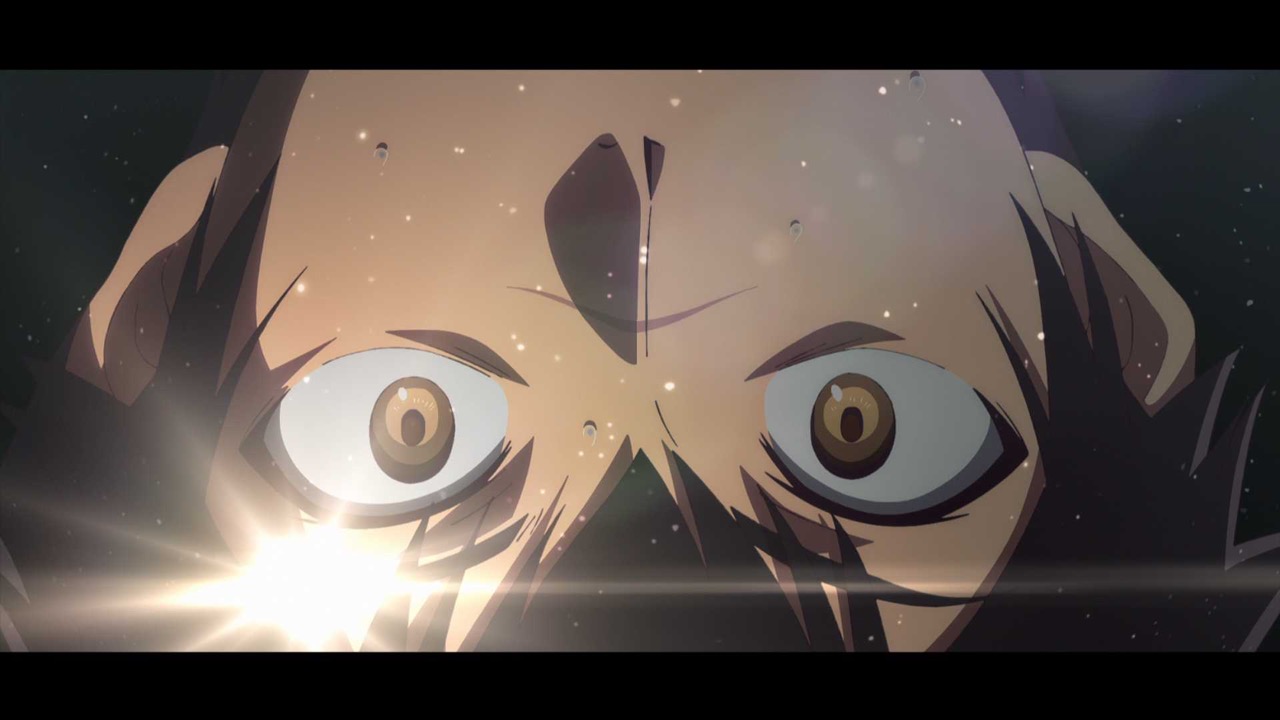
The lead frame from the official first-episode gallery shows Aries pointing across a bright graphic background containing a globe, stars and a rocket, with luggage visible below. The second inspected frame, reproduced beneath this section, places an upside-down face close to the viewer. Its wide eyes, visible droplets and bright flare create a substantially different visual impression.
Our interpretation of the pairing is that it expresses two possible relationships to a journey: an imagined adventure and an immediate exposed reaction. The bright graphic lead offers a playful way to present anticipation. The closer second image concentrates attention on the expression rather than a scenic destination. This comparison is supported by the supplied images; it is not a claim about the full sequence of cuts.
Both original files include horizontal black bands, which are retained. Removing those bands or forcing the figures into a standard promotional crop would change the actual supplied compositions. A single still cannot establish how long a shot lasts, the sound accompanying it or the outcome of the situation. The visual reading therefore stays within expression, framing and contrast.
Original visual reference
Lerche translates a printed ensemble into timed performance
The official staff list credits Masaomi Andō as director, Norimitsu Kaihō for series composition, Keiko Kurosawa for character design and chief animation direction, and Lerche for animation production. These roles locate different responsibilities in the screen version. They should not be collapsed into the manga author’s story-and-art credit.
For an adaptation comparison, choose a short exchange rather than trying to judge every volume at once. On a page, you can control how long you study a face and when you move to the next panel. On screen, the voice and the interval before the next reply affect your response. That difference can make the same basic information feel playful, awkward or urgent.
The official cast page includes the performers’ promotional comments about bringing the characters and the source’s humor to animation. They show an expressed production aim, not independent proof that the adaptation achieves it for every viewer. When deciding whether the anime suits you, evaluate the performance you hear in your chosen language track instead of treating enthusiasm in a launch announcement as a review score.
Follow Shinohara’s storytelling without inventing a shared universe
VIZ identifies Kenta Shinohara as the manga’s story and art creator and summarizes his earlier work on SKET DANCE. The broadcaster interview offers a more specific connection: practice with short narrative payoffs informed his interest in clues and surprises. That gives a reader a useful reason to investigate another work beyond simply matching a name.
If you enjoyed the way an ordinary conversation becomes more consequential, other Shinohara works can be a creator-discovery route. They are not prerequisites for understanding this space journey. A recurring interest in humor or character groups does not establish that different fictional events share a timeline.
Likewise, following the anime’s director or composer is an optional way to find another production, not a reason to enlarge Astra’s twelve-episode watch order. Keep the source author’s catalog and the animation team’s catalog distinct. That makes the next recommendation more informative: you can say which part of the experience you want to explore again.
An award and finished editions are useful evidence; profit is not disclosed
The official project introduction identifies the manga as the 2019 Manga Taishō grand-prize winner. The broadcaster’s account of the author’s appearance also records the award. This is evidence of recognition by that award’s selection process, not a universal score or an audited statement about how many books sold.
The English five-volume print sequence and the twelve-part licensed screen product establish identifiable commercial editions. They are useful for a buyer who wants a bounded commitment. Neither a publisher’s cover price nor a later Blu-ray listing gives us the title’s total revenue, production cost or the proportion of receipts retained by each rights participant.
No verified numeric budget, total retail sell-through or net profit is supplied by the sources used for this guide. We therefore discuss market position in terms of a finished book sequence, a recognized award and an adaptation. A compact property can be commercially interesting without an invented claim that it earned a particular return.
| Evidence | Supports | Does not establish |
|---|---|---|
| 2019 Manga Taishō win | A documented award outcome | Universal preference or book sales |
| Five English manga volumes | An identifiable finished print sequence | Revenue or current stock everywhere |
| AniList TV audience score | Reception for one adaptation entry | Budget or profit |
A survival scenario can invite enthusiasm and practical objections
In the July 2024 first-episode rewatch thread, Forsaken_Ebb1925 appreciates how the characters respond to a shared survival problem, while No_Rex objects to the practical logic of a rescue sequence. Those named individual responses offer useful questions about the same opening: does cooperation make the danger persuasive, and do the proposed actions feel convincing?
Neither comment establishes a scientific audit of the series or the opinion of its whole audience. Our suggestion is to notice your own tolerance for dramatic convenience. A crew adventure may hold your attention through group behavior even when you question a device used to stage a rescue. If such devices repeatedly pull you out of a story, that is a useful preference to recognize.
The displayed rating is AniList’s directly observed weighted average for the 2019 twelve-episode TV entry: 78/100, normalized to 7.8/10 on 1 October 2026. It is not a rating for Shinohara’s manga or an average of both formats. The linked rewatch uses episode-specific threads and spoiler rules, but individual comments can still discuss future material, so enter after the corresponding installment.
Compare the opening, then choose another kind of crew story
After the finale, revisit manga volume one or the first episode and examine which expectations the opening established. Compare a playful introduction with a later moment of dependence, while keeping the actual late explanation out of recommendations to new readers. A mystery is easier to recommend when you can explain what makes its questions engaging without supplying its answers.
Our space-crews collection offers other works organized around people sharing a journey or a vessel. The thematic similarity does not mean their priorities are identical: a survival mystery, a working-life drama and a bounty-hunter series can use a crew in very different ways. Use the comparison page to choose the sort of interaction you want next.
Future verified releases and edition changes can update this guide without replacing its core entry routes. Games and live-action adaptations belong to the site’s separate supplementary system, if confirmed, and will not be inserted into the manga-and-anime map. For the verified materials here, five source volumes and twelve screen episodes are the routes to follow.
Primary sources and useful navigation
- VIZ · official English series and final-volume status
- VIZ · volume one English print identifier
- VIZ · volume five print identifier, ending-description spoilers
- Official TV story directory · first-episode gallery and major later spoilers
- Official production credits and cast comments
- Original Japanese broadcast schedule · extended premiere and finale slot
- Nippon Broadcasting · Shinohara discusses clue preparation in his own words
- Official project announcements · historical release and promotion archive
- Crunchyroll · licensed series navigation, territory-dependent
Community and catalog routes
- AniList · matched 2019 TV entry and audience score
- MyAnimeList · anime catalog navigation
- Wikipedia · Astra Lost in Space references, major spoilers
- Astra Lost in Space Wiki · fan-maintained reference, major spoilers
- Reddit · named first-episode rewatch responses and spoiler discussion
The production and publisher links support project facts. Catalog and community pages are secondary navigation and may reveal later events.
Find this work in our thematic collections
Original series imagery is reproduced under permission asserted by the site owner; the source and rights credits are retained. The route diagram is Animeteor’s own explanatory graphic.