Start with the original TV Sessions 1–26. Watch the animated film afterward for a first encounter, or insert it between Sessions 22 and 23 for the officially confirmed story chronology. Read the companion books separately; Netflix tie-ins belong to another production.
Reviewed 2 October 2026 · Premise, early Ein image, edition facts and film placement; final outcomes withheld. Linked galleries and discussions can reveal later events. · Licensed access varies by country.
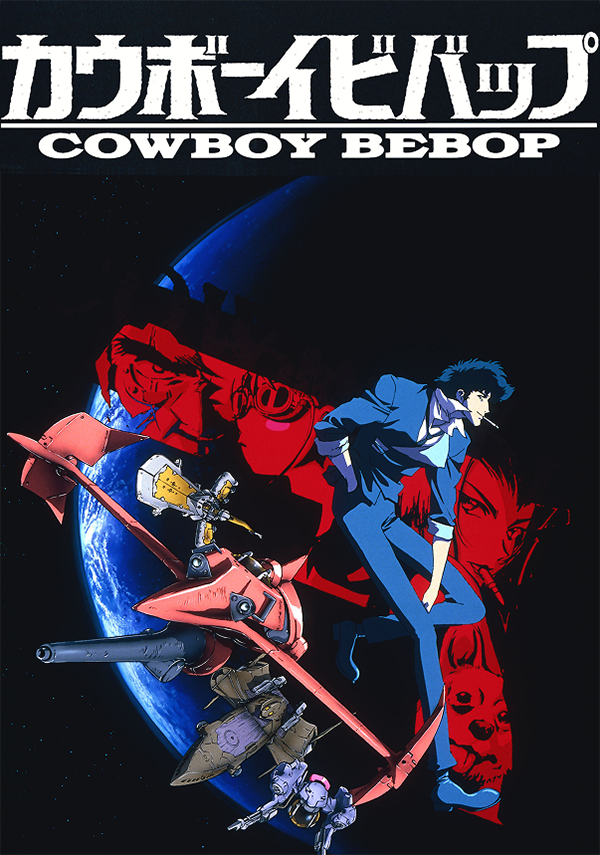
The source and screen branches

First-viewing alternative: finish TV 1–26 before returning to the animated film. Companion manga and the Japanese film book are separate reading options, not chapters after the TV finale. Netflix live action and its tie-ins are excluded.
- WATCH · verified story chronology: TV Sessions 1–22 Official placement 2001 animated film Return to TV TV Sessions 23–26
- READ · companion manga titles: Nanten Japanese volumes 1–3 Separate series OR Shooting Star volumes 1–2
- READ · optional Japanese film prose: Tengoku no Tobira · 2002 Single cataloged book ISBN 9784044199029
A crew that shares a ship without sharing a destination
Cowboy Bebop begins with bounty hunting, but its strongest invitation is the contrast between professional competence and an unsettled personal life. Spike and Jet travel together on the Bebop, pursuing criminals across an inhabited solar system. Knowing how to survive a dangerous encounter is different from knowing what to do with the rest of your day.
Our recommended first encounter is the original twenty-six-episode anime. Its combination of recorded performance, movement and music is central to the experience. Read the companion manga when you want additional adventures in a different medium. The project is an original animation property with related publications; it is not a twenty-six-episode adaptation of Yutaka Nanten’s three books.
Expect changes in tone rather than uninterrupted escalation. A job can support comedy, a chase or a more reflective encounter. If your preferred space story builds toward a single expedition with one shared objective, sample the opening before committing. Bebop’s appeal lies partly in people who occupy the same small home while carrying different interests and histories.
Two useful viewing routes, with an officially placed film
For a first viewing, watch Sessions 1–26 in their numbered order, then the 2001 animated film, Knockin’ on Heaven’s Door, also released under Cowboy Bebop: The Movie. This is our presentation recommendation: it lets the television series establish the ensemble before you return to a feature-length case. The film is not a story set after the television ending.
For an in-story route, watch Sessions 1–22, then the film, then Sessions 23–26. Sunrise World explicitly places the movie between episodes twenty-two and twenty-three. This is a verified insertion point, not a guess based on which characters happen to be present. Choose one route and follow it; you do not need to watch the film twice to complete the television story.
The Japanese broadcast history can explain confusing catalog dates. Sunrise World lists an April–June 1998 TV Tokyo run of thirteen broadcasts and an October 1998–April 1999 WOWOW run of twenty-six. For modern viewing, look for the complete numbered twenty-six-session edition. The Japanese Sunrise catalog identifies Asteroid Blues as Session 1; an unfamiliar platform listing should be checked against the titles, not treated as a new chronology.
| Route | Sequence | Why choose it? |
|---|---|---|
| First viewing recommendation | TV 1–26 → animated film | Preserves the TV presentation before a return visit |
| Verified story placement | TV 1–22 → animated film → TV 23–26 | Uses Sunrise’s explicit placement |
| Companion reading | Select a manga series or Japanese film book separately | Additional format; not a post-finale continuation |
The two manga titles are separate purchases
Yutaka Nanten’s Cowboy Bebop is cataloged by Kadokawa as Japanese volumes 1–3. The publisher lists book 1 on 5 April 1999, book 2 on 28 October 1999 and book 3 on 5 April 2000. Licensed Brazilian publisher JBC describes Nanten’s stories as adventures not seen in the anime, running alongside the television series and film. This supports a companion-reading route rather than an episode-to-chapter conversion.
Shooting Star Bebop is another title. Kadokawa’s two catalog entries identify volumes 1 and 2, dated 28 April 1998 and 25 September 1998, with ISBNs 9784048529358 and 9784048529976. Start each title with its own first book; the three Nanten volumes do not turn into volumes three through five of Shooting Star. We leave its detailed scene concordance unspecified rather than inventing a unified chapter order.
Edition counts need a territory label. JBC’s Brazilian collection lists six approximately hundred-page volumes, while the Japanese Nanten books use three volume numbers. A six-book listing can therefore be an edition difference rather than a sequel or newly discovered material. Check author, publisher, language, ISBN and series title before purchasing a used set. These historical catalogs do not guarantee that a complete English set is currently in print.
| Title | Book range | Verification anchor |
|---|---|---|
| Cowboy Bebop · Yutaka Nanten | Volumes1–3 | First 9784048530781; final 9784048531856 |
| Shooting Star Bebop | Volumes1–2 | First 9784048529358; second 9784048529976 |
| Cowboy Bebop · JBC Brazilian binding | Volumes1–6 | Different local edition of Nanten’s manga |
A Japanese film book and an English Netflix prequel are different branches
Kadokawa catalogs Cowboy Bebop: Tengoku no Tobira under its Sneaker Bunko imprint: a 196-page Japanese paperback released 31 July 2002, ISBN 9784044199029. Its author field credits Shinichiro Watanabe, its original-work field credits Hajime Yatate, and its design field names Stereotype Products. This is an optional film-related prose edition to investigate after seeing the animated film; its catalog does not establish a sequel to Session 26 or an English translation.
The similarly branded English novel A Syndicate Story: Red Planet Requiem belongs to another production. Random House’s distributor record explicitly identifies Sean Cummings’s book as a prequel to the Netflix series. Titan lists paperback ISBN 9781789097757 and different UK/US dates in late 2021. It must not be used as the origin text from which the 1998 animation was adapted.
Titan’s newer Cowboy Bebop graphic novel is likewise associated with the Netflix series. Keep that comic distinct from the older Japanese manga. Animeteor treats the live-action production and its tie-ins as supplementary coverage, outside the anime/manga/prose route diagram below. Familiar character names establish a relationship between products, not an automatic statement that every event belongs to one continuous account.
Listen for the difference between momentum and mood
The original television credits name Yoko Kanno for music and the Seatbelts for the opening Tank!; the official music links offer a direct route to the recordings. Instead of treating the soundtrack as decoration, try listening to how a cue changes your expectation of the same image: speed can feel playful, menacing or strangely relaxed according to its musical setting.
Our reading is that the appeal comes from changes in emotional register. A character’s confidence may make an action sequence exhilarating, while a quieter passage asks what that confidence leaves unresolved. On a first viewing, notice where the energy rises and where it is allowed to settle. You need not recognize every musical reference to follow that contrast.
The manga comparison is useful precisely because recorded timing is absent from a printed page. A reader decides how long to inspect a gesture, where to pause and when to turn. Comparing a comic encounter with the general feel of the screen ensemble can reveal what each medium makes you supply yourself. We do not claim that a soundtrack album maps every track to a specific manga scene.
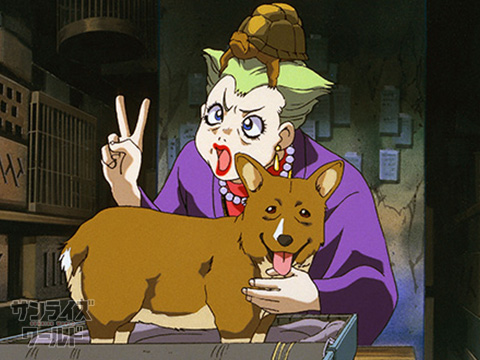
Ein in an ordinary street: a small image of the show’s tonal range
The original Sunrise World still reproduced below places Ein on a surface in front of a flamboyantly dressed figure making a two-finger gesture. A dark, crowded street sits behind them. The corgi’s bright coat, the purple outfit and the expressive face pull attention toward a comic human-and-animal encounter, rather than a sleek spacecraft or a heroic gun pose.
Our visual reading is that this contrast makes the future feel inhabited. The background supplies a place with age and texture; the foreground supplies behavior that is immediate and recognizable. It is a useful example for a newcomer because it suggests that a space setting can accommodate eccentricity, ordinary streets and visual jokes alongside more dangerous business.
The supplied still retains its original frame and Sunrise World watermark. A single image supports observations about color, expression and arrangement; it cannot reproduce the timing of a joke or prove what music accompanies the shot. Look for those additional effects when watching the sequence, and compare them with the impression the static image gives you first.
Original visual reference
Practical work makes the personal distance visible
A bounty-hunting crew has to coordinate, but coordination is not the same as intimacy. That is a useful way to approach Spike and Jet: consider how decisions are negotiated, who makes practical preparations and who acts before a plan is secure. Competence can establish trust in a specific job while leaving other questions unanswered.
The shared ship gives these differences a recurring setting. A temporary encounter ends when a character departs; a crewmate’s habits return with the next day. Our interpretation is that the ensemble gains weight from this repetition. An ordinary exchange can become revealing because the audience knows what is usual for the people involved.
This also explains why the numbered order remains worthwhile in a story with individual cases. A viewer may understand the immediate bounty while missing how a response differs from an earlier one. On a return viewing, compare reactions and silences as well as plot outcomes. The point is to notice accumulation, without supplying a fabricated hidden chronology that rearranges the official sessions.
Audience enthusiasm does not guarantee a personal match
The indexed 11 October 2021 r/anime Asteroid Blues rewatch includes a first-time viewer who praises the direction, sound and character-building while acknowledging uncertain expectations. Another participant cautions that the show’s reputation does not make it the right choice for every anime fan. Together these responses suggest a better question than whether it is universally essential: do its pacing and tonal changes suit what you enjoy?
A July 2026 r/cowboybebop discussion asks why different platforms seem to put different episodes first. That is useful evidence of a real reader problem, but comments alone are not the episode authority. Our route uses Sunrise’s session list and its explicit film placement. The forum remains a place to discuss why an order matters emotionally, not to replace the production record.
On a first viewing, avoid full-series wiki summaries and unmarked final-episode discussions. The external links below are optional navigation; several reveal late events. After finishing, return with a specific question about a character, a visual motif or the film’s position. A focused discussion can help distinguish your response to an episode from the reputation surrounding the series.
What the 2026 remaster actually confirms
The official 1 September 2026 announcement confirms that the animated film’s 4K remaster is scheduled for Japanese theaters from 30 October 2026, under Watanabe’s supervision. It also warns that some theaters may show a 2K conversion depending on their equipment. This is a renewed exhibition of the 2001 film, not a newly announced television season or a sequel.
The anniversary project is concrete evidence that the film continues to receive production and distribution attention. Its new visual credits illustration, background and graphic design separately, showing that an anniversary campaign involves work beyond reposting an old poster. That does not disclose ticket revenue, licensing income or the original television budget. We leave title-level profit unestimated.
The official 25 September 2026 event notice schedules a preview at TOHO Cinemas Shinjuku on 23 October at 18:30, with director Shinichiro Watanabe and composer Yoko Kanno expected to appear. Opening commemorative screenings are scheduled there on 31 October at 09:55 and 13:20, with Watanabe and Spike’s voice actor Koichi Yamadera expected. These are Japanese local screening times; guest appearances and schedules remain subject to change. The nationwide Japanese remaster run remains scheduled from 30 October.
For a reader planning attendance, follow the Japanese special site and its theater-information link. A domestic announcement does not establish a worldwide theatrical date or a home-video release. For everyone else, the practical benefit is an updated reason to revisit the film and a verified source to monitor. The announcement remains dated so it can be revised if the schedule changes.
Where to go after your chosen route
After the television series, choose the animated film for a longer case with the familiar ensemble, or Nanten’s manga for companion adventures in print. Choose the Japanese film prose book only if that language and edition fit your reading plans. None of these choices requires replacing the television ending with an invented continuation chapter.
If the crew’s shared space interested you most, our space-crews collection links to Planetes and Astra Lost in Space as other starting points. Their situations and group needs differ, so the comparison page helps you choose rather than implying a shared universe. Each work has its own entry route and its own relationship between print and screen.
If you want to follow a creator, the official anniversary profile lists other Watanabe projects, including Samurai Champloo and Space Dandy. Those credits support a creator connection, not a mandatory viewing order. Follow the director when you want to compare sensibility across projects; follow the numbered Bebop route when your goal is to complete this specific story.
Primary sources and useful navigation
- Official project and news
- Sunrise TV project record
- Sunrise Japanese numbered session list
- Sunrise World TV staff, broadcast history and original imagery
- Sunrise animated film record
- Sunrise World film chronology and production credits
- Kadokawa · Nanten manga book 1
- Kadokawa · Nanten manga book 2
- Kadokawa · Nanten manga book 3
- Kadokawa · Shooting Star book 1
- Kadokawa · Shooting Star book 2
- JBC · licensed Brazilian companion manga edition
- Kadokawa · Japanese film prose book
- Random House · Netflix prequel identity
- Titan · Red Planet Requiem edition details
- Titan · Netflix-associated graphic novel
- Official dated4K announcement
- Official film anniversary and Japanese theater information
- AniList · original TV score entry
Community and catalog routes
- MyAnimeList · original TV catalog
- Wikipedia · project overview; spoilers
- Fandom · story reference; spoilers
- Reddit · 11 October 2021 Asteroid Blues rewatch; episode spoilers
- Reddit · July 2026 numbered-watch-order discussion
The production and publisher links support project facts. Catalog and community pages are secondary navigation and may reveal later events.
Find this work in our thematic collections
Original series imagery is reproduced under permission asserted by the site owner; the source and rights credits are retained. The route diagram is Animeteor’s own explanatory graphic.
Games and live-action adaptations
- Cowboy Bebop on Netflix — Live action: Series · 2021
A historical game collaboration remains outside the story route
Blizzard’s March 2024 event used Cowboy Bebop-inspired cosmetics on existing Overwatch 2 characters. The original campaign ran through 25 March 2024; that historical announcement does not certify current skin availability or a standalone Bebop story game.