Watch the 2014 TV season (12 episodes), Battle for Planet Nine (12 episodes), then the 2021 concluding film Love Woven in the Stars. Read the manga in standard volumes 1–15 or Master Edition books 1–7. Kitto Arifureta Koi is an optional Japanese prose viewpoint; the 2015 compilation is an optional recap.
Reviewed 1 October 2026 · Opening premise, format relationships and broad film time jump; final revelations withheld. Publisher summaries and community pages may reveal later outcomes. · Licensed access varies by country.
The source and screen branches

The 2015 compilation film is an optional recap, not another required sequel. The 2021 feature includes material different from the manga. Start reading at book 1 for the verified complete route; no exact chapter seam is asserted. Game coverage remains outside this map.
- READ · source editions: Standard manga 1–15 Different bindings OR Master Edition 1–7
- WATCH · main animated story: 2014 TV · 12 episodes Battle for Planet Nine 2015 TV · 12 episodes Love Woven in the Stars 2021 concluding film
- READ · optional prose viewpoint: Kitto Arifureta Koi · Japanese Companion; no exact insertion Mechanic viewpoint · 2021
A home that must keep moving
Knights of Sidonia follows Nagate Tanikaze from the hidden lower levels of a generation ship into its pilot training system. The ship carries the surviving society as well as its weapons; protecting it means protecting the place where ordinary life remains possible. Tsutomu Nihei’s manga is the source, with Polygon Pictures responsible for the main animated adaptations.
Choose the fifteen-volume manga for the complete source route, or the two television seasons followed by Love Woven in the Stars for the main animated route. Both choices begin with Nagate learning to live among people he has scarcely encountered before. There is also a Japanese prose companion, Kitto Arifureta Koi, focused on a different inhabitant of the ship; it is not the source novel behind the anime.
This is an appealing choice if you enjoy machinery, enclosed societies and survival pressure alongside awkward personal relationships. Expect alien violence and unsettling bodily imagery as well as quieter social encounters. The premise is accessible without another Nihei work, and the opening television episode is a useful test of whether its computer-generated presentation suits your taste.
Two seasons, then the concluding film
Start with the 2014 television season, episodes 1–12, then Battle for Planet Nine, the 2015 second season, episodes 1–12. They are consecutive stages of the screen story, even when a platform numbers the second season separately. Polygon’s production records identify the two projects and their years; Bandai Channel lists the second season’s twelfth episode, and broadcaster MBS explicitly describes that episode as its finale.
Continue with the 2021 animated film Knights of Sidonia: Love Woven in the Stars. Its official story introduces a ten-year interval after the preceding victory, while the project’s April 2021 announcement calls it the concluding installment. Follow the story from the television run into the film rather than treating the later release as a new first episode.
There is a different theatrical film titled Knights of Sidonia from 2015. UNIJAPAN’s Japanese Film Database describes it as a television compilation with added scenes, previously unused cuts and revised sound effects. It is an optional alternate presentation, not another mandatory sequel between seasons. For a first encounter we recommend the full first season, which provides more room to become familiar with the setting.
| Aim | Route | What the route means |
|---|---|---|
| Main animated story | 2014 TV 1–12 → 2015 TV 1–12 → 2021 film | Two seasons and the concluding feature |
| Optional recap | 2015 compilation film | Alternate presentation of earlier TV material |
| Complete source | Standard manga volumes 1–15 | Nihei’s manga route |
| Larger English binding | Master Edition books 1–7 | Collected edition; not a sequel |
| Additional prose viewpoint | Kitto Arifureta Koi | Japanese companion; no verified exact insertion |
Fifteen standard books and seven Master books are different bindings
Kodansha USA identifies standard volume 15 as the final installment. Its English print release is 26 April 2016, ISBN 9781942993131; the digital edition has the same release date and ISBN 9781682332634. These are edition-specific records, not the date on which the Japanese story first ended. Read the standard books in numerical order from volume 1.
The English Master Edition uses larger pages and collected bindings. Penguin Random House catalogs Master Edition 1 on 9 April 2019, ISBN 9781947194427, and book 7 on 13 October 2020, ISBN 9781949980745. Its series catalog displays the Master books alongside standard volumes. A Master book numbered 7 is therefore not the same amount of story as standard volume 7.
The generic publisher description advertises two and a half original volumes per Master book. That language should not be used to calculate chapter boundaries or conclude that six books must be the whole set. The catalogs list a seventh book; Kodansha’s Japanese enlarged edition also has a seventh volume containing material from the final magazine period and an earlier Blu-ray bonus work. Choose one binding sequence and check the actual contents before mixing editions.
A screen conclusion is not a chapter concordance
If you finish Battle for Planet Nine, the next main animated installment is Love Woven in the Stars. A reader seeking the manga’s own route can begin at standard volume 1 or Master Edition 1. The full source route avoids guessing how rearranged events, added scenes and different book boundaries match a particular episode ending.
The official July 2020 film announcement explicitly says the new movie includes material different from the comic, with Nihei supervising. In his accompanying comment, the author describes an additional revelation absent from the manga. That establishes a meaningful adaptation distinction without revealing the revelation itself. Reading and watching can consequently offer different experiences even when both reach an ending.
We have not inspected a complete licensed scene-to-chapter comparison, so this guide does not supply a definitive chapter to start after season two. The ten-year interval belongs to the screen film’s stated premise and is not a calculation for skipping manga volumes. A future concordance can add an exact shortcut with its source edition identified; until then, the complete reading branch remains dependable.
The prose companion changes whose work you follow
Kodansha’s Japanese catalog credits Asaura as the author of Shosetsu Sidonia no Kishi: Kitto Arifureta Koi, Jun Suemi as illustrator and Nihei as original creator and supervisor. The print book was released 6 May 2021, ISBN 9784065226971; the digital listing is dated 30 April. These two dates refer to different formats of the same companion.
The publisher’s novel page introduces Yoshi Kaneuchi, a mechanic who dreams of piloting a Garde and trains secretly, and the clone pilot Honoka Sui. The viewpoint moves attention from the celebrated combat role to someone who works on the machines. That is a useful reason to explore the book after becoming familiar with the main setting, rather than assuming it must be read before television season one.
Our interpretation of this premise is that an adaptation can deepen a society by changing the position from which it is seen. A mechanic’s aspiration makes maintenance and recognition visible beside combat achievement. The verified catalog is Japanese; we have not established a licensed English edition or an exact episode at which this companion should be inserted. Its lane therefore shows a side viewpoint, not a chronological bridge.
A person facing a machine: the episode-one visual
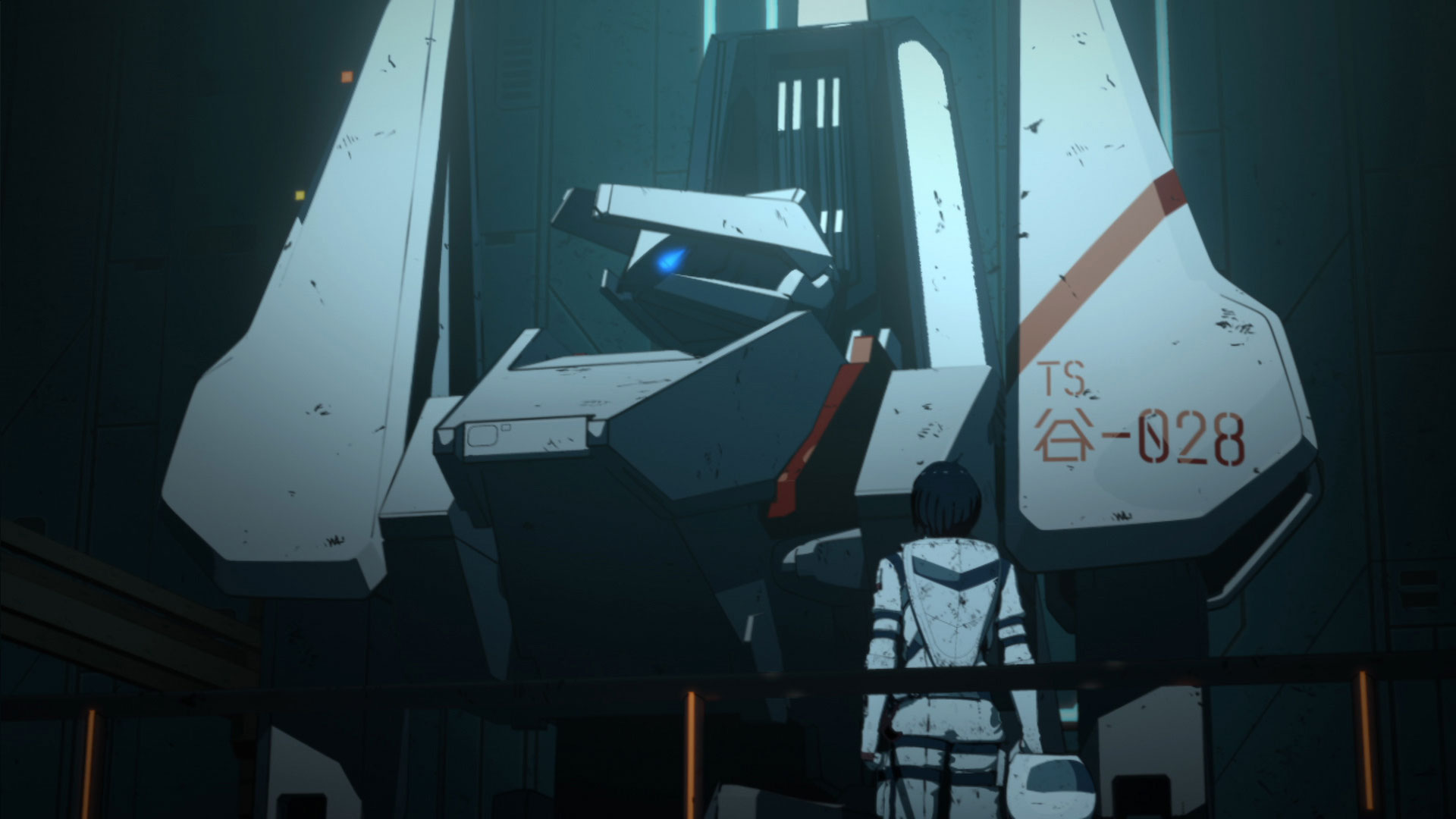
Bandai Channel’s original episode-one image places a small, suited human figure in front of an enormous white machine in a dark hangar. Its blue eye shines above the person; red markings, scuffed plates and a foreground rail give the equipment a specific physical presence. We retain the complete 1920-by-1080 composition rather than cropping it into a character portrait.
Our visual reading is that the scale makes entering the pilot role feel consequential before any battle is shown. The human figure faces away from the viewer, allowing us to share the act of looking upward. The rail and hangar surfaces also place the weapon inside an institution: this is equipment that must be housed and approached, rather than a detached emblem of power.
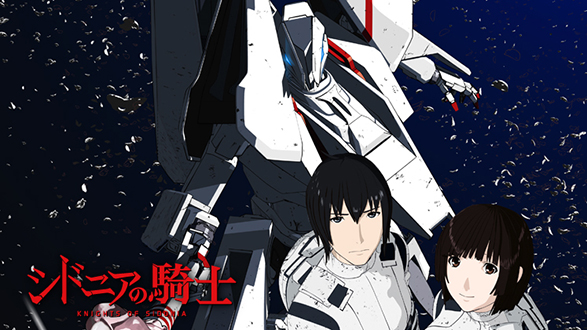
The episode’s official description confirms Nagate’s move from isolation into pilot training and his first contact with a wider social world. The still supports an analysis of scale and presentation; it does not prove an exact manga panel match or reveal the machine’s full history. The studio’s lead artwork then offers a contrasting introduction, bringing human faces and the white Garde into one compact promotional composition.
Original visual reference
The ship is a society, not only a battlefield
The premise makes home and transport inseparable. The place that shelters people must also travel through danger, so defense affects their living environment directly. Our reading is that this arrangement gives survival a more intimate meaning than an abstract mission to rescue humanity: the defended object is where the inhabitants eat, work, meet one another and understand their place.
Nagate’s upbringing beneath that society creates a useful entry point. A trained ability and a lack of social experience can coexist in the same person. Watch how competence with a machine differs from knowing how to address somebody or read an unfamiliar situation. The opening asks the viewer to learn the social environment alongside him, rather than relying entirely on a glossary of future technology.
The ordinary encounters matter because the setting puts them under pressure. A training school suggests repetition and learning; the external threat makes mistakes consequential. For a first viewing, pay attention to how scenes establish spaces and who seems comfortable inside them. That gives the political and personal dimensions something observable to rest on without requiring an explanation of later plot secrets.
Computer animation gives scale and surfaces a particular character
Polygon’s original series record names Kobun Shizuno as director, Hiroyuki Seshita as co-director, Sadayuki Murai for series construction and script, and Yuki Moriyama for character design. The 2015 continuation names Seshita as director. These are project-specific roles; attributing every creative decision to the studio alone loses the distinction between writing, design and direction.
The inspected hangar image offers a concrete way to consider the computer-generated presentation. Broad rigid surfaces, worn edges and deep space behind the machine can be organized into a strongly readable scale relationship. Our interpretation is that the visible wear helps the equipment feel used. It also provides something more precise to discuss than treating all CG animation as either automatically impressive or automatically unsuitable.
For the concluding feature, Polygon lists Tadahiro “Tady” Yoshihira as director, Seshita as supervising director, and Murai with Tetsuya Yamada for screenplay. Shuji Katayama supplies music and CAPSULE the theme and insert songs. Returning creative contributors can preserve familiarity while a new production changes the viewing experience; the feature should be evaluated as its own adaptation stage rather than assigned the first season’s audience score.
Readers discuss book packaging; viewers discuss the changing look
In the linked r/MangaCollectors discussion, HolyManBob questions the repeated two-and-a-half-volumes description because it seems inconsistent with seven Master books. Other commenters offer explanations for the boundaries. This is a useful example of a reader’s purchasing concern; the official catalogs, rather than the replies, establish which books and edition identifiers exist.
In the 2021 r/anime film-trailer discussion, Fun-Ad-1145 comments that Polygon’s shading appears improved compared with six years earlier. That is one viewer’s response to a trailer, not a measurement of every frame or a consensus about the television series. Comparing the early original imagery with the official film material provides a more grounded way to decide which presentation appeals to you.
Bandai Channel also records reactions that pull in different directions. Reviewer razoku1 in January 2016 finds the character faces doll-like while enjoying the imagined setting; kikuhisa in July 2015 praises wear and dirt on machines and suits. These observations explain why a visual style can discourage one viewer and attract another. They are attributed preferences, and the linked discussions may expose later events.
A film, an event and a closed game have different meanings
The official 10 May 2021 notice moved Love Woven in the Stars from its planned 14 May opening to 4 June because of emergency restrictions and cinema closures. That documented postponement should replace an earlier promotional date when discussing the Japanese theatrical schedule. The feature is a released 2021 project, not an upcoming installment at this October 2026 review.
The official news archive shows an orchestra concert campaign in 2026, including a 27 April notice about merchandise sales after the event. This is evidence of continued franchise activity. It is not an announcement of a third television season, and an old concert ticket or merchandise window should not be presented as currently open without checking its individual terms.
The smartphone game Shoui no Kizuna was announced for 12 August 2021. WFS’s official service notice records closure on 28 June 2022. The original launch announcement cannot therefore support a present-day download recommendation. The verified records describe adaptation and commercial activity, but they do not supply audited production profit or a title-level animation budget; no revenue estimate is inferred from the number of releases.
Follow creators and supplementary formats without adding false story links
Polygon’s second-season portfolio mentions a BLAME! short preview planned for episode eight. BLAME! is another Nihei work and a useful creator connection, but the presence of a preview is not proof that it is a Sidonia prequel. You can follow Nihei’s other manga or Polygon’s animation projects independently of the Sidonia reading and viewing route.
Shoui no Kizuna belongs to supplementary game coverage. The project announcement describes a trainee viewpoint, cooperation with the animation staff and converted 3D graphics. It remains outside our anime, manga and prose route map, and its closed service is stated plainly. This guide does not add an unverified live-action installment merely to populate another format category.
For another story about people inside large machines or an enclosed mission, use the thematic collection links below. The manga route, television-plus-film route and optional Japanese prose viewpoint give Sidonia distinct entry choices. Future updates can add an inspected chapter concordance or a confirmed new project while retaining the same guide address, source history and edition distinctions.
Primary sources and useful navigation
- Polygon Pictures · original 2014 TV production and artwork
- Polygon Pictures · 2015 second-season production and BLAME! preview
- Bandai Channel · episode-one record and original image
- MBS · second-season episode twelve identified as finale
- Bandai Channel · second-season episode twelve
- Official project · television and film story premises
- Polygon Pictures · 2021 film and staff
- UNIJAPAN · 2015 compilation production record
- Official film announcement · Nihei and adaptation differences
- Official concluding-film trailer announcement
- Official film release postponement notice
- Kodansha USA · final standard manga volume 15
- Penguin Random House · Master Edition 1
- Penguin Random House · Master Edition 7
- Penguin Random House · edition series catalog
- Kodansha Japan · enlarged manga volume seven contents
- Kodansha Japan · companion novel formats and dates
- Kodansha novel imprint · companion viewpoint
- Official project · 2021 smartphone game launch announcement
- Official project · game adaptation staff and premise
- WFS · official game service closure
- Official project · 2026 post-concert merchandise notice
- AniList · original television audience score
Community and catalog routes
- MyAnimeList · original TV catalog
- Wikipedia · adaptation overview; spoilers
- Nihei Fandom · manga reference; spoilers
- Reddit MangaCollectors · Master Edition packaging discussion
- Reddit anime · 2021 film-trailer reactions
The production and publisher links support project facts. Catalog and community pages are secondary navigation and may reveal later events.
Find this work in our thematic collections
Original series imagery is reproduced under permission asserted by the site owner; the source and rights credits are retained. The route diagram is Animeteor’s own explanatory graphic.
Games and live-action adaptations
- Knights of Sidonia: Shoui no Kizuna — Game: Communication adventure