Read the complete Japanese manga in volumes 1–46, or watch TV episodes 1–99. Animated #0 is a prequel; we recommend it after the TV run for a first encounter. English digital volume 46 is listed for 27 October 2026, not yet released at this review.
Reviewed 1 October 2026 · Opening career and childhood premise, broad prequel placement and production context; later outcomes withheld. Final-book descriptions and community links contain spoilers. · Licensed access varies by country.
The source and screen branches

First-viewing recommendation: TV 1–99 then optional animated #0. The anime is not the complete 46-volume manga. Start reading at volume 1 for the verified full comparison route; no unverified chapter seam is asserted. Live action is excluded.
- READ · complete source manga: Japanese volumes 1–46 Edition distinction English final digital volume 46 Upcoming at review Listed 27 October 2026
- WATCH · broad story chronology: Animated #0 · 2014 prequel Several years before main story TV episodes 1–99
A childhood promise meets an adult restart
Space Brothers places two siblings on different sides of the same aspiration. Hibito has become an astronaut; Mutta has lost his job and has to decide whether the dream they once shared still belongs to him. The opening makes space exploration a question of self-belief, family comparison and returning to something postponed.
Choose Chuya Koyama’s manga if your priority is the complete story: the Japanese source concluded in 2026 with volume 46. Choose the ninety-nine-episode television anime if you want performance, music and an extended screen encounter with the ensemble. The television run finished in 2014, long before the manga’s final book; completing the anime does not complete all forty-six volumes.
This is a strong candidate for someone who enjoys training, professional choices and people learning how to work together. It asks you to spend time with preparation as well as the imagined destination. If you want a new planet or an action crisis in every episode, the early emphasis on applying, observing and waiting may require an adjustment in expectations.
Watch the TV run first; #0 is an optional prequel
The main television route is episodes 1–99 in numbered order. A-1 Pictures identifies the 2012 television adaptation and its production staff; the official author site dates the broadcast from 1 April 2012 to 22 March 2014. Bandai Channel supplies individually numbered episode records, and Kodansha’s 2026 distribution announcement independently identifies the complete television run as ninety-nine episodes.
Space Brothers #0 is a 2014 animated film. The author’s official movie page places its story several years before the beginning of the manga, while Warner Bros.’ official trailer description identifies it as an original film story written by Koyama. Our first-viewing recommendation is the television series before the prequel, so a later visit to earlier circumstances has the context of the main ensemble.
If chronology is your priority, the alternative is #0 before TV episodes 1–99. That describes the film’s broad placement; it does not rearrange childhood memories inside individual episodes. The 2012 live-action movie is a separate adaptation and is excluded from this core map. It is neither an extra anime episode nor a required bridge between the film and the television series.
| Your aim | Route | Scope |
|---|---|---|
| First anime encounter | TV episodes 1–99 → optional #0 | Our presentation recommendation |
| Broad story chronology | Animated #0 → TV episodes 1–99 | Officially described prequel placement |
| Complete Japanese manga | Volumes 1–46 | Source story concluded |
| English digital completion | Volumes 1–45; volume 46 listed 27 October 2026 | Final English release still upcoming on 1 October |
Japanese completion and English availability have different dates
Kodansha’s Japanese catalog identifies volume 46 as the concluding book, released 22 July 2026, ISBN 9784065442012. The author’s corresponding official page lists chapters 422–432 in that volume. A June announcement separates the final magazine installment on 11 June from the final collected book in July. Those are different publication milestones, rather than contradictory statements about when a story ended.
Kodansha USA’s English series page lists digital editions and marks the series complete, but the actual volume 46 product is still labeled Coming 10/27/26. Its individual record gives 27 October 2026 and ISBN 9798898302979. As checked on 1 October, the reliable wording is that the source is complete and the final English digital volume is scheduled; a series status label does not make a future book available today.
Start with volume 1 in your chosen language and follow the numbered books. The English first volume is a digital edition dated 3 November 2015, ISBN 9781682330388. This guide does not turn that listing into a promise of an English paperback run. Before buying, check format and territory as well as the cover title; online reader access and a physical bookshelf are different purchases.
After episode99, the manga offers the complete route
If you finish the television series and want the source’s eventual conclusion, read the manga. Starting at volume 1 provides a reliable comparison route without depending on an unverified episode-to-chapter seam. It also lets you observe how printed pacing handles the same kind of professional and family pressure that drew you to the screen version.
Readers often request the first chapter after the anime. A named 2021 community thread recommends chapter 187, but a forum recommendation alone does not prove that no scene, memory or rearranged passage would be missed. We have not verified a full scene concordance against the final television episode and the licensed chapter text, so the map does not present that number as a confirmed continuation point.
A precise continuation shortcut can be added after that comparison is completed. For now, the editorial distinction is clear: the anime’s final numbered episode is not the manga’s final chapter, the source has a complete Japanese edition, and the final English digital book has its own scheduled date. This gives readers a dependable full route while leaving an unsupported shortcut out.
Two boys looking upward make the ambition personal
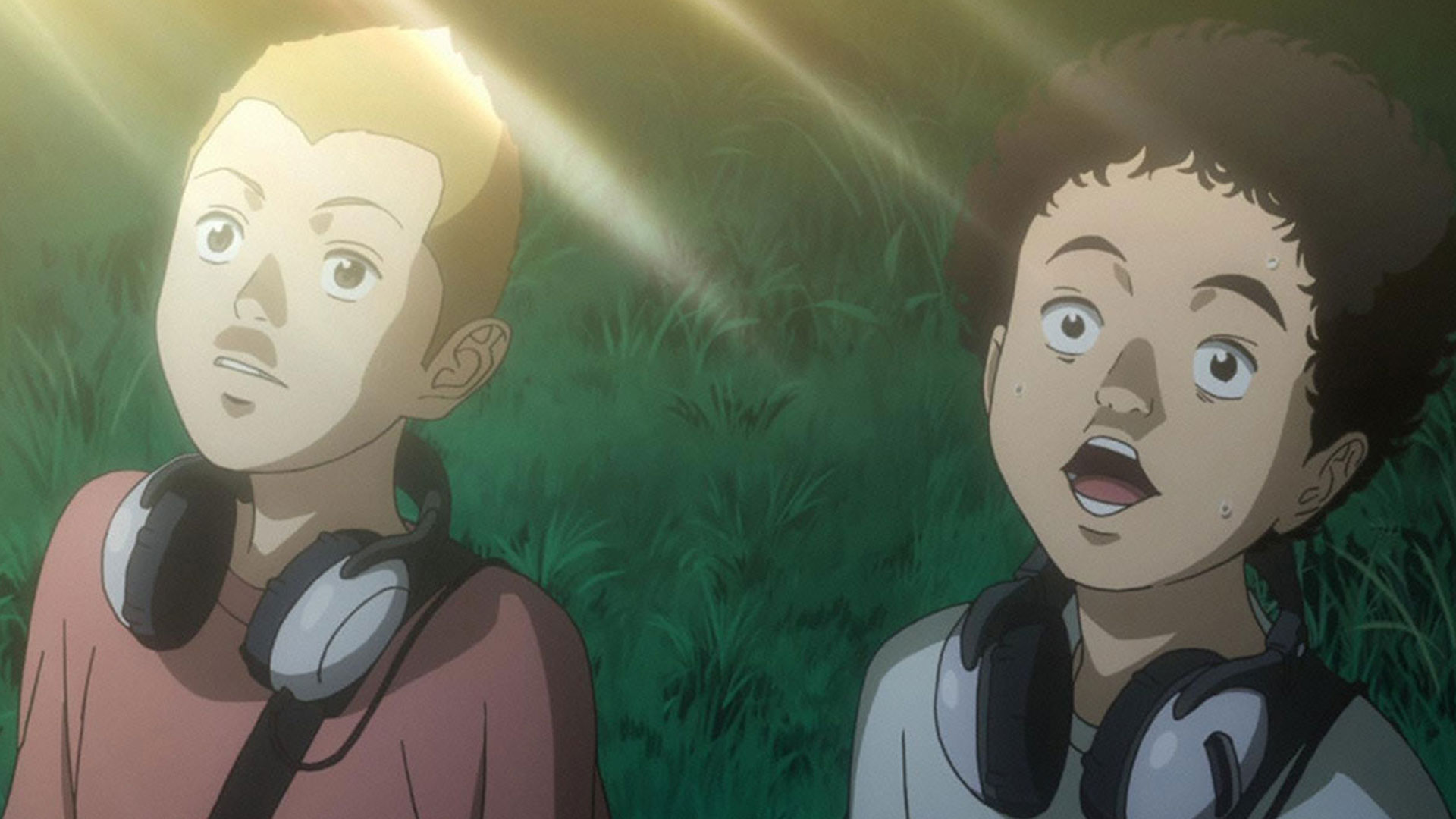
Bandai Channel’s original episode-one image shows the two young brothers in grass, their faces turned toward bright light outside the frame. Headphones hang around their necks. The faces carry different expressions: one seems intent, while the other has an open mouth and visible beads on his cheek. We preserve the supplied composition and native image proportions.
Our reading is that the scene connects an extraordinary sight to an ordinary shared memory. The grass and headphones locate the children in a familiar environment; the upward gaze directs attention beyond it. The image does not need to show the destination itself to make the wish understandable. What matters first is that these two people are looking together.
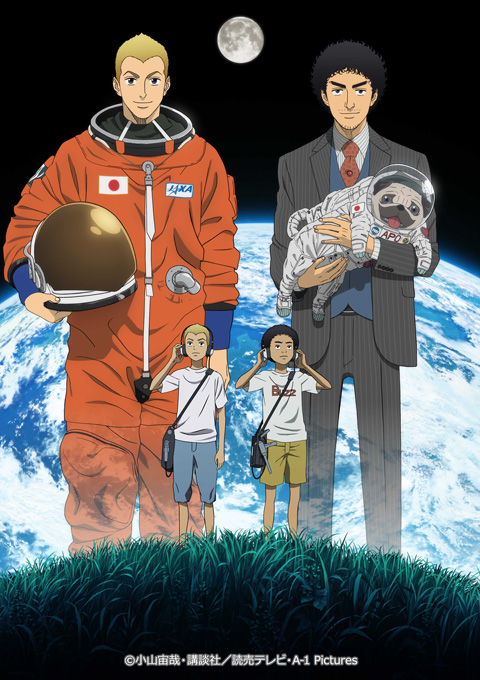
Compare this with A-1 Pictures’ lead artwork: the adult brothers stand above smaller childhood figures, with Earth and the Moon behind them. The juxtaposition makes the passage of time visible. That is a useful entry to the central question: how does the same promise feel when one person has moved toward it and the other has built a different adult life?
Original visual reference
Comparison can encourage someone and make them hesitate
The opening premise makes Hibito’s progress both an invitation and a difficult comparison for Mutta. Admiring somebody close to you can clarify what you want, while also making your own delay feel larger. Our interpretation is that the sibling relationship gains its force from that double role. The younger brother’s success can be meaningful without making the older brother’s life a simple failure.
Watch for the difference between asking what another person has achieved and asking what you can do next. The first question can freeze somebody in a ranking; the second creates a practical decision. A career story becomes more interesting when an aspiration must be translated into an application, preparation or a conversation rather than repeated as a slogan.
The age difference also changes what returning to a childhood dream means. An adult has experiences and responsibilities that the child could not imagine. The interesting choice is not whether the past can be restored exactly, but whether something from it can guide a new action now. That makes the opening approachable even for a reader with no personal interest in becoming an astronaut.
Koyama’s research looks for ordinary work inside the extraordinary setting
In JAXA’s QZ-vision interview, Koyama explains that an essay about an astronaut’s life drew his interest toward daily difficulties and inconveniences, beyond a general image of impressive technology. He describes visiting training facilities and speaking with JAXA staff and astronauts. His stated aim includes depicting the feelings of people whose jobs he cannot experience personally.
Our critical reading is that this focus gives preparation narrative value. A facility is not simply impressive machinery; it is a place where people have to communicate, move around and solve practical problems. A small inconvenience can reveal behavior more clearly than a speech about courage. Read the interview as a record of the author’s approach, rather than as a certification of every fictional technical detail.
The setting includes a fictional 2025 near-future premise. That date belongs to the story’s construction and should not be mistaken for a documentary statement about what real lunar bases existed in 2025. The researched setting and the imagined career trajectories work together, but they have different evidentiary roles.
A real ISS recording is a specific production connection
Yomiuri TV’s 9 October 2012 announcement records astronaut Akihiko Hoshide performing his own role while aboard the International Space Station. It describes a satellite connection to JAXA’s Tsukuba Space Center, where the audio was recorded. The broadcaster identifies the resulting appearance with episode 31, Rocket Road, broadcast 4 November 2012.
The same announcement says an anime-original scene was created for the appearance. This is a concrete reason to avoid calling the television version a perfectly interchangeable transcription of the manga. A source adaptation can retain its central premise while adding a production-specific encounter. It also gives a return viewer something precise to look for rather than a vague assertion that the whole cast recorded in space.
A-1’s production record names Ayumu Watanabe as director, Yoichi Kato for series composition, Koji Yabuno for character design and Toshiyuki Watanabe for music. These are different contributors with different responsibilities. Following a studio or a director can lead to other work, but that creator connection does not make unrelated productions part of the Nanba brothers’ chronology.
The pace inspires some viewers and frustrates others
A January 2020 r/anime discussion praises the series’ optimistic mood, performances and ninety-nine-episode journey. An April 2021 r/spacebrothers manga-versus-anime thread gives a less uniform response: some commenters enjoy the mood and music, while a reader of the manga criticizes repetitive flashbacks and slower progress. These are named audience responses, not a poll of everyone who watched.
Taken together, they offer a useful viewing test. Do you enjoy spending time with a character’s preparation and uncertainty, or do repeated reminders interrupt your involvement? Watching a few opening episodes can answer that more reliably than accepting either universal praise or a blanket claim that the anime is too slow. Printed pages also offer more direct control over the pace of return passages.
A July 2025 watch-order discussion recommends the main series before #0 because familiarity can make the prequel’s callbacks more enjoyable. That supports our presentation recommendation as an audience preference; the author’s official movie description supports its chronological position. We keep those two kinds of evidence distinct and link the conversations for readers who want to compare reactions.
A finished source creates a different point of entry
The completion of a forty-six-volume source changes the practical reading proposition: a new reader can plan a complete Japanese route rather than wait indefinitely for a final installment. The English edition still requires attention to its last scheduled digital release. Neither statement proves that a new television season has been dated; a source ending and an animation production announcement are separate events.
Kodansha’s 1 May 2026 press release offered the ninety-nine TV episodes in staged free YouTube windows ending by 3 August 2026. Those windows have passed as of this review. The promotion confirms a distribution campaign around the manga’s conclusion, but an old free-viewing announcement should not be advertised as current worldwide access.
The same early press release projected a 23 July final-book date, whereas the final Japanese product catalog and author’s book page say 22 July. We use the later edition-specific records for the book date. The sources do not provide an audited television budget or title-level profit, so continued distribution and a long complete edition are discussed as commercial activity rather than converted into invented revenue.
Choose the kind of space story you want next
Our space-crews comparison links Space Brothers with Planetes, Astra Lost in Space and Cowboy Bebop. Each uses a group differently: becoming qualified for a career, maintaining the environment, finding a route home or sharing a ship through individual jobs. That is a thematic connection for discovery, not a shared universe or a requirement to watch all of them.
For this work, keep the core options clear: the source manga, the original television adaptation and the animated prequel. The official movie page also documents the 2012 live-action production, which is supplementary coverage and remains outside the roadmap. Companion essays, merchandise and fan discussions can enrich a finished reading without becoming mandatory story chapters.
This guide can be updated when the English final volume is released or a production announces a new screen installment. Until then, its dates retain their observed status and the route labels make the medium visible. Follow the official edition links for access, and use the community links when you are ready for discussion that may contain later outcomes.
Primary sources and useful navigation
- A-1 Pictures · TV production and artwork
- Author official anime and broadcast page
- Author official animated and live-action film distinctions
- Author official final manga book and chapter range
- Kodansha Japan · final volume46
- Official magazine/collected-book completion announcement
- Kodansha USA · English digital series
- Kodansha USA · English volume1
- Kodansha USA · forthcoming final English volume46
- Bandai Channel · original episode1 image and premise
- Bandai Channel · episode99
- Warner Bros. official #0 trailer and original-film description
- Yomiuri TV · Hoshide ISS recording announcement
- JAXA QZ-vision · original Koyama interview
- Kodansha dated2026 TV distribution campaign
- AniList · original TV score record
Community and catalog routes
- MyAnimeList · original television catalog
- Wikipedia · media overview; spoilers
- Fandom · character reference; spoilers
- Reddit · January2020 television response
- Reddit · April2021 manga and anime pacing opinions
- Reddit · July2025 #0 viewing-order preferences
- Reddit ·2021 continuation question; substantial spoilers, unverified seam
The production and publisher links support project facts. Catalog and community pages are secondary navigation and may reveal later events.
Find this work in our thematic collections
Original series imagery is reproduced under permission asserted by the site owner; the source and rights credits are retained. The route diagram is Animeteor’s own explanatory graphic.
Games and live-action adaptations
- Space Brothers — Live action: Film · 2012
- Space Brothers Picture Logic — Game: Number-grid picture puzzle