5 Time-Loop and Time-Travel Anime About Changing an Outcome
Repeated attempts, altered histories and clues carried across time. Pick a mystery, a laboratory or a relationship-driven second chance.
Reviewed 2026-09-30 · Premise-level spoilers · Editorial selections, without a universal ranking.
An opportunity to change an outcome across time must drive the premise. Memory scenes alone do not qualify. Repeated loops and backward time travel are distinct devices and are not presented as the same rule system.
Choose your starting point
Follow the branch that sounds most appealing. This is a selection map, not a shared universe or a chronology.
How we chose these five
Each selection needs a theme that shapes its premise, a distinct reason to choose it and a verifiable anime project. We distinguish films from television, explain tone differences and use official production, studio, publisher or licensed-distributor pages for project identity. The order groups viewing experiences; it is not a score based on popularity or a claim that one work is objectively better.
Re:ZERO − Starting Life in Another World
TV anime · Learning across repeated attempts

Subaru’s arrival in another world leads into a repeated-attempt premise in which the information carried through setbacks matters to his choices.
Why choose it?
Choose this when repeated events should change what a protagonist knows about people, rather than merely offer a fresh combat try. Our selection emphasizes the cost of having an experience that other characters may not share. It is a useful contrast to a detective-like return to the past: the emotional burden of an attempt can become part of the next decision. The premise is enough to establish the thematic fit without explaining later revelations.
Where to start
Start with the main television opening. Our Work guide separates the prose, manga and screen branches; the latest finale notice does not establish an exact source-volume handoff.
Tone & scope: Violence, death and distress are central tone considerations. Official later-season pages and fan discussions can expose major developments.
Steins;Gate
TV anime · Cause, communication and consequence

An experiment in communication and time draws an initially small circle of characters into decisions whose consequences extend beyond an ordinary laboratory routine.
Why choose it?
Select this when you enjoy following how a change and its information travel together. Our editorial reason is the tension between discovering a possibility and understanding what it costs to use it. Treat it as a cause-and-consequence choice rather than assuming that every story about time uses the same reset rules. It is the laboratory and communication branch of a shelf that also includes island mystery and social intervention.
Where to start
For a first viewing, begin with the original television series. The original official site and the separately named Steins;Gate 0 portal identify distinct projects; later chronology advice can reveal the original’s turns.
Tone & scope: A chronology compiled from later events can spoil the discovery experience. We do not assign a universal visual-novel route from this anime selection.
Summer Time Rendering
TV anime · An island mystery that repeats

Shinpei returns to his home island following Ushio’s death; the official introduction frames the return as a mystery that develops around repeated events.
Why choose it?
Choose this for a contained setting where familiarity becomes something to question. Our list includes it because repeated encounters can make an apparently known place a problem to investigate. The useful pairing is with Re:ZERO: both invite attention to knowledge carried into another attempt, while the island-mystery premise supplies a different scale and mood. Start with the premise rather than an explanation of every mechanism.
Where to start
Begin with the television premiere and use the official anime and Shueisha source links to distinguish the screen project from the manga.
Tone & scope: Bereavement, violence and horror imagery are relevant. Detailed official character descriptions and discussion threads may reveal the mystery.
Read the full Summer Time Rendering guide & visual adaptation map →
ERASED
TV anime · Changing an earlier tragedy
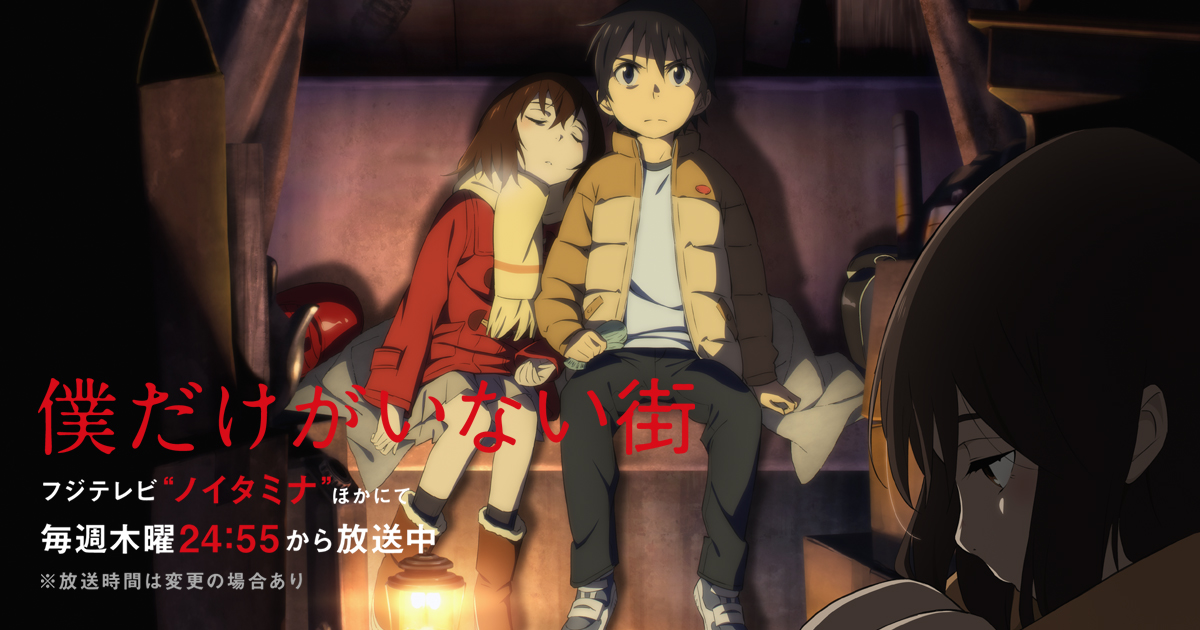
Satoru’s unusual returns to earlier moments draw him toward events in his childhood and the possibility of preventing tragedy.
Why choose it?
Pick this for a time-shift story whose stakes are personal safety and an earlier social environment. Its place in the collection is defined by intervention: what can someone do differently when he recognizes a danger that was once beyond his reach? That makes it a different experience from a laboratory experiment or a fantasy retry. We recommend it for viewers who want the altered past to be connected to vulnerability and responsibility.
Where to start
Begin with the television opening. The anime, manga and live-action versions are separate presentations; keep their endings and access labels distinct.
Tone & scope: Child endangerment and abuse are serious tone considerations. This article does not compare the adaptations’ ending details or claim that they are identical.
Tokyo Revengers
TV anime · A second chance through relationships

Takemichi’s return to his younger life gives him a chance to confront events tied to delinquent groups and people whose futures matter to him.
Why choose it?
Choose this when changing the past should involve relationships, loyalties and a social structure a protagonist has to re-enter. Its role is to give the collection a group-centered intervention branch. The appeal is different from replaying a single physical challenge: what someone knows about a later outcome may not tell him how to persuade the people around him. We select that premise without treating the theme as approval of the violence depicted.
Where to start
Start with the original television opening and use the official portal’s named arcs to identify later screen projects. The manga is the source-reading branch.
Tone & scope: Expect violence, bullying and emotionally difficult outcomes. Promotional arc labels can disclose later circumstances, so a newcomer should avoid full future cast pages.
Read the full Tokyo Revengers guide & visual adaptation map →
Case check: repeated attempts are not one universal mechanic
Re:ZERO’s portal and maintained guide identify Subaru’s repeated-attempt screen route; ERASED’s official project presents a return to earlier events tied to a childhood mystery. These support the thematic connection without making their mechanisms identical. Our editorial reading is to watch what information a protagonist carries and what other people can know. The selected posters identify the projects; they cannot prove a complete timeline or determine a recommended first-viewing spoiler boundary by themselves. No hidden identity, final outcome or exact source-chapter handoff is reconstructed here.
Confirmed: the linked primary descriptions establish project identity and starting premises. Editorial reading: the thematic fit and comparisons are our interpretation. Not established here: exact adaptation endpoints, production costs, complete viewing availability or a scene-by-scene source comparison.
Discuss and continue
Community and catalog links are secondary navigation. They can help you find contrasting responses, but they are not evidence of audience-wide agreement. Discussion threads and later-season pages may contain spoilers.
Use official source pages for project identity and check your licensed service for regional availability.
Find community discussions on Reddit · Watch-order guides · Reading routes · Visual adaptation maps
Another experience to explore
Review and artwork notes
This selection was reviewed on 2026-09-30. Original official or licensed images identify each project; later-season art is labeled where used. Artwork is reproduced under permission asserted by the site owner, with attribution and source links retained. This is not an open-license claim. Future revisions can replace a pick, improve source routes or add a maintained Work guide while preserving the selection’s published purpose.