Watch the 2016 anime in order from episode 1 to 12, or begin Kei Sanbe’s manga at volume one. English hardback and digital numbering differ: check format and ISBN. Save extra-character manga and Japanese Another Record prose until after the main story; the 2017 drama is a separate adaptation.
Reviewed 1 October 2026 · Opening Revival/accident premise; culprit, character outcomes and ending withheld. · Licensed access varies by country.
The source and screen branches

Identify language, binding and ISBN before following a manga volume number. Extra manga and Japanese Another Record prose are supplementary reading. Live-action adaptations are covered separately, outside this route.
- READ · source and extra: Main manga · begin with volume 1 → Supplementary character manga · after main story
- WATCH · anime: 2016 A-1 Pictures anime → Episodes 1–12 · screen conclusion
- OPTIONAL · separate branches: Japanese Another Record prose
Choose the anime or the original manga first
ERASED is a mystery about an adult confronting dangers connected to his childhood. Satoru Fujinuma experiences a phenomenon called Revival, which pulls him back before a harmful event. His ordinary work and family life become entangled with an older case. The practical attraction is not a large science-fiction universe: it is the possibility of acting differently when a familiar moment returns.
For animation, watch the 2016 series from episode one through episode twelve. The official Japanese and English episode pages identify the twelve-part route. Do not start with a later episode because its title appears to explain the mystery, and do not place the separate live-action drama between anime episodes. Each screen adaptation has its own presentation of the story.
For the source, choose Kei Sanbe’s manga from volume one. Finish the main story before supplementary character material or Another Record. If the anime makes you want more context, reading from the beginning is the clearest comparison route. This guide does not invent an exact chapter where every screen scene ends; different formats and editions need an inspected scene-by-scene match before such a claim would be useful.
English hardbacks and digital books need different labels
The Japanese collected line contains the main narrative followed by a ninth supplementary book. Yen Press’s English hardcover line packages the story into fewer physical books and includes a fifth extra volume. Its series page describes that extra book as revisiting the lives of Satoru’s friends. That is a post-main-story reading choice, not the fifth installment of the original Japanese numbering.
The same publisher’s individual product pages mix selectable digital and hardback records. On the reviewed volume-four page, the hardcover ISBN 9780316468466 has 406 pages, while the digital ISBN 9780316468541 has a separate 160-page record. On volume five, the hardcover ISBN 9781975301743 and digital ISBN 9780316468565 likewise identify different packages. A shared web-page title is therefore insufficient to match content.
When shopping or following a recommendation, write down the language, format and ISBN. If you already own an ebook, use that edition’s contents rather than importing a hardback handoff number. After the main narrative, select the extra-character book deliberately. The publisher’s descriptions themselves contain later-story information, so this route avoids repeating their detailed plot blurbs.
| Route | What to identify | How to use it |
|---|---|---|
| Japanese manga | Main books followed by supplementary volume nine | Begin at one; save the extra book |
| Yen Press hardbacks | Omnibus packaging and the fifth extra book | Use hardback ISBN and contents |
| Yen Press digital | Separate page counts and ISBNs on product pages | Follow the selected ebook edition |
| 2016 anime | Official episodes one through twelve | Watch in release order |
The people behind its different forms
Kei Sanbe created the source manga, serialized in Young Ace. A-1 Pictures’ production record names Tomohiko Ito as director, Taku Kishimoto for series composition and Keigo Sasaki for character design. Yuki Kajiura is credited for music. These are the relevant credits for the 2016 anime, rather than credits taken from the later live-action project.
The studio also records separate performers for Satoru: Tao Tsuchiya and Shinnosuke Mitsushima. That distinction makes sense for a narrative that asks an audience to recognize one character across different life stages. It is a production fact; judging how the performances connect requires listening to the actual scenes rather than deducing tone from a cast list.
Another Record is a Japanese spin-off novel by Hajime Ninomae, with Sanbe credited for the original work. KADOKAWA’s reviewed paperback edition dates to 24 August 2018 and includes a conversation between the novelist and original creator. The Novel badge here refers to this real supplementary prose product. It does not change the manga origin of ERASED or promise an English prose release.
Case check: an ordinary workplace gives danger a scale
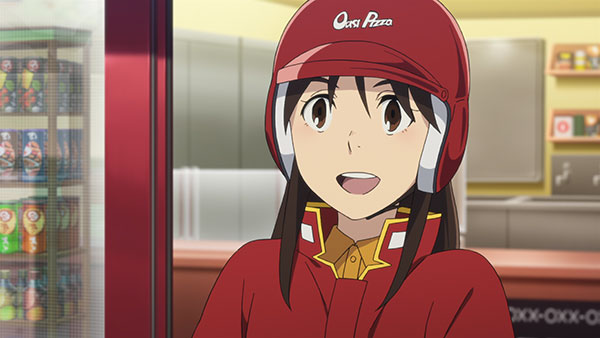
The original premiere still below depicts Airi at a pizza workplace. She wears a red helmet and uniform, with equipment and shelves visible behind her. Her open expression occupies a brightly lit everyday setting. These visible details support a discussion of the series’ ordinary working world; the frame is not an image of Revival happening and does not establish a later character outcome.
The official episode-one introduction begins with the twenty-nine-year-old Satoru, an accident associated with Revival and his mother’s arrival after he is hurt. The selected workplace image offers a useful counterweight to the supernatural premise. There is a job to return to and a person to speak with before the story becomes an abstract puzzle about changing time.
Our interpretation is that such normal surroundings make disruption easier to measure. A threatening development matters because it interrupts an intelligible routine. When comparing manga and anime, ask how each format establishes that routine: a page can invite a pause on background detail, while a cut can move past it quickly. The official still supplies an observable visual anchor, not proof of which version handles every scene better.
Original visual reference
The central question: what would acting differently require?
A second chance is not automatically a solution. Knowing that something terrible happened gives Satoru a reason to act, but the useful analytical question is what kind of action would actually change the conditions around a vulnerable person. A mystery answer and a successful act of care are not identical achievements. Watch for situations in which obtaining information is easier than persuading someone to help.
For a spoiler-light first viewing, separate remembered danger from present evidence. A protagonist’s knowledge of an earlier outcome may guide attention, yet the audience still needs to see how a decision becomes workable in the current situation. This is where the story’s time premise connects to relationships: recognition, trust and willingness to intervene can matter as much as identifying a suspect.
The material includes violence, child endangerment and abuse-related themes. That description helps set expectations for the kind of mystery you are choosing. It is not a scene-by-scene warning list or a substitute for checking a service’s age classification. This guide keeps the perpetrator, major survival outcomes and the conclusion out of its first-viewing route.
How to compare an ending without treating it as a missing season
Completing a screen narrative does not imply that every original page appears on screen. Conversely, an omitted or rearranged sequence does not prove that a second season is required. The anime’s episode-twelve record marks its concluding installment. A good comparison should explain what a particular change does to pacing, viewpoint or emotional emphasis, rather than declaring the source unfinished because the presentation differs.
After finishing, pick one conversation you remember and find it in your licensed manga edition. Compare who receives the first line, which reaction gets a panel or close-up, and how much context is supplied before a decision. Record the edition and the episode. This creates a reproducible adaptation note instead of borrowing an unexplained chapter number from a forum.
The supplementary manga gives other characters additional space, according to the English publisher’s extra-volume description. That supports recommending it to readers interested in those perspectives after the main story. It does not make the first viewing invalid without that book. Another Record also has a separate author and purpose; its highly revealing product synopsis should be saved for later.
The live-action drama is an alternative screen branch
Netflix’s licensed page identifies a 2017 live-action ERASED starring Yuki Furukawa, Mio Yuki and Jin Shirasu. Its medium and year separate it from the 2016 A-1 Pictures anime. If a search result shows live performers rather than animation, check the title record before assuming you have found an anime sequel.
The drama is an optional comparison after choosing a main route, not a bridging installment required before episode twelve. Compare the work each medium asks its audience to do: a drawn face, animated performance and live performance communicate attention differently. This is a basis for an informed comparison, not a claim that the drama reproduces every manga chapter unchanged.
Access depends on territory and on the current catalog. A licensed page is a useful identification and legal-discovery route, but an old availability comment is not a streaming guarantee. The guide’s map therefore shows the drama separately and avoids a universal watch-here claim. Prose and extra manga are also optional branches once the main mystery is complete.
What the publishing records can tell us about value
The reviewed hardcover and digital entries disclose edition size, format, identifiers and release dates. These facts make a practical value comparison possible: a larger hardback may contain material packaged across several smaller books, while an ebook can follow another numbering system. Compare included content before counting how many products a retailer displays.
Page count does not disclose print quality, current stock, shipping cost or the reader’s preferred way to hold a book. Nor does a publisher having manga, prose and screen-linked products establish the adaptation budget or profit. We have no verified project-level financial disclosure to turn these records into a revenue estimate.
The article keeps the commercial discussion at that verifiable level. If you want the full source narrative, identify a complete licensed edition; if you mainly want the animated mystery, the twelve-episode project is a bounded commitment. Additional products can be interesting later without becoming a compulsory bundle to understand the initial route.
Community perspective: the cover-number confusion is real
The reviewed Reddit discussion begins with a collector noticing that one English hardback cover looks different from the others. A reply explains the combined-volume packaging. The thread is useful because it demonstrates a concrete reader confusion; it is not our authority for ISBNs, a representative opinion poll or evidence that all editions use the same cover design.
We checked the publisher records rather than repeating the discussion’s numbering as a universal rule. Readers should be especially cautious with old advice that says English volume five is the extra book without specifying hardcover: the current product pages also expose a different digital volume-five record. The format qualifier is the difference between helpful guidance and a wrong purchase.
For another completed mystery with edition-number differences, see our Summer Time Rendering guide. Its thirteen Japanese volumes and six English omnibuses present a related purchasing problem, but its own anime runs twenty-five episodes. The time-loop and small-clues collections provide different thematic reasons to compare these stories without pretending their watch or read routes are interchangeable.
Primary sources and useful navigation
- Official Japanese anime project
- Official premiere synopsis and original still
- Official concluding episode record; later-story spoilers
- Official English anime episode index
- A-1 Pictures: staff, studio and cast
- Yen Press: English series and extra-volume description
- Yen Press: differing hardcover/digital volume-four records
- Yen Press: differing hardcover/digital volume-five records
- KADOKAWA: supplementary Japanese ninth manga book
- KADOKAWA: Ninomae/Sanbe Another Record prose; ending spoilers
- Netflix: separate 2017 live-action adaptation
- Related guide: Summer Time Rendering edition and anime routes
Community and catalog routes
- Reviewed collector discussion: English cover/edition confusion
- Fan wiki: chapters/volumes; secondary spoiler-heavy navigation
- MyAnimeList anime catalog; secondary navigation
The production and publisher links support project facts. Catalog and community pages are secondary navigation and may reveal later events.
Find this work in our thematic collections
- 5 Time-Loop and Time-Travel Anime About Changing an Outcome
- Small clues, different mysteries: five anime for curious viewers
Original series imagery is reproduced under permission asserted by the site owner; the source and rights credits are retained. The route diagram is Animeteor’s own explanatory graphic.
Games and live-action adaptations
Explore these additional versions of this work.