Quick answer: The light novel volumes provide a coherent prose route. Manga releases are divided into separately titled story chapters or arcs, so check the arc title when crossing from anime to manga rather than looking for a single continuous manga numbering system.
Spoiler scope: opening premise and format relationships. Fan wikis, official volume catalogs and discussions may reveal later events. Case sources checked 30 September 2026; access varies by region.
Edition and adaptation map

Check each lane: Light novel, Television anime. Follow the numbering within the chosen edition. An exact screen-to-page handoff needs a scene comparison; optional branches are not mandatory next chapters.
Edition details and access
The light novel volumes provide a coherent prose route. Manga releases are divided into separately titled story chapters or arcs, so check the arc title when crossing from anime to manga rather than looking for a single continuous manga numbering system.
Start with an official edition: Yen Press light novel vol. 1. Availability and chapter access can vary by region or subscription.
Publication and edition check · 2 October 2026
The production news archive records fourth-season finale messages on 30 September 2026 and the extended, 45-minute episode 85. This is a season-finale update, not an upcoming season premiere or a light-novel volume number. Source record →
The original light novels and manga adaptations retain separate numbering. The Japanese publisher groups manga by named arc, so a restarted manga volume 1 is not a new beginning for the entire prose story. Source record →
Choose a route before you continue
Choose the light novel for a continuous numbered prose series. If choosing manga, use the named arc title as well as its volume number. Anime episodes, light novel volumes and manga arc numbering are different reference systems. For a first experience, keep the order in which Subaru learns information instead of reorganizing attempts by an imagined master timeline.
Case check: Subaru arrives without the power he expects
Confirmed by primary sources: The official first-season story page introduces Subaru returning from a convenience store and finding himself in a fantasy world. The premiere setup gives him no convenient supernatural advantage and puts him in danger before a girl helps him. That beginning matters before considering the story’s later repeated attempts.
Official image and premise source · Yen Press light novel vol. 1 · Official Japanese book catalog
Look at the original presentation
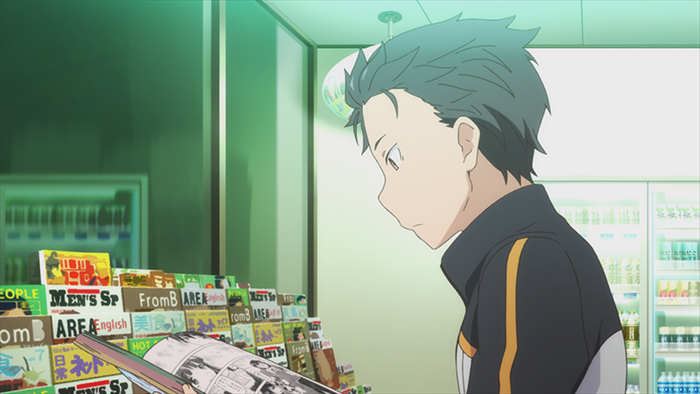
Our visual reading: The selected episode-one still shows Subaru in the convenience store, surrounded by everyday shelving. It establishes the ordinary-world starting point. This is a genuine opening image, not a depiction of a timeline reset, and it should not be used as proof of how a later loop works.
Verification boundary: this check uses official descriptions and the identified image. It is not a complete page-by-page or shot-by-shot comparison. A numbered continuation requires the last licensed screen scene and the corresponding named source edition to be checked together; promotional art cannot establish that handoff.
Why this opening matters
Our reading of the opening is that the expectation of being special comes before the ability to act effectively. The convenience-store starting point reinforces how little preparation Subaru has for the new setting. When the story later makes knowledge consequential, the useful question is what he has actually learned through experience. A guide should resist describing him with information that only an experienced reader possesses.
How to compare the editions
When taking notes on repeated attempts, separate the starting situation, Subaru’s retained knowledge, and the action he changes. A repeated location does not mean the emotional circumstances are identical. For adaptation analysis, inspect how internal reasoning reaches the audience: narration, performance, framing or dialogue. Only the complete licensed passage and episode can establish that a specific thought has been removed.
Reader discussion and reference shelf
In this June 2026 reading-route discussion, respondents recommend starting the novels from the beginning, citing richer detail and Subaru’s perspective. That is a preference grounded in their experience. We do not adopt the thread’s continuation numbers without inspecting the named licensed edition and screen endpoint.
- Selected Reddit discussion — reader responses; spoiler scope depends on the thread.
- Find the named edition on MyAnimeList — catalog navigation and user reviews; ratings are not evidence for canon.
- Fan wiki reference shelf — character and terminology navigation; expect later-story spoilers.
Publisher and production records support the factual route above. Community pages supply reader perspectives and reference navigation. Any future installment-level comparison will be dated here when the licensed material has been checked.
What is worth comparing?
A reset changes the reader’s knowledge but often leaves other characters unaware. An effective timeline should show loops as parallel attempts, not flatten them into one uninterrupted sequence.
Questions to take into the story
What new information survives a reset? How does the anime make an invisible repetition feel different on screen?
The route through novels, manga, and anime
The Yen Press light-novel line begins a continuous prose route. Manga adaptations use titled chapter or arc lines, so a reader shopping for “manga volume 1” must check which story arc that edition covers. The official Japanese book catalog separates books and related editions. The anime is its own screen route through the story. We do not equate a season number with a light-novel volume without checking the final scene of the season.
How to read a repeated timeline
Re:ZERO’s returns can look like repeated scenes, but the repetition is the structure of the problem. Subaru carries information forward while most people around him do not. When tracking an arc, record the starting point of each attempt, the knowledge he brought into it, and the decision that changed. This creates parallel branches that can converge on a successful outcome; a simple straight timeline would lose why a later attempt matters.
That structure also changes adaptation analysis. A novel can give extensive internal reasoning even when the physical scene looks similar. An anime can make a familiar location feel different through performance, sound, and what it omits from a repeat. A good comparison should ask what new information the audience gains, not count repeated events as if they were filler.
Record the knowledge carried into each attempt
A repeated starting situation does not mean the same story is simply being played again. Subaru can carry a memory or suspicion into the next attempt while other people around him act without it. For each return, record the starting point, what he believes has changed, and which decision he tries differently. This makes the consequence of a loop visible without flattening the story into a single success-or-failure timeline.
The light novels can express a private theory even when outward action repeats; animation can make familiar surroundings ominous through performance and sound. Compare one repeated encounter by asking what the audience knows this time that it lacked before. The Yen Press novel line and official anime story index offer separate installment sequences. An episode label is not a novel-volume pointer without a matched final scene.
Verified creators
Tappei Nagatsuki (Original light novel story)
Community discussion
Compare reader interpretations in Reddit discussions about Re:ZERO -Starting Life in Another World-. Community posts are individual opinions; use the official sources below to verify release and edition facts.
Official sources
Independent editorial commentary. Thematic illustration is original and unofficial; source links lead to publishers, production sites, or licensed platforms. Availability varies by region.
The Japanese light novel reached volume 46
The official book catalog dates Japanese light novel volume 46 to 25 September 2026. The exact edition is ISBN 978-4046605269, with Tappei Nagatsuki and Shinichirou Otsuka credited. This prose volume number should not be compared directly with anime episode 85 or manga numbering.