Start with the original 24 anime episodes, then Christmas Showdown and Tenjiku. Three Titans’ scheduled Japanese broadcast window has begun; it remains an ongoing arc, not a completed season. For the completed source, read Ken Wakui’s manga from volume one: Kodansha digital volumes or Seven Seas printed omnibuses. Spin-offs and films are separate branches.
Reviewed 1 October 2026 · Opening Hinata news/time-leap premise; major character outcomes and manga ending withheld. · Licensed access varies by country.

The source and screen branches

Choose a named manga edition or follow the anime arcs. The Baji manga is supplementary; live-action films are separate products outside this route.
- READ · source manga: Kodansha digital volumes 1–31 OR Seven Seas print omnibus ranges · final 29–31
- WATCH · anime arcs: Original 24 episodes → Christmas Showdown arc → Tenjiku arc → CURRENT · Three Titans · scheduled window began 2 October broadcast day
- OPTIONAL · other projects: A Letter from Keisuke Baji manga
A second chance inside a delinquent-gang story
Tokyo Revengers follows Takemichi Hanagaki, an adult whose disappointing present is interrupted by news that his former girlfriend Hinata has died. A sudden leap takes him twelve years back to his middle-school life. Saving someone requires more than remembering a date: he must confront relationships and power structures he previously avoided. Expect time-travel suspense combined with gang conflict and emotionally charged loyalty.
The original work is Ken Wakui’s manga. Kodansha’s English digital catalog marks it complete with thirty-one volumes. Seven Seas publishes the English print omnibus edition, whose final book combines volumes twenty-nine through thirty-one. If you want the completed source without waiting for further animation, start at manga volume one and follow the edition you selected.
For animation, begin with the original twenty-four episodes, then continue through the Christmas Showdown arc and the Tenjiku arc. The War of the Three Titans arc follows Tenjiku. At the 4 October 2026 check, its official Japanese scheduled broadcast window has begun; it is an ongoing arc, not a finished season that we have reviewed. Arc names are more dependable than a platform’s season number.
Watch order and the broadcast date that needs care
The official project identifies the original twenty-four episodes as the August 3rd Conflict and Bloody Halloween material. A dated promotional notice explicitly groups episodes one to twelve and thirteen to twenty-four. Its temporary free-streaming windows were in 2025; those dates establish the earlier grouping, not a promise of free access now.
The following screen arcs are Christmas Showdown and Tenjiku, which the project’s staff and distribution records present as later stages. Continue in that release sequence rather than arranging episodes according to the year a flashback depicts. The viewer is supposed to discover information in the order the adaptation provides it. Moving a revelation earlier can change the mystery rather than clarify it.
The official 18 September 2026 notice advertises Three Titans from Friday 2 October, using Japanese late-night scheduling. MBS and TBS list 1:23 a.m. in that broadcast-day convention; after midnight, that corresponds to the following civil-calendar date. Other stations list different starts. The same notice announces a Disney+ release, but your local service listing should be checked for language, availability and actual time. We do not convert a Japanese station label into an unsupported worldwide release hour.
Reading after an anime arc: name the edition first
The manga is the cleanest route to the completed original story. English digital volumes belong to Kodansha’s line, while Seven Seas’ physical edition combines multiple original volumes. A recommendation to buy book eleven can therefore mean a different object from a recommendation to read original volume eleven. Use the printed range on an omnibus cover and its contents.
The final Seven Seas omnibus is explicitly labeled final and dated 25 March 2025. It combines three volumes rather than a usual two-volume pair. A calculation based on every printed book having exactly two original volumes fails at that boundary. The ending is available in the licensed English source edition; future anime announcements do not mean the manga itself remains unfinished.
If you are switching midway, record your last completed named anime arc and compare its final scene with your chosen licensed edition before skipping ahead. We have not published a universal chapter handoff from a forum suggestion. Starting the source at the beginning is the supported option here, and it also makes it easier to observe differences in dialogue, pacing and how a reaction is framed.
Wakui, LIDENFILMS and the later director change
Ken Wakui writes and illustrates the main manga. The official anime staff list credits Koichi Hatsumi as director for the earlier arcs, Yasuyuki Muto for series composition, Kenichi Onuki and Keiko Ota for character design, and Hiroaki Tsutsumi for music. LIDENFILMS is the animation studio. These are the earlier screen-project credits, not a blanket claim that every later installment has an identical team.
The Three Titans staff block names Maki Kodaira as director and Hatsumi for series-composition cooperation. Muto remains in the composition role, and the character-design list expands to include Airi Tsuyuki and Kaori Takakura. This distinction matters for a guide that will be updated after broadcast: a later production needs its own credit record and cannot be evaluated solely through the 2021 team.
A Letter from Keisuke Baji is a separate spin-off manga credited to Wakui and Yukinori Natsukawaguchi. The English Seven Seas project and Kodansha’s K MANGA listing identify that branch. Their plot descriptions disclose important events involving the characters, so first-time viewers should postpone them. Sharing a creator or setting does not make a spin-off volume the next main-story volume.
Case check: the present feels small before the gang story expands
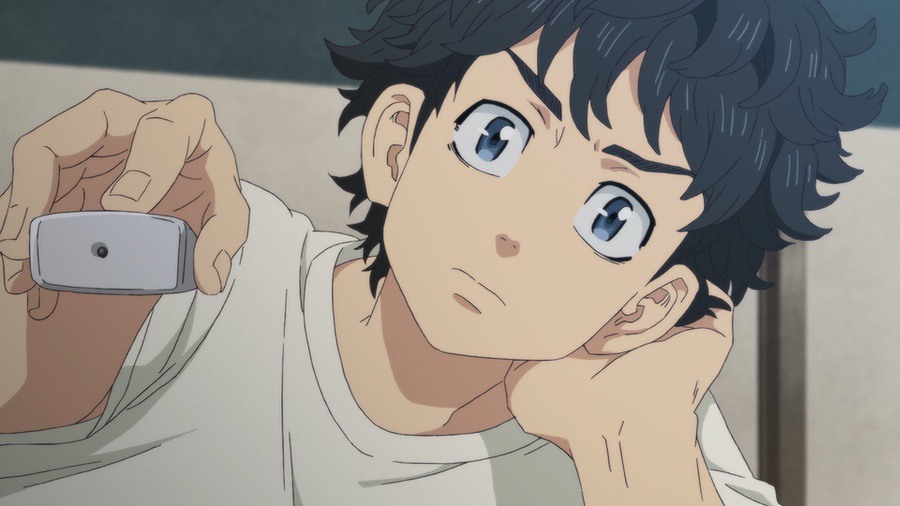
The original premiere still below shows adult Takemichi resting his head on one hand while holding a small device in the other. His posture is slouched and his expression looks uncertain rather than triumphant. The unglamorous interior and plain shirt locate the image in ordinary life. The frame itself does not show a successful rescue or demonstrate how a time leap works.
The official premiere record supplies context: Takemichi learns about Hinata’s death, continues his routine, and experiences the event that sends him twelve years back. The publisher’s introduction also emphasizes his discouraging adult circumstances. Those descriptions establish the contrast between the life he has accepted and the life he might try to change. They do not tell us that any single intervention will succeed.
Our reading is that beginning with a diminished adult makes courage a social problem before it becomes a fight scene. The viewer is invited to ask whether this person will speak, stay or intervene when he previously withdrew. On an adaptation comparison, watch for how long a version allows this uncomfortable ordinary life to register. A close-up can convey exhaustion, while a manga page may keep more environmental detail in view.
Original visual reference
Power, loyalty and the cost of a rescue plan
The useful tension is between personal rescue and collective consequences. Takemichi wants to protect a particular person, yet the route draws him toward an organization with its own loyalties and conflicts. A plan that looks simple from a future news report can become complicated when its participants are people he knows. Ask whose safety a decision considers and whose it leaves outside the frame.
Persistence is not the same thing as control. A protagonist can be emotionally committed while misreading how a group will respond. That is a productive way to assess confrontations without reducing the story to whether he wins a fight. Who can command attention? Which promise binds someone? What does an apparently private relationship change about an organization’s decisions?
The gang setting includes serious violence, intimidation and death. Treat uniforms, poses and promotional group images as fictional presentation rather than a guide to real-life conflict. For analysis, distinguish a character’s justification from the consequences shown by the narrative. This guide withholds major deaths and the manga conclusion so these questions remain usable during a first viewing.
Spin-offs, color editions and live-action adaptations
A Letter from Keisuke Baji explores characters associated with the main gang story. Its English print and ebook publishing announcement dates to October 2023, with the first Seven Seas book released in 2024. K MANGA offers another licensed digital route. Finish the relevant main-story context before opening its premise, because the synopsis assumes knowledge of a major event.
Brilliant Full Color editions repackage the manga with color; they should be identified as an edition, not automatically treated as a new plot arc. Kodansha’s related-products record separates the completed manga from its adaptations. When choosing a book, determine whether you want the original monochrome presentation, an omnibus or a color edition before comparing release dates or number of volumes.
The publisher also identifies the 2021 live-action film and the 2023 two-part Bloody Halloween film project. These are a separate screen branch. They are not required between the anime’s two original arcs. Choose animation or live action as your main first-viewing presentation, then compare another version if the story interests you; do not splice projects together simply because they cover similarly named events.
What the commercial evidence actually supports
This is a franchise with distinct manga editions and licensed screen and spin-off products. The final English print omnibus is a 600-page book containing a specified three-volume range. Those facts explain a packaging decision and help a reader avoid buying duplicates. They do not disclose how revenue is divided among publisher, creator, animation producer or distributor.
Kodansha’s Japanese related-products page advertises worldwide circulation above eighty million copies. We attribute this as the publisher’s circulation claim observed at review, not units sold in a particular year or a present-day profit figure. The page does not give us a usable milestone announcement date. Circulation, sales, gross receipts and production profit are different measures.
The right purchase comparison therefore starts with language, included volume range and format. Check price and stock with a current retailer when buying. An old forum answer about waiting for unfinished print publication is no longer the completion evidence: the official final-omnibus record now exists. No verified production budget is available in the sources used here.
| Record | Verified position at review | Practical meaning |
|---|---|---|
| Kodansha English digital manga | Complete; thirty-one volumes listed | Read the source from volume one |
| Seven Seas main print omnibus | Final book combines 29–31; March 2025 | Check range before buying |
| Earlier TV arcs | Original run, Christmas Showdown, Tenjiku | Watch in release sequence |
| Three Titans TV arc | Japanese scheduled window has begun | Current arc; not completed |
Community perspective: finding the correct English publisher
The reviewed Reddit discussion comes from a reader who wants a licensed edition but cannot find the series in a Shonen Jump subscription. A reply distinguishes Kodansha digital volumes from Seven Seas printed omnibuses. That is a concrete discovery problem this guide can solve. The thread is not a representative audience survey, and its old price and publication-wait advice should not be promoted to current facts.
We use the publishers’ current catalog records for completion and direct licensed navigation. Library access, local stock and subscriptions differ by territory. A library recommendation can be worthwhile without guaranteeing that a particular library owns the books. Likewise, we do not reproduce scan-site suggestions from other replies as official reading routes.
The time-loop collection compares this title with ERASED and Summer Time Rendering, whose guides are linked below. Tokyo Revengers offers a gang-centered rescue problem; ERASED uses a childhood-connected mystery; Summer Time Rendering begins with an island investigation. These are useful thematic neighbors, while their completed source records, screen lengths and branching products remain distinct.
Primary sources and useful navigation
- Official anime portal and new-arc announcement
- Official premiere episode guide
- Official episode data behind the project’s guide
- Official staff records by anime arc
- Official distribution and broadcast records
- 18 September notice: upcoming Three Titans broadcast details
- Dated official notice: original 24-episode grouping; expired windows
- Kodansha USA: complete English digital source
- Seven Seas: final main-manga print omnibus 29–31
- Seven Seas: Baji spin-off branch; plot spoilers
- Kodansha Japan: editions, circulation claim and screen adaptations
- Related guide: ERASED routes and edition records
- Related guide: Summer Time Rendering
Community and catalog routes
- Reviewed reader discussion: licensed English publisher discovery
- Fan wiki: secondary navigation; major spoilers
- MyAnimeList manga catalog linked by Kodansha
The production and publisher links support project facts. Catalog and community pages are secondary navigation and may reveal later events.
Find this work in our thematic collections
Original series imagery is reproduced under permission asserted by the site owner; the source and rights credits are retained. The route diagram is Animeteor’s own explanatory graphic.
Games and live-action adaptations
Explore these additional versions of this work.
- Tokyo Revengers — Live action: Film · 2021
- Tokyo Revengers 2: Destiny and Finale — Live action: Two films · 2023
Mobile game identities and ended service
The official DMM edition portal states that Tokyo Revengers: Last Mission ended service at 12:00 Japan time on 21 January 2026. The separately named UNLIMITED portal identifies a mobile RPG, with its own original stories and team systems. These are different licensed game products; an old Last Mission store or launch notice is not evidence that its online service is still playable. Neither game changes the manga/anime route.
Official Last Mission — service-end notice · Official UNLIMITED product portal
GOODROID’s authorized Japanese store entry identifies Puzz Reve! Road to National Domination as a separately named match-three smartphone puzzle game. It is distinct from UNLIMITED and the ended Last Mission service. Store availability and campaigns are territory-specific; development-labelled promotional images are not evidence of a new anime installment.