Watch episodes 1–11, or read one complete manga edition. Japanese standard 5, bunko 3, Full Game 2 and English 2 are alternative editions. The live-action film and production references stay separate.
Reviewed 3 October 2026 · Opening premise and adaptation relationships. Major endings withheld; linked catalog summaries and discussions may contain spoilers. · Licensed access varies by country.
The source and screen branches

The manga editions are alternatives, not successive arcs. Reference products are optional study. No required prose branch is verified here. Games and the 2002 live-action film remain outside this map.
- WATCH · 2014 television: Episode 1 · meet Peco and Smile → Episode 11 · finish the TV route
- READ · choose a manga edition: Japanese standard · 5 volumes · Japanese bunko · 3 volumes · Japanese Full Game · 2 books · English VIZ · 2 books
- REFERENCE · optional study: Production notes and storyboards · Soundtrack and artwork
Eleven episodes make a focused first route
Ping Pong the Animation follows childhood friends Peco and Smile as high-school table tennis turns their familiar relationship into a competitive problem. Peco approaches the game with confidence; Smile has ability without the same apparent hunger for victory. Coaches and opponents see possibilities in both boys that they do not understand in the same way. Start with episode one, where those contrasting relationships with the sport are the foundation rather than background trivia.
The 2014 television adaptation contains eleven episodes. There is a simple numbered watch route, without a sequence of films, prequels or replacement recaps to navigate first. The original Taiyo Matsumoto manga provides a separate complete reading route. Our map gives those options equal clarity: the manga is the source of the animation, not a sequel that must wait until the last episode.
Choose the anime if movement, voice and music are your preferred introduction. Choose the manga if you want control over the time spent examining faces, lines and the arrangement of a rally on the page. Either way, give the opening space to establish the people around the table. A visitor looking mainly for a long tournament ladder should know that this is also a concentrated account of friendship, self-image and changing ambitions.
Different book counts describe different editions
The official anime site’s book page distinguishes three Japanese manga presentations: the standard five-volume set, the three-volume bunko edition and the two-book Full Game edition. Those are parallel editions of the source, not three successive stories. The two-book English VIZ edition is another publication choice. A progress record should identify which one you are reading before comparing volume numbers with a recommendation.
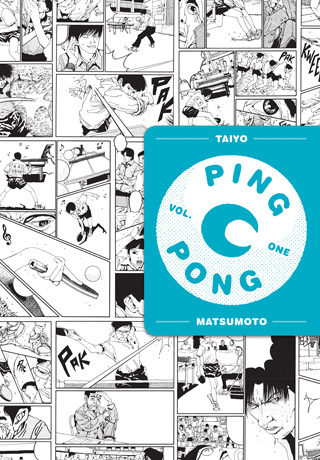
VIZ presents the English edition as complete in two volumes, with color artwork, the additional Tamura story and an afterword by the original Japanese editor. It credits Michael Arias as translator. The extras provide context for source reading but should not become an invented season or a third required English book. We identify the actual edition so that a reader understands what a listing for volume two is completing.
This guide has not established a required prose-novel branch for the core story. Bunko is a publishing format, and the official book page still lists manga in that format. Production notebooks and art collections are reference material. A film adaptation can have associated publications, but that would need a separately verified bibliographic entry rather than an assumption that every screen version generates another novel to place on the main route.
There is no sequel handoff to manufacture
The shortest useful checklist is television episodes one through eleven, or a complete named manga edition from its first book. Finishing the anime does not require a chapter jump to an officially identified next arc here. Returning to the source is a comparison route. That distinction lets someone satisfied with the animation explore Matsumoto’s pages without being told they have watched an incomplete introductory season.
For comparison, choose an early meeting between the two friends and an opponent. Record the edition, locate the corresponding animated encounter and observe what each medium gives time to. Do not infer a chapter-to-episode formula by dividing five Japanese books by eleven episodes. Page counts, scene order and supplemental material vary between editions, and the storytelling can reorganize an encounter without making a simple arithmetic handoff accurate.
The 2002 live-action film is a separate adaptation documented in the Japanese Film Database. Its release precedes the television anime, but chronological release order does not make it a prerequisite for this viewing route. Under our site standard it belongs in separate live-action discovery, alongside a link to its own product record. Interactive products also stay outside the anime-and-manga map. A shared title is insufficient reason to merge distinct adaptations into a continuation chain.
Original visual reference
Talent can make a person harder to understand
Our editorial reading begins with the difference between being able to win and wanting what victory appears to promise. Smile’s ability can tempt others to assign him an ambition. Peco’s confidence can make his own ambition seem settled before the competition tests it. The table becomes a place where other people’s expectations meet a player’s less straightforward relationship with the activity.
The friendship is therefore more than a convenient pair of contrasting personalities. A childhood role can remain comfortable until a new environment asks someone to change. Coaches, rival schools and the Chinese exchange player Kong Wenge bring other standards into a relationship that previously had its own informal balance. Watch which person defines an achievement, and whether the player agrees with that definition after the immediate excitement of a match has passed.
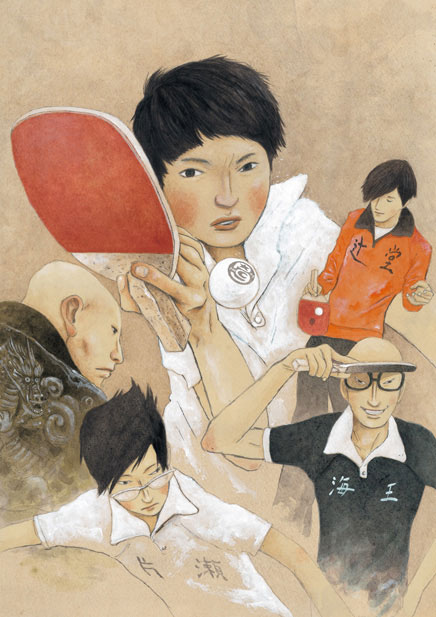
The visual style is part of how those questions arrive. An irregular-looking face or a compressed movement can draw attention to strain, confidence or the memory of a moment rather than to a clean athletic diagram. When comparing the manga with animation, ask how the body is presented as an expressive shape. That approach makes the unusual imagery something to investigate, instead of dismissing it because it differs from a smoother contemporary character template.
A particular collaboration shapes the television version
Taiyo Matsumoto created the manga. The television production’s official staff page names Masaaki Yuasa as director, Nobutake Ito for character design and Kensuke Ushio for music, with Tatsunoko Production producing the animation. These credits identify the eleven-episode version rather than every work carrying the Ping Pong title. They give a useful starting point for tracing another project by a creator without asserting a common fictional universe.
The official credits also identify Aymeric Kevin as art director, Kunio Tsujita for color design and Eriko Kimura as sound director. Fukujuro Katayama voices Peco, Koki Uchiyama voices Smile and Wen Yexing voices Kong Wenge. The language and performance of the exchange student are worth listening to alongside the athletic exchanges. Production roles help specify the questions a comparison can ask; they do not reduce the resulting style to a single person’s contribution.
Our lead image comes from the official site’s promotional visual gallery, and the second is VIZ’s English manga cover. They deliberately show different visual presentations of the same source relationship. Michael Arias’s English translation credit supplies another production connection to investigate: VIZ identifies him as the director of the Tekkonkinkreet film. That is a creator and translation link, not a route connecting the two stories.
A distinctive style attracts praise and some resistance
The named AniList television entry reports 86 out of 100, displayed as 8.6 out of 10 and observed October 3, 2026. This covers Ping Pong the Animation, the 2014 television production with eleven episodes. It is an external audience score rather than our grade. It does not combine the manga, the earlier live-action film or another title about table tennis into a franchise average.
A selected Reddit discussion begins with appreciation for the sport’s depiction. Replies discuss the music, the movement and the unusual visual presentation, with some viewers saying the style initially gave them pause. Another participant wanted more sustained match coverage. The range is useful: enjoying the expressive direction and wanting longer athletic exchanges are different priorities, even when both visitors like the characters.
We treat that conversation as a taste guide, not a representative survey or technical certification by verified professional players. Its participants also discuss endings, so the link carries a spoiler warning. Our practical recommendation is to try an early complete episode before deciding from a still image. If its rhythm suits you, continue the numbered route; if studying the lines and competition at your own pace appeals more, the complete manga is a clear alternative.
Compare package contents rather than the word complete alone
The official disc page lists a limited Complete Box and a Standard Box. It identifies supplementary material such as production notes, interviews, a making book and a soundtrack in the limited package, alongside a storyboard gallery for all eleven episodes. These are edition differences. They make a collection potentially interesting for production study without turning its extras into missing narrative installments in the standard viewing route.
The advertised collaboration on the box artwork also gives a concrete source-comparison detail: the official description credits Yuasa’s rough layout and Matsumoto’s finished illustrations. That is a documented production relationship, unlike an inference about a budget from the art style. A viewer studying the adaptation can use such materials to ask how the source artist and animation director approached its presentation, provided the actual purchased edition contains those extras.
No verified production budget, royalty figure or profit statement is established by the sources used here. We do not invent commercial success from a high audience score or a deluxe package price. The book counts, licensed English completion and disc configurations are supported observations. Older advertised store bonuses and Japanese rebroadcast banners need dates and territory checks; a promotional site that remains accessible is not proof of a current global streaming license or guaranteed collector stock.
Use the source relationship to guide a second visit
For a first visit, choose the eleven-episode television route or the completed manga in one identified edition. The map lists Japanese standard, bunko, Full Game and English book counts as alternatives. It keeps production references separate from narrative reading and leaves the live-action version outside the anime-and-manga chain. That organization avoids making a compact story look like a sprawling release puzzle.
For a second visit, compare one early rally and its surrounding reactions. Notice whether the important change is a point on the scoreboard, an opponent’s assumption or a friend’s response after play. Follow the sound and music in animation, then the positioning of panels and blank space in manga. Those observations give the visitor something specific to do with the source instead of reducing a comparison to a score or a list of alleged omissions.
The official anime site verifies staff, introductory context, book-edition distinctions and disc extras. VIZ verifies the English reading route and translation. The Japanese Film Database identifies the separate film adaptation. AniList supplies the scoped audience number; community discussion and the linked manga catalog offer further discovery. Later revisions should check licensed access and confirmed edition changes while retaining that separation between source reading, animation, reference products and live-action viewing.
Primary sources and useful navigation
- Official anime · promotional visual gallery
- Official anime · staff and cast
- Official anime · introductory story context
- Official anime · episode guide
- Official anime · Japanese five-, three- and two-book manga editions
- Official anime · disc contents, storyboards and production extras
- Shogakukan · Japanese comic bunko first volume
- VIZ · complete English two-volume manga and translator
- VIZ · English volume-one cover and licensed preview
- Simon & Schuster · official distributed VIZ final volume
- Japanese Film Database · separate 2002 live-action adaptation
- AniList · named anime audience score
Community and catalog routes
- MyAnimeList · named anime catalog
- Reddit · sport depiction, music and style discussion; spoilers
- MangaUpdates · optional manga catalog navigation
The production and publisher links support project facts. Catalog and community pages are secondary navigation and may reveal later events.
Explore related story guides
Original series imagery is reproduced under permission asserted by the site owner; the source and rights credits are retained. The route diagram is Animeteor’s own explanatory graphic.
Games and live-action adaptations
- Ping Pong — Live action: Film · 2002