Watch the 75-episode TV series, then Road to the Hokuto Cup. The special covers qualification, not the full manga tournament. Read the 23-volume source for the complete route; the two Japanese novels adapt early material.
Reviewed 3 October 2026 · Opening premise and adaptation relationships. Major endings withheld; linked catalog summaries and discussions may contain spoilers. · Licensed access varies by country.

The source and screen branches

The special sets up the Hokuto Cup; it does not animate the entire final manga tournament. Novels adapt early material. Comic bunko editions remain manga. Games and live-action stay outside this map.
- WATCH · television and special: Television series · 75 episodes → Hokuto Cup special · qualifiers
- READ · completed source: Standard manga · volumes 1–23 · Complete source · final tournament
- PROSE · optional early adaptations: Boy Meets Ghost · KAIO vs. HAZE
Start with the boy before the reputation
Hikaru no Go follows Hikaru Shindo, a schoolboy whose encounter with an old Go board brings the spirit Fujiwara-no-Sai into his consciousness. Sai already understands the game at a level Hikaru cannot explain. Their unusual partnership puts the boy in front of rivals who see the moves but cannot see the person supplying them. Start with the first television episode or the first manga volume to preserve that difference in knowledge.
The original television adaptation has 75 episodes. Studio Pierrot records its broadcast from October 2001 to March 2003, while its anniversary page gives the exact opening and closing dates. The straightforward animated route is that television run followed by the special commonly called Road to the Hokuto Cup. The special is additional animated story material, rather than a replacement introduction or a second full television season.
A newcomer does not need to understand Go strategy before starting. The practical attraction is watching an identity form around an activity that initially means something different to the two central participants. Try the opening volume or episodes for the relationship, then decide whether competitive development and quiet concentration suit your taste. Knowing that the manga has material beyond the animated route is useful without revealing the eventual outcome of a match.
Twenty-three manga volumes, with a separate optional prose branch
Yumi Hotta writes the manga and Takeshi Obata supplies its art. The original standard edition ends at volume 23, and VIZ also catalogs an English volume 23. The source is therefore a completed reading route. Start with volume one when comparing the versions: page composition, internal reactions and the passage between encounters matter alongside the headline result of any single game.
There are also Japanese prose adaptations. The publishing industry’s Books database identifies Boy Meets Ghost and KAIO vs. HAZE under Jump j Books, with Michiko Yokote credited alongside Hotta and Obata. The first returns to the ghost-board premise; the second covers the school Go-club setting. These are optional adaptations of early material, not two books that finish the international competition after the television special.
Edition language matters here. Shueisha also lists the manga in a comic bunko edition, but bunko is a physical publishing format and does not automatically mean a novel. Likewise, an illustration collection is not another narrative volume. Choose the standard manga numbering, the particular Japanese comic edition or the prose title explicitly, and keep that choice on your reading checklist. We have not verified an official English edition of these two novels and do not promise one.
The Hokuto Cup special sets up a tournament rather than completing it
TV Tokyo’s original special announcement describes Japanese representatives preparing for a junior team competition against China and Korea. Its synopsis focuses on selection and the encounters around qualification. That distinction prevents a misleading watch-order claim: finishing the special does not mean you have watched the manga’s complete final tournament in animation. The title’s wording is a useful clue, but the broadcaster’s actual synopsis is the evidence.
Our first-pass recommendation is the 75-episode television series and then the special. For the fullest source route, read the completed manga. We do not supply an exact chapter jump here: a reliable handoff would require matching the special’s final scenes against the relevant edition and checking what earlier source material the animation reshapes or leaves out. A fan’s convenient volume recommendation is a research lead, not sufficient proof of a universal starting point.
The Chinese live-action adaptation is another legitimate discovery route, documented by a licensed TBS catalog. It changes the setting and presentation and belongs on a separate adaptation page under our site standard. It does not enter this anime, manga and prose map. Board-game software, adaptations for interactive media and real Go lessons likewise should not appear as mandatory steps between the television finale and a source book.
Original visual reference
Borrowed ability makes recognition uncomfortable
Our reading of the opening centers on a mismatch between performance and ownership. Hikaru can be credited with a move that comes from Sai. Other players then react to an apparent level of expertise that does not match the boy’s initial interest or understanding. The story can make recognition feel uncomfortable before it makes recognition rewarding: an opponent wants an answer from the person across the board, not from an invisible explanation.
Akira Toya gives that mismatch a personal direction. His interest in the player he meets can sharpen into a demand for consistency. Hikaru’s own learning therefore matters beyond winning a game. It offers a way to inhabit the attention already attached to his name. The supernatural premise creates competitive questions about work, authorship and responsibility without needing the reader to treat every board diagram as a technical lesson.
Compare one early encounter in manga and animation by watching where your attention is directed. A page can make you pause over the board or a face; animation controls the length of a silence and adds the sound of a stone. Ask whether a reaction makes the uncertainty clearer, and whether the next scene gives that uncertainty time to settle. This is an editorial method for comparing adaptations, rather than a claim that every change is an improvement or a mistake.
Keep the writing, visual art and Go supervision distinct
The manga partnership gives Hotta and Obata different creative responsibilities. VIZ’s creator description connects Obata with later work including Death Note and Bakuman, but a shared artist does not put those stories in the same universe. They are useful discoveries for a reader interested in his visual storytelling. Within Hikaru no Go, the board, expressions and social setting all deserve attention when assessing how the premise becomes readable.
TV Tokyo’s staff page credits Yukari Umezawa of the Nihon Ki-in for supervision. It lists Susumu Nishizawa, Jun Kamiya and Tetsuya Endo as directors across the television production, Yoshiyuki Ohashi for series composition, and Hideyuki Motohashi and Kanami Sekiguchi for character design. We name the credited roles without turning the staff page’s overlapping episode boundaries into an exact director-by-episode checklist.
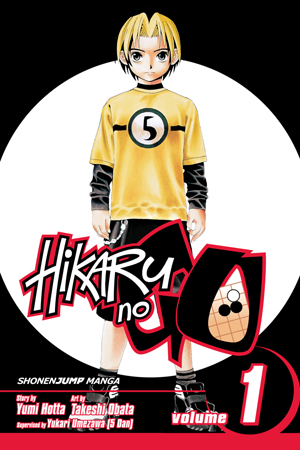
The same official credits identify Tomoko Kawakami as Hikaru, Susumu Chiba as Sai and Sanae Kobayashi as Akira, with TV Tokyo, Dentsu and Pierrot on the production line. The cast helps a comparison concentrate on how confidence and hesitation are performed. Our lead image is VIZ’s official series promotional art, and the second is its English volume-one cover. They are labeled as publisher imagery rather than screenshots of the special.
Viewers disagree about where the most satisfying stopping point lies
The named AniList television entry reports 78 out of 100, displayed here as 7.8 out of 10 and observed on October 3, 2026. Its scope is the original 2001 television anime with 75 episodes. This is an external audience score, not our editorial grade, and it does not rate the special, the source manga, the prose adaptations or the Chinese drama. Keeping the scope visible prevents a single number from standing in for every format.
A selected discussion on the Go community’s Reddit forum compares the anime and manga. Some participants prefer the animated stopping point, while others recommend the later source material or value the manga’s handling of time and school competition. Those responses help explain a genuine decision for a new visitor: wanting additional story and preferring a particular ending experience are related preferences, but they are not identical.
This thread is a small, self-selected conversation, so we do not turn it into a claim about what most fans think. It also contains spoilers and informal reading handoffs. Our recommendation is to finish a chosen introductory route, then decide whether to examine the full source rather than treating a dissatisfied comment as a reason to omit it. Readers who like gradual competitive development may find the discussion useful after viewing, when they can judge the cited tradeoffs for themselves.
A collection date is not a new adaptation announcement
TV Tokyo’s DVD collection page documents the 75 episodes and the special in a complete box, with a 2009 collection release and accompanying illustration material. Those details establish package contents. They do not date the first television broadcast to 2009 or establish a newly produced season. Likewise, Pierrot’s twentieth-anniversary page is an anniversary record tied to the 2001 launch, not evidence of a confirmed 2026 continuation.
The two prose reissues have a shared July 3, 2009 release date in the Books bibliography. Their ISBNs distinguish Boy Meets Ghost from KAIO vs. HAZE even when retailer romanization or page counts differ. For a buyer, the title and ISBN are safer identifiers than a loose listing called simply Hikaru no Go novel. Historical prices and bonus booklets should be checked against the exact current offer rather than assumed to survive every resale or digital edition.
The sources used here do not establish an anime production budget, license fee or profit statement. We therefore do not calculate financial success from episode count, a manga score or the existence of a boxed edition. The defensible commercial observations concern the verified products: a completed source manga, licensed English books, Japanese prose adaptations and later screen collections. Availability still depends on territory and provider; an old anniversary list is not a current worldwide streaming guarantee.
Choose a complete source or an animated introduction, then branch deliberately
Use the television series followed by Road to the Hokuto Cup for the animated route. Use the 23-volume standard manga for the complete source route, keeping your edition’s numbering visible. The map explicitly labels the special as a qualifying-stage story and the novels as early-material adaptations. Neither should be sold to a reader as a complete animated or prose version of the final manga competition.
For a comparison project, start from one early game rather than a list of results. Track who believes Hikaru is responsible for each decision, which reactions the page or scene emphasizes, and how the experience of silence changes between formats. That makes revisiting the opening useful even after finishing the anime. It also avoids spoiling late developments just to demonstrate that the manga offers a broader source narrative.
Studio Pierrot and TV Tokyo verify the animation and production identity. Shueisha and VIZ verify the source books; the Books bibliography identifies the two prose titles. AniList provides the scoped score, and the linked Reddit discussion and fan wiki are optional discovery routes. Future updates should check licensed access, edition changes and actual official adaptation announcements. They should retain separate game and live-action navigation and replace any provisional reading handoff only after a documented scene-to-edition comparison.
Primary sources and useful navigation
- Studio Pierrot · original television scope
- Studio Pierrot · twentieth-anniversary record and broadcast dates
- TV Tokyo · special synopsis and qualification context
- TV Tokyo · original special broadcast and merchandise
- TV Tokyo · television staff, cast and Go supervision
- TV Tokyo · complete DVD collection scope
- Shueisha · original manga final volume
- Shueisha · comic bunko edition, not prose
- VIZ · original series art and creators
- VIZ · English volume one and original cover
- VIZ · English final volume, digital edition
- Books publishing bibliography · Boy Meets Ghost prose adaptation
- Books publishing bibliography · KAIO vs. HAZE prose adaptation
- TBS licensed catalog · Chinese live-action discovery, outside story map
- AniList · named anime audience score
Community and catalog routes
- MyAnimeList · named anime catalog
- Reddit r/baduk · anime and manga comparison; spoilers
- Hikaru no Go Wiki · optional fan navigation; spoilers
The production and publisher links support project facts. Catalog and community pages are secondary navigation and may reveal later events.
Explore related story guides
Original series imagery is reproduced under permission asserted by the site owner; the source and rights credits are retained. The route diagram is Animeteor’s own explanatory graphic.
Games and live-action adaptations
- Hikaru no Go: the Chinese drama — Live action: Series · 2020
- Hikaru no Go: Heian Gensō Ibunroku — Game: Adventure · playable Go
Separate PlayStation adventure
The linked Heian Gensō Ibunroku guide covers Konami’s separately named PlayStation adventure, with playable Go and familiar characters recast in a Heian setting. TV Tokyo’s manufacturer archive also lists other Game Boy Advance and PlayStation products; their dates and features are not transferred to this adventure. It remains outside the manga/anime sequence.