Watch episodes 1–22 in order. Keep world notes and ending discussions for later; no verified manga or novel handoff is supplied.
Reviewed 3 October 2026 · Opening premise and adaptation relationships. Major endings withheld; linked catalog summaries and discussions may contain spoilers. · Licensed access varies by country.
The source and screen branches

The complete named television route is 22 episodes. Historical disc packages and related creators’ works are not extra chapters.
- WATCH · 2003 television anime: Episode 1 · STRANGER → Episodes 2–21 · follow discovery order → Episode 22 · MYTH
Start with STRANGER and follow the complete 22-episode order
For a first encounter, watch Texhnolyze from episode 1, STRANGER, through episode 22, MYTH. The licensed d Anime Store record lists the complete sequence. This is an anime discovery route: there is no verified manga chapter or novel volume presented here as a required second half. Start with the actual first episode rather than an explanation of the ending.
The opening asks for unusually patient attention. Try tracking who controls a room, which bodies seem vulnerable and which sounds interrupt stillness before demanding a complete vocabulary of the city. That approach is a viewing recommendation, not an official decoding key. Confusion can be part of the encounter without making every unclear detail equally significant.
The official archive contains setting notes and historical DVD listings, while the streaming catalog supplies episode names. Use those resources for different questions: a product volume is a container, not a new story installment, and a staff page explains authorship rather than plot order. Lain and Haibane Renmei are useful comparisons after viewing, not prequels.
| Entry | Relationship | Suggested use |
|---|---|---|
| 2003 television anime | 22 episodes; complete named route | Start at STRANGER; finish at MYTH |
| Official world database | Supplementary setting explanations | Consult after meeting the setting |
| Historical DVD unite releases | Disc packaging of the anime | Check included episodes, not volume labels |
| Lain / Haibane Renmei | Separate productions with creative connections | Optional comparisons; no shared chronology |
A complete anime route does not need an invented reading handoff
Texhnolyze benefits from a short map because the difficult part is interpretation, not finding twenty competing branches. The verified catalog describes the violent city of Lukuss and Ichise, a young man who has survived through underground boxing. It also introduces Ran as a consequential encounter. These are opening coordinates; they are not an invitation to recite later revelations.
A diagram that directs viewers from the final episode to a speculative book would undermine the very clarity it promises. Our map therefore ends with the television sequence. Official promotional illustrations, music releases and production material can deepen attention to the anime, but they do not establish an additional canonical ending or a missing adaptation that must be purchased.
When selecting a release, check that it contains all 22 episodes and identify the language, subtitles and region of that particular edition. Old broadcast or rental descriptions can count a different delivery package. The named complete licensed record is the basis for this guide; current access still depends on the service and territory a visitor actually uses.
Visual case: a damaged environment surrounds the body
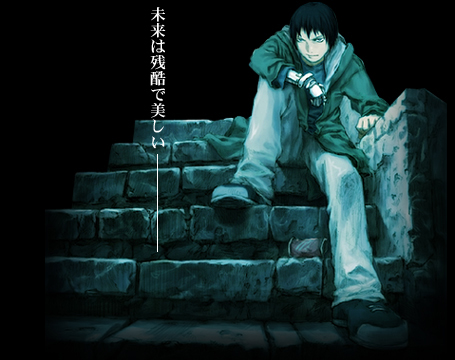
The official lead illustration places a seated figure on broken stone steps against a largely black background. Cool green light connects clothing, masonry and a metallic-looking arm. Our visual reading is that the body does not stand apart from the environment: both appear worn, constrained and dependent on surfaces whose stability is uncertain.
The licensed episode-one reference below places a dark-haired figure in a gray coat against an almost blank pale space. Compare that isolation with the broken steps in the promotional illustration: the person remains central, while the environment becomes harder to read. This is a visual comparison between two references, not a reconstruction of the full opening sequence.
A useful observation exercise is to ask how much space the person is allowed, where illumination comes from and whether a mechanical detail reads as protection, burden or both. None of those questions requires naming a late transformation. The limited image evidence supports a discussion of atmosphere and bodily dependence; a claim about a specific sequence would require that sequence itself.
Original visual reference

Lukuss makes power visible through dependence
The official world database describes Lukuss as an isolated, aging city outside the wider network. Its central Obelisk functions as an inaccessible system hub. Our interpretation treats this setting as a problem of dependence: people must live inside arrangements they can neither fully inspect nor simply leave. An imposing structure matters because access to it is unequal.
The separate faction notes describe a labor group whose work is necessary to the city and whose ideological leadership rejects texhnolyzation, as well as less organized young people attracted to freedom from institutional ties. These descriptions suggest questions about belonging rather than a simple good-faction/bad-faction chart. Who can refuse a system, and who must keep it running?
The body is a particularly forceful place to stage those questions. A capability can make someone useful while also linking them to resources and decision-makers they do not control. Read that as our analytical lens, not a universal explanation for every event. Watching who supplies help, who demands loyalty and who controls entry points can make a seemingly opaque encounter more concrete.
Separate Hamasaki, Konaka and ABe’s credited roles
The official staff archive names Hiroshi Hamasaki as director, Chiaki J. Konaka for composition and screenplay, Yoshitoshi ABe for original character concepts, and Shigeo Akahori for character design. MADHOUSE is credited for animation production. These roles make collaboration visible; calling the entire anime a single illustrator’s story would flatten the evidence.
The archive also credits Keishi Urata and Hajime Mizoguchi for music and Koji Kasamatsu for sound design. That distinction matters for a work whose atmosphere may be discussed more often than its dialogue. A musical cue, an environmental sound and a character design are different contributions, even when a viewer experiences them together as one sustained mood.
Lain offers a useful comparison for Konaka and ABe connections, while Haibane Renmei gives ABe a different writing role. Neither relationship proves that all three works express the same philosophy. A productive comparison asks how a particular production handles communication, vulnerability and social space, then returns to each work’s own credits and observable choices.
Patience and frustration are both useful discussion questions
The linked August 2022 Reddit discussion asks viewers directly for their thoughts on Texhnolyze. Indexed responses include a reader who found the presentation frustrating on a first encounter and expected it might work differently on a rewatch. That is an individual experience, not a representative audience result or evidence that a second viewing will change everyone’s judgment.
For a first viewing, distinguish uncertainty about basic relationships from dissatisfaction with pacing. You can record a scene that made a faction’s position clearer without deciding that the episode became more enjoyable. Those are separate assessments. Our recommendation is to take a short pause between episodes if the atmosphere becomes tiring, while preserving the numbered order.
The score panel refers only to AniList’s named 2003 television entry, normalized from its weighted score out of 100 to a value out of 10 on the review date. It measures that catalog’s participating audience. It is not a measure of interpretive difficulty, financial performance or the quality of a different ABe-associated series.
Historical editions establish products, not a profitability verdict
The official item archive documents early DVD unite packages and edition extras. Those listings show how the anime was packaged for home viewing; they do not supply an audited animation budget, profit statement or a current worldwide stock check. An old NOW ON SALE label is part of the archive and should not be read as a fresh 2026 retail announcement.
For a buyer, the practical questions are episode coverage, subtitle quality, disc region and the exact extras attached to a named edition. For a viewer, the practical question is access to the complete sequence in their territory. Neither decision improves when an article invents a production cost from the darkness of the backgrounds or an audience score.
The commercial observation we can defend is that the work has identifiable home-video products and a licensed Japanese catalog record. Broader claims about a revival, a new season or profitability would need new evidence. This guide keeps the route useful without turning a historical product description into a release calendar.
Finish the route before using explanations as conclusions
Begin at STRANGER, preserve the 22-episode order and save ending explanations for after MYTH. During viewing, keep a small list of people, institutions and bodily dependencies rather than trying to solve every symbolic detail immediately. A map should remove navigation anxiety so that the work’s actual ambiguities can remain available to the viewer.
After finishing, use the official world database to revisit relationships and the linked discussion to compare interpretations. Wiki summaries can help locate a term, but reading a complete plot summary early can remove uncertainty the series deliberately creates. Separate an observed scene, a documented production fact and your own proposed meaning when discussing the work.
Continue to our Lain guide for a different treatment of communication and identity, or to Haibane Renmei for another approach to vulnerability and belonging . These are thematic exits from this article. They do not extend Lukuss into a shared universe or turn creative overlap into a mandatory viewing order.
Primary sources and useful navigation
- Official Texhnolyze archive
- Official staff credits
- Official Lukuss setting notes
- Official faction notes
- Licensed complete 22-episode catalog
- Historical DVD package archive
- AniList · named anime audience score
Community and catalog routes
- MyAnimeList · named anime catalog
- Wikipedia · navigation and spoilers
- Reddit · selected 2022 audience discussion; spoilers
The production and publisher links support project facts. Catalog and community pages are secondary navigation and may reveal later events.
Explore related story guides
Original series imagery is reproduced under permission asserted by the site owner; the source and rights credits are retained. The route diagram is Animeteor’s own explanatory graphic.