Start television layer 1 and continue through layer 13. Historical disc numbers and soundtrack products are not episode numbers; no verified novel or manga continuation is claimed.
Reviewed 3 October 2026 · Opening premise and adaptation relationships. Major endings withheld; linked catalog summaries and discussions may contain spoilers. · Licensed access varies by country.
The source and screen branches

This map covers the named television anime only. Games, music and supplementary books are not required installments; complete explanations may reveal endings.
- WATCH · complete television route: Layer 1 · first introduction → Layers 2–12 · follow discovery order → Layer 13 · complete television story
Watch the thirteen layers before opening a complete explanation
Serial Experiments Lain is a 1998 television production whose thirteen episodes are identified as layers in the official release archive. Begin layer one and continue through layer thirteen. The licensed premise introduces an inward-looking fourteen-year-old whose surroundings become uncertain as networked and physical existence begin to overlap. This is a psychological-horror route, not a numbered sequence of unrelated internet mysteries.
The original story is best encountered before a complete character-history page explains its later relationships. A first-time viewer can keep track of what is directly shown, what another person reports and what remains unclear. The distinction allows uncertainty to be part of the viewing experience without assuming that every unfamiliar image has already been explained incorrectly.
This guide maps the named television production only. The official archive also recognizes a game project and music products, but those are not anime episodes or required links in a novel-to-manga-to-anime chain. We have not verified a complete serialized manga or novel adaptation for this entry, so no invented reading continuation or book-format badge is added.
A layer number and a disc number are not interchangeable
The official release page identifies older lif.-numbered video products containing groups of layers, with its final listed single-volume package holding layers twelve and thirteen. Begin with the first layer, not a guessed equivalent between a disc's number and an episode's number. A five-disc historical set does not mean the story contains only five episodes.
The same archive lists soundtrack, Cyberia Mix and BOOTLEG products. These are distinct audio or supplementary releases, not later television seasons. BOOTLEG includes audio and computer extras according to its historical product description; a collector using that name is not necessarily buying a complete modern video edition.
For a current viewing purchase, inspect the actual thirteen-layer contents, language options, region and advertised picture or sound specifications. The archive's old prices and broadcast language are historical records, not current offers. We do not assign a manga chapter after layer thirteen, nor use a soundtrack title as proof that a new narrative installment has been announced.
| Item | Role | Check |
|---|---|---|
| Layers 1–13 | Complete named television route | Episode order, not disc number |
| Historical lif. video volumes | Groups of layers | Actual included episodes |
| Soundtrack / Cyberia Mix | Separate music releases | Not television continuation |
| Game project | Separate franchise product | Outside this core animation map |
| Online explanations | Optional later interpretation | May disclose endings immediately |
Network imagery surrounds a person before a terminal becomes the subject
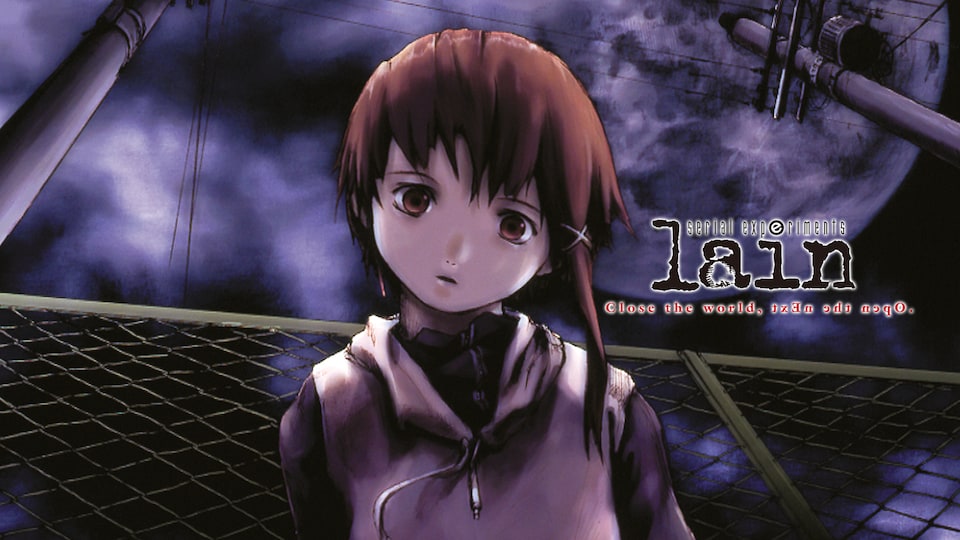
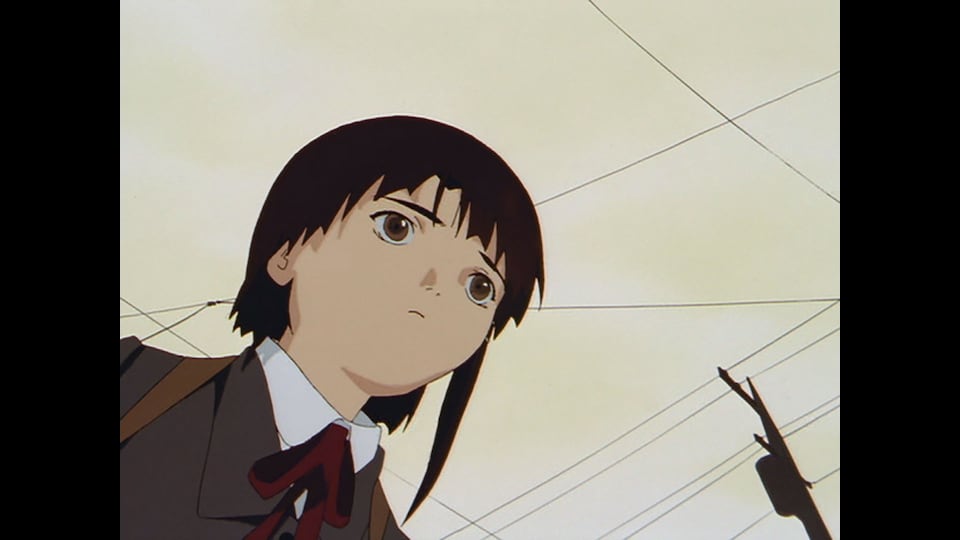
The licensed promotional image places Lain before a mesh barrier, with utility structures and wires above her against a dark violet sky. The opening-layer reference below shows her in school uniform, framed from a low viewpoint beneath pale sky, cables and a utility pole. They are different original compositions, not two versions of a generated character portrait.
Our interpretation begins with how the environment surrounds the face. In the promotion, the mesh visibly divides space and the darker palette intensifies separation. In the episode reference, thin lines cross an apparently ordinary sky while Lain's gaze points away from the viewer. Those observations are visible in the inspected images; they do not establish the surrounding scene's complete sound or what she is thinking.
The comparison introduces a question about network presence that does not require an explanatory computer screen. Can connections become part of the atmosphere through everyday infrastructure and framing? The image supplies a starting observation, while a later sequence-based analysis would need to examine duration and audio before claiming precisely how the episode makes the environment feel intrusive.
Original visual reference
Connection can promise reassurance while changing the terms of belonging
The official setting page describes NAVI devices as ordinary tools of communication, linking friends through messages, rumors and shared information. Our reading asks how an apparently practical means of belonging can also become a condition for it. A person may feel reassured by being reachable while discovering that relationships increasingly depend on what circulates through the network.
That tension is more specific than a general prediction that technology is dangerous. The communication system is woven into everyday habits, not only used by an exceptional antagonist. Follow what someone gains by connecting and what they lose by remaining disconnected. The same channel can support intimacy, gossip and an account of a person that the person did not choose.
The opening reference's utility lines give a physical counterpart to this social question. Wires are recognizable surroundings, yet the composition can make them unusually prominent. That is our interpretation of the image's emphasis, not proof that every cable represents the same fictional system. The chosen layers provide the actual narrative context in which ordinary connection becomes uncertain.
An online account of a person need not feel like that person’s own experience
The licensed premise describes a girl whose appearance resembles Lain while her behavior differs, within a story where boundaries between network and physical life begin to fail. Our analysis asks who gets to define a person's identity when reported actions and private experience no longer align. A recognizable face alone may not settle whether an account feels true to its subject.
The official character introduction also presents Lain's difficulty fitting into ordinary peer activity. That supplies a useful personal scale for the larger network question. An externally familiar identity can seem stable to classmates while feeling unstable to the person carrying it. Watch how information about Lain reaches her, and whether she can control the interpretation attached to it.
The guide leaves the later explanation of the multiple appearances undisclosed. It also avoids diagnosing the character from a promotional face or reducing the story to a real-world medical label. The worthwhile first-view distinction is between an event, a report about an event and an explanation someone offers. Keeping those separate preserves the story's investigation rather than preempting it with a single answer.
Nakamura, Konaka and Abe are distinct creative routes into Lain
The official production record names Ryutaro Nakamura as director, Chiaki J. Konaka for the screenplay and Yoshitoshi Abe for original character design, alongside Triangle Staff's animation. These are complementary credits. A visitor drawn to the figure's design can follow a different creative contribution from someone interested in the story's organization or the moving sequence's direction.
The historical music record credits Reichi CHABO Nakaido and identifies Bôa's Duvet within the Cyberia Mix release. Those named records are useful music-discovery links after viewing, not instructions to play an unofficial upload or add a persistent music feature to the page. A soundtrack product remains separate from the anime's narrative route.
Sound is a particularly useful next question for the wire-and-sky reference. The still lets us examine lines, gaze and negative space, but it cannot demonstrate a hum, silence or musical cue. A detailed future essay should identify the actual layer and sequence before arguing that a sound makes an ordinary setting feel oppressive. Creator credits identify people to follow; they do not substitute for hearing the scene.
Confusion is a viewing response, not evidence that every interpretation is equal
The displayed AniList figure belongs to the thirteen-layer television entry. It does not pool games, soundtrack products or art books into a franchise average. The number can indicate response to that named production, but it cannot establish that every viewer understood or enjoyed its uncertainty in the same way. We have not added local votes or presented the figure as our own critical grade.
The linked 2026 first-time viewer discussion includes an individual reader expressing strong interest alongside confusion, and another describing difficulty continuing through an earlier viewing. Those are personal responses rather than a representative survey. They suggest a practical approach: notice the questions a layer creates, then see whether later layers answer, redirect or intensify them before seeking an unrestricted final explanation.
The independent Lain encyclopedia and subreddit are optional deeper navigation. The licensed catalog also offers a named critical perspective by Ryusuke Hikawa on everyday computer life and creeping unease. These are invitations to compare readings after the story, not primary proof for an episode order. Different interpretations should still name the images, dialogue or sequence that supports them.
The original archive is a source register, not a current shopping cart
The official website preserves old broadcast information and prices for video and music products. Those records are useful for identifying what an edition was, but they do not establish present inventory or a live broadcast schedule. For a current purchase or stream, confirm the authorized distributor's territory, named production, thirteen-layer coverage and language options.
No audited production budget, profit total or current rights valuation was verified for Lain. A long-lived online community, catalog score and recognizable music do not provide the figures needed to calculate financial success. The reader's useful commercial comparison is whether an actual edition supplies the intended animation and accurately names its supplementary material.
Finish the thirteen layers, then return to the official character and setting pages or the selected discussion if you want to compare explanations. Explore credited creators and the named soundtrack as separate discovery paths. RahXephon offers another production about uncertain perceptions and a changing relationship to an apparently familiar environment, outside Lain continuity.
Primary sources and useful navigation
- Bandai Channel · licensed premise, imagery and named critical perspective
- NBCUniversal · original official character introduction
- NBCUniversal · network society setting
- NBCUniversal · official production credits
- NBCUniversal · historical layer contents and music records
- AniList · named anime audience score
Community and catalog routes
- MyAnimeList · named anime catalog
- Lain Wiki · independent encyclopedia, spoilers possible
- Reddit · 2026 first-time viewer discussion, spoilers
- Reddit · Lain community
The production and publisher links support project facts. Catalog and community pages are secondary navigation and may reveal later events.
Explore related story guides
Original series imagery is reproduced under permission asserted by the site owner; the source and rights credits are retained. The route diagram is Animeteor’s own explanatory graphic.