Watch the complete 13 episodes in order. The Haibane of Old Home is credited source background, not a verified post-anime continuation.
Reviewed 3 October 2026 · Opening premise and adaptation relationships. Major endings withheld; linked catalog summaries and discussions may contain spoilers. · Licensed access varies by country.
The source and screen branches

The credited source concept is optional background, not a certified continuation. Lain and Texhnolyze are separate productions.
- WATCH · 2002 television anime: Episode 1 · meet Rakka → Episodes 2–12 · discover the community → Episode 13 · complete television story
Watch the 13-episode anime in its numbered order
Begin Haibane Renmei with episode 1 and follow the complete 13-episode television sequence. The opening introduces Rakka into a community whose customs she must learn alongside the viewer. There is no required sequel film in this route and no verified post-finale novel chapter to select. The television story is the practical first encounter recommended here.
The official credits name Yoshitoshi ABe’s The Haibane of Old Home as the original concept and also credit ABe for the anime’s screenplay and series composition. That source connection deserves recognition. It does not justify selling the short source work as a complete, long-running manga continuation or telling an anime viewer to resume at an invented volume number.
Keep the official dictionary and full-series discussion for later if you want to discover the setting with Rakka. They are helpful reference tools, but character pages can reveal information before the anime introduces it. A simple route protects the encounter: watch first, then choose whether to investigate production, compare interpretations or seek the separately named source material.
| Material | Role | First-viewing advice |
|---|---|---|
| 2002 television anime | 13-episode complete viewing route | Episodes 1–13 in order |
| The Haibane of Old Home | ABe’s credited original concept/source work | Optional background; no certified handoff |
| Official Haibane dictionary | Setting and character reference | Use cautiously; later information possible |
| Lain / Texhnolyze | Separate works with creative connections | Comparisons, not required chronology |
Credit the original concept without promising another ending
A source/adaptation guide should explain the relationship it can establish. In this case, the official staff record explicitly connects ABe to both the original concept and the anime’s writing. Our core map follows the complete television sequence, while the source is identified in the comparison table as optional background. It is not drawn as episode 14 in another medium.
That choice is particularly useful for an older, relatively short work. A viewer may encounter illustrations, a source booklet, soundtrack packaging and a television box bearing similar imagery. Their shared design language does not mean that every item supplies a missing plot segment. Ask whether an item is a story, a reference publication or an edition of material already watched.
No exact reading endpoint or English source-book availability is certified in this guide. If exploring the source, use its full title and creator rather than a generic manga search. For watching, verify that the selected edition includes the complete 13 episodes and suitable subtitles in your territory. The number on a disc box is packaging information, not automatically an episode count.
Visual case: an unfamiliar halo becomes a shared practical task
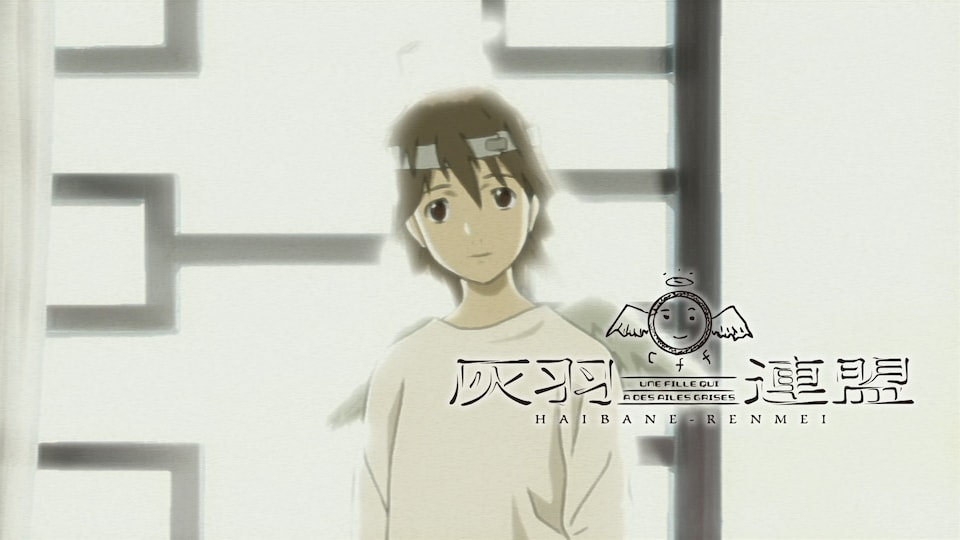
The licensed lead image places Rakka against a pale, geometric interior. Her gray wings and improvised-looking hair arrangement make the supernatural detail sit beside ordinary bodily awkwardness. Our reading is that the image invites attention to a person who is still learning how to inhabit her new condition, rather than displaying a finished, effortless angelic identity.
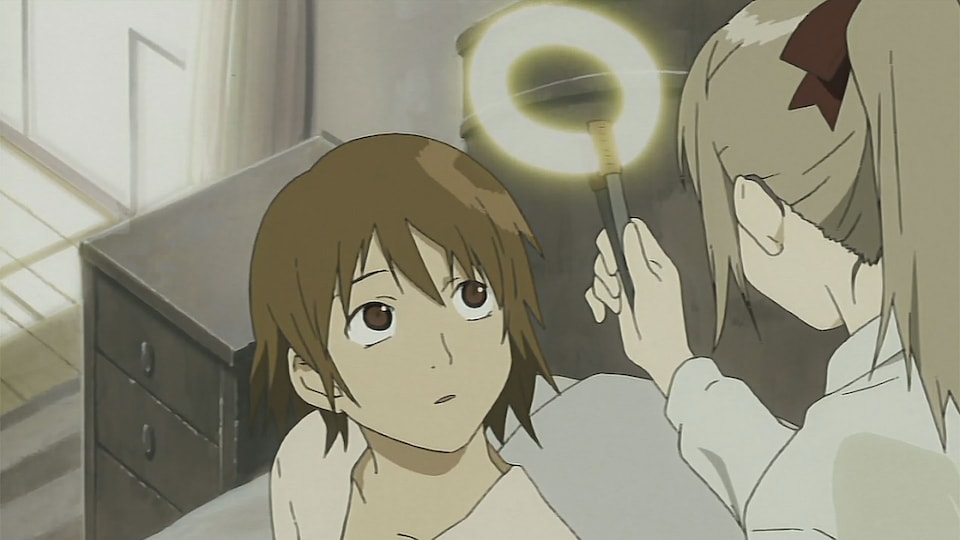
The original first-episode reference below shows another girl holding a luminous halo near Rakka’s head. The framing turns a magical object into something handled at close range by two people. It supports a bounded observation about care and orientation: the newcomer’s unusual situation becomes a task that somebody else can help her navigate.
This still does not establish the dialogue, sound, duration or complete emotional progression of the scene. We also avoid treating the halo as proof of a single religious explanation for the whole series. Compare where each girl looks, how close their bodies are and how the brightness changes the otherwise muted room. Those visible details keep interpretation anchored to the reference.
Original visual reference
A shelter can be both welcoming and unfinished
The official Old Home entry describes a disused building resembling a school or dormitory at the edge of town. It is one of several places where Haibane live. Our analytical interest lies in that combination of refuge and prior abandonment: a place somebody else no longer uses becomes the setting in which newcomers learn how to belong.
The official Haibane entry describes beings born from cocoons who receive halos and develop gray wings, living within the walled town of Glie. These details establish the premise without settling its metaphysics. A viewer can watch the practical routines of the community before deciding what the walls or wings might symbolize. Several meanings can be explored without turning one into a sourced fact.
Rakka’s character entry presents her as quiet and gradually adapting while others protect her. Our reading asks where protection becomes reciprocal: when does accepting help also require noticing another person’s needs? That is a stronger discussion question than asking only whether the town is idyllic or sinister. Ordinary work and conversation can carry emotional development without a sequence of battles.
ABe’s writing and the production team shape different parts of the encounter
The official archive credits Tomokazu Tokoro as director, Yoshitoshi ABe for screenplay and series composition, Akira Takata for character design, and RADIX for production. It also names Ko Otani for music. These credits distinguish the source concept, animated character construction, direction and musical contribution instead of placing every decision under one creator’s name.
The illustrated imagery is a useful starting point for thinking about that collaboration. A character can look fragile without the story declaring them helpless; a softened palette can make a room feel sheltered while leaving its rules unexplained. Those are our interpretive questions for viewing, not statements taken from an interview or claims about what a particular staff member intended.
Compare with Lain or Texhnolyze only after respecting each production’s separate authorship. ABe’s involvement does not make the three series chapters of one narrative. The comparison becomes more interesting when it follows a precise question—how an unfamiliar social environment is introduced, for example—rather than treating all quiet or unsettling images as the same artistic message.
Warmth and uncertainty can coexist in the same response
The linked April 2025 Reddit thread was started by a viewer who watched Texhnolyze before Haibane Renmei and found the latter gentler while still philosophically engaging. Another participant described difficulty enjoying Texhnolyze. These are individual reactions in a small discussion. They help explain why a creator-based recommendation can produce very different experiences without establishing a consensus.
Our recommendation is to avoid promising either uninterrupted comfort or constant horror. Observe how the show makes daily life legible while leaving larger questions open. If you find an episode affecting, ask whether that response came from a practical act of care, an unexplained rule or a character’s hesitation. This separates an emotional observation from an all-purpose explanation of the setting.
The external score displayed here is AniList’s named 2002 television entry, observed on the review date and normalized from 100 to 10. It does not average Haibane with other ABe-associated works or represent our own vote. Spoiler discussions can be useful after episode 13, when different interpretations no longer have to become instructions for a first viewing.
A Blu-ray promotion is evidence of an edition, not a new season
The official homepage promotes a Blu-ray box and links a promotional video. That identifies an edition and a way the work has been presented to collectors. It does not, by itself, announce a new television installment, guarantee current stock or establish distribution in every English-speaking market. The age and territory of a product record remain part of its meaning.
For a purchase decision, compare actual episode coverage, subtitles, region compatibility and included materials. A visitor interested in the visual art may value a booklet differently from somebody simply seeking a complete legal viewing route. Neither preference requires a claim that an expensive edition changes the canon or includes a sequel that the series otherwise withholds.
The verified sources do not provide an audited budget or profit statement. An audience score and a collector edition cannot fill that gap. The defensible commercial account is limited to identifiable licensed viewing and home-video presentation. Any later reissue, streaming change or adaptation announcement can update this section once its exact product, date and territory are documented.
Let the television story establish its own emotional questions
Watch episodes 1–13 in order and delay full character summaries if you prefer to encounter Rakka’s uncertainty directly. The viewing map deliberately remains compact. It removes the worry that an unfamiliar title must have several hidden seasons while giving the story room to introduce its own rules and emotional relationships.
After the finale, return to the official dictionary for specific names and setting terms, then compare the linked audience discussion with your own observations. Mark the difference between a visible detail, an official premise description and a metaphor you find persuasive. That makes discussion more useful than insisting every unanswered question must have one authoritative online solution.
Our Lain guide offers another route into identity and communication, and Texhnolyze offers a harsher examination of institutional dependence. Choose them because a question interests you, not because Haibane Renmei needs them to become complete. The source concept remains a separately identified optional exploration rather than a promised continuation beyond the television ending.
Primary sources and useful navigation
- Official Haibane Renmei archive
- Official source and staff credits
- Official Haibane setting entry
- Official Old Home entry
- Official Rakka character entry
- Licensed Bandai Channel catalog and original imagery
- AniList · named anime audience score
Community and catalog routes
- MyAnimeList · named anime catalog
- Wikipedia · source/background navigation; spoilers
- Reddit · selected 2025 viewer discussion; spoilers
The production and publisher links support project facts. Catalog and community pages are secondary navigation and may reveal later events.
Explore related story guides
Original series imagery is reproduced under permission asserted by the site owner; the source and rights credits are retained. The route diagram is Animeteor’s own explanatory graphic.