Start the 24-episode 2003 television series or Sakaki’s first novel. Yabuki and Sogabe’s comics are separately named editions; no exact prose handoff is certified.
Reviewed 2 October 2026 · Opening premise and format relationships; major ending revelations withheld. Linked publisher summaries and discussions may reveal later events. · Licensed access varies by country.
The source and screen branches

The source and screen are related presentations. Comic entries are different editions, not consecutive volumes of one comic. Start each selected route at its beginning.
- READ · prose: First source novel → Continue named novel editions
- WATCH · television: 2003 BONES adaptation · 24-episode screen route
- READ · manga: Yabuki · Escapees’ Concerto ≠ Sogabe · later comic edition
Begin with Pacifica’s television journey or the source novel
Scrapped Princess offers a straightforward screen entry: the twenty-four-episode 2003 television series produced by BONES. For prose, begin Ichiro Sakaki’s first novel rather than treating the anime’s final episode as a precise chapter marker. These are related presentations of a threatened young woman’s journey, not interchangeable page counts.
The official studio introduction identifies Pacifica as a girl condemned by a prophecy about her sixteenth birthday. Her adoptive siblings Shannon and Raquel accompany her. That opening situation supplies enough context to choose the work without exposing the explanations that change how the setting is understood later.
Manga editions need a separate label. Dragon Age catalogs Go Yabuki’s Escapees’ Concerto, while KADOKAWA identifies Toshinori Sogabe’s later Scrapped Princess comic. Start the selected comic at its own first volume; do not assume that a shared title means its panels can replace a missing television season.
Two comics and a digital reissue are different publishing records
KADOKAWA’s first-novel record distinguishes its 1999 paper release from the later electronic edition. The electronic date belongs to a product becoming available in that format. It does not signal that Pacifica’s adventure was first written then, or that the text is an anime sequel.
The 2002 Dragon Age comic credits Yabuki for the manga, Sakaki for the original and Yukinobu Azumi for the original design contribution. The later publisher entry names Sogabe. Keeping those creator labels beside a purchase or library search is more useful than describing every associated book simply as the manga.
This guide verifies those edition identities and the television entry. It does not publish an exact anime-to-novel handoff or a claim that every comic has identical coverage. Readers who want the source’s full development should begin the prose route, then compare an adaptation as a distinct interpretation.
A protective group challenges the label placed on one girl
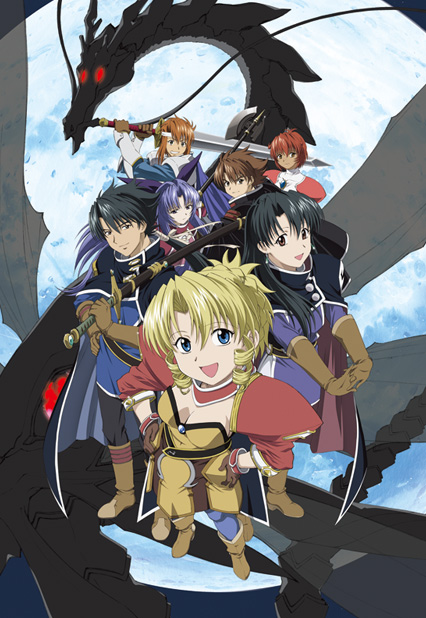
BONES’ original promotional artwork places Pacifica with her companions inside a fantasy setting. The official introduction makes their relationship practical: Shannon and Raquel protect her while people pursue the supposedly dangerous princess. The image is a visual reference for that premise, not a verified still from a named episode.
Our reading starts with a mismatch between public description and intimate knowledge. To the pursuers she is a category, a future catastrophe. To the people accompanying her she is a particular person who must eat, move and survive today. Protection becomes a refusal to let an abstract label settle every question about her.
The companion original comic cover is credited to its named edition. Its different character presentation invites comparison of how an opening is framed, without proving that a specific event occurs identically in both versions. This case stays before the story’s major revelations and avoids explaining the mechanism behind the prophecy.
Original visual reference

A predicted danger can become a permission structure
Our interpretation asks what a prophecy allows other people to do. The frightening prediction matters, but so does the institution that distributes it and the public willingness to accept its authority. Violence can appear responsible when a target has already been defined as a future threat.
That creates a useful distinction between evidence and authorization. Does a pursuer learn anything new about Pacifica, or simply receive permission to act against her? Is the proposed response tested against her conduct, or justified by repeating the same prediction? Those questions reveal how certainty can circulate without adding knowledge.
The point is not that every believer is personally identical. A frightened individual and a powerful authority can use the same story for different reasons. A careful review should examine their choices separately. The opening premise establishes the conflict; detailed judgments about later institutions require evidence from the relevant scenes.
Being someone’s sibling makes the threat concrete
Shannon and Raquel’s protective position gives the journey an immediate emotional scale. Our reading treats family as an everyday practice rather than a label that guarantees agreement. Somebody must decide when to travel, how to respond to danger and whether protecting a person includes listening to what she wants.
A guardian may know more about immediate risk while still failing to understand the experience of being guarded. Watch for moments when practical protection and Pacifica’s own agency point in different directions. A decision made for her can be loving and restrictive at the same time, depending on the circumstances.
That tension is more interesting than dividing all choices into selfishness and sacrifice. Shared life includes fatigue, negotiation and uneven responsibility. The guide does not claim a specific late resolution for these relationships; it offers a way to follow how the opening group responds to pressure without spoiling what they discover.
A journey tests whose account of the world remains usable
Our interpretation of the travel structure asks how a new place changes what the companions can trust. A road story can make knowledge provisional: an explanation that seemed sufficient in one settlement may fail in the next. Movement is therefore an intellectual problem as well as a physical one.
Track the difference between what the characters have witnessed and what somebody tells them is universally true. They may need to act before they can reconcile the two. That is where the prophecy’s certainty and the journey’s uncertainty come into direct conflict, without requiring this introduction to reveal the setting’s deeper architecture.
The prose and screen routes can allocate attention differently to that uncertainty. A novel can stay with hesitation, while a television sequence can place an unfamiliar landscape or reaction before the audience. This is a comparison framework, not a measured claim about a particular passage’s adaptation until both versions are checked.
Match the score and credits to the version you chose
BONES identifies the original novelist and illustrator alongside television director Soichi Masui and the adaptation’s staff. Publisher records supply the separate manga authors. These roles should stay attached to their actual products rather than merge into a fictional single creator credit.
The AniList audience score displayed here is for the 2003 television series, observed on 2 October 2026. It does not rate the novels or either comic. Its ten-point display is a scale conversion of the provider’s weighted score, not an Animeteor review and not a vote collected on this site.
The linked anime rewatch discussion is a place to compare personal responses after choosing a version. Individual comments can help a reader think about tone or pacing, but they cannot verify a chapter handoff. Wikipedia and MyAnimeList are navigation aids; the studio and publisher records support the production facts.
Publication longevity does not reveal a production profit
The catalog records show a property expressed through prose, television and more than one comic edition. That is evidence of associated products. It does not disclose how much each earned, what the animation cost or whether a particular reissue performed well in a given territory.
No audited title-level net profit or complete animation budget was verified for this guide. An old cover’s availability also does not guarantee that an English translation is currently licensed or stocked. Check the named publisher, language and seller before interpreting a catalog page as a current access offer.
Choose the television series for the screen journey or the first source novel for prose, then explore one clearly identified comic. The route can be expanded with edition-specific coverage later. Any future game or live-action feature belongs in a separate adaptation section, outside these reading and viewing branches.
Primary sources and useful navigation
- BONES · television production and opening premise
- KADOKAWA · first source novel
- Dragon Age · Go Yabuki comic volume one
- KADOKAWA · Toshinori Sogabe comic
- AniList · named adaptation audience score
Community and catalog routes
- MyAnimeList · named adaptation catalog
- Reddit · Scrapped Princess rewatch entry
- Wikipedia · secondary franchise navigation
The production and publisher links support project facts. Catalog and community pages are secondary navigation and may reveal later events.
Explore related story guides
Original series imagery is reproduced under permission asserted by the site owner; the source and rights credits are retained. The route diagram is Animeteor’s own explanatory graphic.
A tabletop role-playing book is a separate product
The 2003 Scrapped Princess RPG is a Dragon Book tabletop rulebook using Sword World’s 2d6 system. It does not become another numbered novel or a console sequel.