Start the 26-episode television series at episode 1. The film is a separate presentation; Momose’s manga and Onogi’s prose begin independently at volume 1.
Reviewed 3 October 2026 · Opening premise and adaptation relationships. Major endings withheld; linked catalog summaries and discussions may contain spoilers. · Licensed access varies by country.
The source and screen branches

The film is not television episode 27. The manga has a distinct opening presentation; no exact after-anime chapter handoff is certified.
- WATCH · original television: 2002 TV · episode 1 → Continue through episode 26
- WATCH · film comparison: Pluralitas Concentio · 2003 → Begin the film’s own presentation
- READ · Momose manga: Volume 1 → Continue through volume 3
- READ · Onogi prose: Named volume 1 → Follow the prose book sequence
Start with television, then choose a film variation or a reading route
RahXephon begins with the 26-episode 2002 television production associated with BONES and Yutaka Izubuchi. The licensed opening premise follows Ayato Kamina, a Tokyo student whose ordinary trip toward an examination is interrupted by an aerial attack and a mysterious encounter. Begin at episode one rather than treating a later explanation of the world's rules as required preparation.
Pluralitas Concentio is the separately titled 2003 theatrical presentation. Its official FlyingDog record identifies Tomoki Kyoda as director and Izubuchi as executive director, distinguishing that production's creative roles from the television entry. Watch it as a later comparison or a deliberately selected film route, not as television episode 27.
The three-volume comic by Takeaki Momose and Hiroshi Onogi's named prose books offer reading routes beginning with their own first volumes. The site map separates those presentations. Familiar names and a shared machine do not certify that the manga's first chapter occurs after the television finale or that a reader should skip the book's introduction.
The comic’s opening makes the medium distinction concrete
Shogakukan credits BONES, Izubuchi and Momose in its manga record and identifies the series as complete in three volumes. The first book's description introduces Ayato and Reika as classmates with an established personal connection before the attack. That is a more useful comparison point than assuming every detail of the television introduction is repeated unchanged.
KADOKAWA identifies Onogi as author of the first MF Bunko J RahXephon volume, with its record dated July 25, 2002. Begin the named prose version there and follow its book numbering. The publication record establishes a reading edition; it does not prove an official English translation is currently available or supply a post-animation chapter jump.
For viewing products, distinguish the television episodes from Pluralitas Concentio and inspect the actual language and contents. The film's separate soundtrack is another edition-specific record, not proof that a package contains the television animation. Optional extras should be named by the distributor before being inserted into the route; this guide does not invent a mandatory interleave for unverified bonus material.
| Presentation | Start | Do not assume |
|---|---|---|
| 2002 television | Episode 1 → 26 | Every later release is episode 27 |
| Pluralitas Concentio | Beginning of the named 2003 film | A direct post-TV sequel |
| Momose manga | Volume 1 → 3 | Identical introductory relationships |
| Onogi prose | Named volume 1 | A certified after-anime chapter continuation |
The manga cover and an opening image introduce different visual relationships
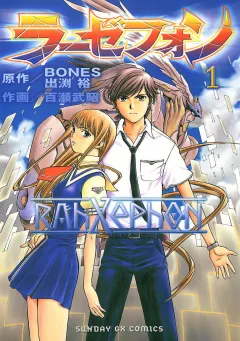
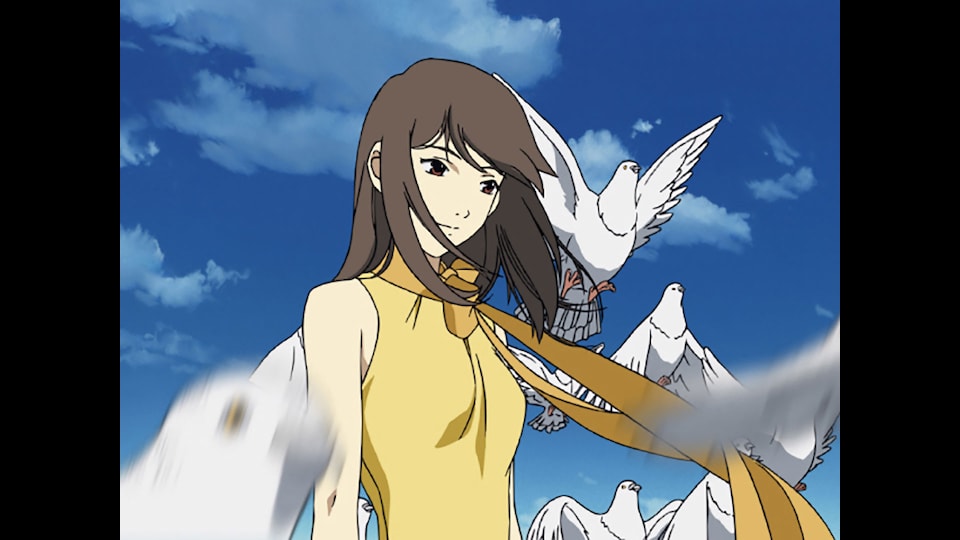
The lead image is Shogakukan's original first-volume manga cover. It places a white-shirted boy and a girl in blue and red clothing against a large mechanical figure and bright title design. The anime reference below shows a yellow-clothed girl with white birds against a blue sky. These are deliberately different original assets and different media, not two crops of the same scene.
Our interpretation follows proximity and movement cues. The cover groups people with a large mechanical presence, making their connection visually immediate. The anime image distributes birds across the foreground and sky, with hair and clothing appearing drawn into the same airy environment. A static image can show these compositional cues without proving the complete action, sound or meaning of the scene.
The comparison encourages a first-view question about what attracts Ayato's attention before he understands the surrounding crisis. An image can be calm or inviting even when its context is uncertain. We do not use the birds as proof of a hidden identity or an ending revelation; the visual reference introduces the atmosphere of uncertainty while the selected route supplies its own later explanation.
Original visual reference
A disrupted journey makes an ordinary city suddenly unreadable
The licensed television premise begins with a student traveling toward an exam and encountering an attack. Our reading asks how a familiar city becomes difficult to interpret when routine collapses. The protagonist does not begin with the viewer's later encyclopedia of factions and rules; his initial decisions are shaped by partial information and immediate danger.
That makes the order of discovery significant. An explanation can stabilize a confusing image, but an early explanation can also remove the uncertainty through which the animation introduces the world. Begin the television story before opening a complete timeline or character history if you want to experience how recognition and knowledge develop together.
The manga record offers a concrete medium comparison at the opening rather than only at the finale. Its description of Ayato and Reika's existing connection changes the starting information a reader receives. Whether that difference affects a particular later scene requires the actual pages and episodes; the publisher's premise supports the introductory distinction, not a blanket claim that the manga is simpler or more faithful.
A barrier around Tokyo makes separation spatial before it becomes personal
The licensed film premise describes Tokyo enclosed by a Jupiter-like barrier and isolated from the outside world. Our interpretation treats that visible boundary as a way of making separation understandable before all of its temporal and personal consequences are known. Being inside a familiar place does not necessarily mean sharing the same frame of reference as someone outside it.
A viewer can follow who is offering Ayato a way out and what assumptions accompany that offer. Movement across a boundary may promise clarity while also requiring trust in a person whose knowledge is greater than his. The guide keeps that question open rather than revealing the ultimate relationship between the central characters.
The blue-sky and birds reference provides a contrasting sense of openness, but it should not be mistaken for documentary proof that every pictured space is unrestricted. Its visual invitation and the premise's enclosure can coexist as analytical questions. Follow how a selected presentation links place, memory and relationship, without substituting an explanatory wiki diagram for the dramatic order in which it makes those links.
Design and music provide useful connections beyond a genre resemblance
FlyingDog's official film credits name Izubuchi and BONES for the original work, Akihiro Yamada for character design, Ichiko Hashimoto for music and Kyoda for direction. Its introduction connects Izubuchi's earlier work to Patlabor's mechanical design and Record of Lodoss War illustration. Those are verified creative bridges through craft, not a shared fictional universe.
The film soundtrack record identifies newly recorded Hashimoto music and Maaya Sakamoto's theme song tune the rainbow, with Yoko Kanno's composition credited in the film introduction. A reader arriving through music therefore has a concrete official route into the project. The track list may contain later-scene titles, so a first-time viewer can explore it after the chosen presentation.
Sound is especially relevant to a story organized around musical language, but the silent reference image cannot establish how a cue functions. A later scene essay should name the actual sequence and distinguish score, dialogue and visual framing. Our entry guide identifies the contributors and an analytical question rather than claiming an unheard soundtrack proves a particular character's motive.
Use the television score alongside a named critical perspective
The displayed AniList audience figure belongs to the 26-episode television entry. It does not pool the film, three-volume manga and prose books into one score. That scope matters for someone seeking the film's concentrated presentation or reading Momose's different introduction. Animeteor has not added its own local voting system or relabeled the external figure as an editorial grade.
The licensed television page includes Ryusuke Hikawa's critical perspective, which emphasizes the arrangement and balance of the production's creative contributions. We present that as one named critical lens, not a summary of all viewers. Our own opening-image reading focuses on uncertainty and visual invitation; readers can compare the two approaches after encountering the work.
The optional franchise encyclopedia and mecha community links provide deeper navigation and edition discussion. Complete character histories can reveal the relationship that a first viewing is still trying to understand. Use the format table and primary records for the initial route, then return for discussion of particular scenes with the production and spoiler scope clearly named.
The linked August 2024 Anime of the Week discussion contains individual reactions ranging from disappointment with comparisons to Evangelion to appreciation of the soundtrack. Those contrasting views are not a representative audience survey. They suggest separate questions about genre expectations and musical attachment, which readers can examine within RahXephon’s own presentation.
Three complete manga volumes do not guarantee a complete animation package
The publisher's complete three-volume manga record establishes the scope of that reading series. It says nothing about the contents of a television box or movie disc offered by another distributor. Compare the actual production, episode or film contents, language options, region and advertised restoration specifications before treating a product's use of complete as universal.
No audited RahXephon production budget or net-profit figure was verified here. A soundtrack catalog, a historical book publication and a strong response from one critic establish products and perspectives, not a financial total. The useful commercial comparison for a reader is what the specific edition includes and whether its language and format fit the route being chosen.
Begin television episode one, finish that production and choose Pluralitas Concentio for a later film comparison. Start Momose's manga or Onogi's prose from the first volume for their own presentations. Patlabor supplies an earlier verified Izubuchi design connection, while Macross Plus offers another story where music and technology matter outside RahXephon continuity.
Primary sources and useful navigation
- Bandai Channel · original television premise, imagery and named critic
- Shogakukan · Momose first-volume manga and complete three-volume scope
- KADOKAWA · Onogi first prose volume
- Bandai Channel · separate film presentation
- FlyingDog · official film credits and creator connections
- FlyingDog · film soundtrack and named music
- AniList · named anime audience score
Community and catalog routes
- MyAnimeList · named anime catalog
- RahXephon Wiki · franchise navigation, spoilers possible
- Reddit · 2024 Anime of the Week discussion, spoilers
- Reddit · mecha discussion
The production and publisher links support project facts. Catalog and community pages are secondary navigation and may reveal later events.
Explore related story guides
Original series imagery is reproduced under permission asserted by the site owner; the source and rights credits are retained. The route diagram is Animeteor’s own explanatory graphic.