Start the four-part OVA at installment 1 or choose Movie Edition as an alternative presentation. TAC Name is a later comic adaptation, not a post-OVA sequel.
Reviewed 3 October 2026 · Opening premise and adaptation relationships. Major endings withheld; linked catalog summaries and discussions may contain spoilers. · Licensed access varies by country.

The source and screen branches

OVA and Movie Edition are alternative presentations with documented reconstruction differences. TAC Name adapts the OVA; no exact post-anime chapter handoff is certified.
- WATCH · original OVA: OVA installment 1 → Installments 2–4
- WATCH · film reconstruction: Movie Edition · beginning → Complete the film’s own presentation
- READ · later comic adaptation: TAC Name · U.G.E. volume 1 → Follow the comic’s own sequence
Choose the four-part OVA or the separate Movie Edition
Macross Plus is the 1994 original-video production identified by the official franchise catalog as four installments. Begin with the first installment and continue through the fourth for that route. Its pilot rivalry and virtual-idol premise make it a more compact discovery than the original Macross television run, while retaining a distinct project identity.
Movie Edition is a separate film presentation. The franchise’s official description identifies re-edited OVA material, added footage and a different last scene. Do not append it as installment five or assume that watching the OVA automatically means every part of the film has been seen. The differences are worth a later comparison without disclosing the outcome here.
This guide recommends the OVA sequence first when you want its serialized development, then the film if you want to examine the reconstruction. A visitor with time for one film can choose that named presentation instead. Neither choice requires completing every other Macross production first, although the original television guide offers useful broader franchise context.
TAC Name is an adaptation of the OVA, not its original source
KADOKAWA’s Web Ace listing identifies Macross Plus: TAC Name volume one, credits U.G.E. as author and Big West for the original work, and explicitly describes a comic adaptation of the OVA. Begin the comic at its first volume. The presence of manga does not mean the 1994 animation was adapted from that later book.
For a purchase, distinguish the OVA set, Movie Edition and TAC Name manga by their actual contents and language. A poster shared in a store’s search results cannot establish which presentation is included. The Japanese publisher record proves a named comic release; it does not establish an official English translation or a current complete collector set.
A remaster or Ultra HD disc is an edition of the presentation named on that product. The official series page lists later Movie Edition release and screening notices, which should be read with their dates. An old screening announcement is not a current showtime calendar, and a new restoration is not automatically a new narrative sequel.
| Presentation | Start | What to avoid |
|---|---|---|
| 1994 OVA | Installment 1 → 4 | Treating the movie as part 5 |
| Movie Edition | Beginning of the film | Assuming identical final presentation |
| TAC Name manga | U.G.E. volume 1 | Calling it the OVA’s original source |
| Later restoration/disc | Check named presentation and specs | Reporting an edition as a sequel |
The opening reunion puts confrontation ahead of an aircraft diagram
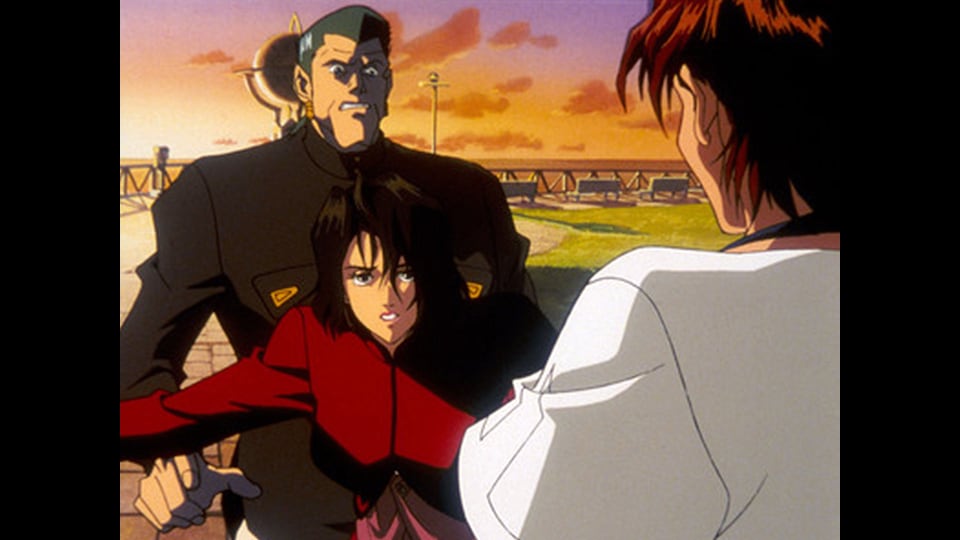
The licensed opening-installment reference below frames a red-clothed figure facing a person in white whose back occupies the foreground, with another figure standing behind. The sunset setting gives the confrontation a different visual emphasis from the official promotional artwork, which encloses a pilot within detailed cockpit machinery.
Our interpretation starts with the distribution of faces and viewpoints. Two faces are visible to the audience while the nearer person partially blocks the scene. That arrangement can make a reunion feel unequal or tense before a reader knows its history. The still supports this observation about framing; it cannot establish all the characters’ motives or summarize the full encounter.
The cockpit poster offers a contrasting introduction: a person appears integrated with a technological environment. Placing the promotional image and the opening reference alongside the discussion makes the mechanical and interpersonal invitations equally concrete. They are different original assets with named sources, not two generated illustrations pretending to document scenes.
Original visual reference
A test program can make a personal rivalry institutionally useful
Bandai Channel’s premise places Isamu as a YF-19 test pilot on Eden and Guld as a rival testing the YF-21. Their machines are competing for formal adoption. Our reading asks how that institutional competition gives personal friction a stage, a measure of success and a reason to escalate.
A pilot’s claim about superior performance can therefore carry more than an engineering argument. Ask whether a demonstration is serving the test program, an audience or a need to defeat another person. The same maneuver may be evaluated differently by those perspectives. This analytical question does not require knowing which aircraft or pilot ultimately wins.
For a later close comparison, identify how a particular sequence frames the observers, the cockpit and the rival’s reaction. Technical spectacle can communicate precision while interpersonal editing communicates provocation. The opening reunion image supplies a small starting observation about uneven viewpoints; the full flight scenes would be needed to establish a specific claim about that competition.
A virtual idol raises questions about who shapes a performance
The official franchise page introduces Sharon Apple as a virtual-idol figure and explains that appearance and voice can change in response to music and fans. Our interpretation asks how a performance’s apparent personality is shaped by systems and by the audience that consumes it. That is a more precise starting question than labeling every synthetic performer simply unreal.
A virtual image can become emotionally important to real listeners. The useful analysis concerns the relationship among the performer’s presentation, the people behind it and the audience’s expectations. A familiar song or convincing image does not automatically tell a viewer who controls the experience. Follow that uncertainty in the story rather than resolving it through a contemporary technology analogy alone.
The guide keeps that discussion at premise level. It does not disclose Sharon’s later actions or the project’s final confrontation. A future spoiler-marked essay can compare the OVA and Movie Edition by naming a performance sequence and its actual framing. The public route map instead preserves the distinction between two presentations so that readers can discover those differences themselves.
The music is part of the project’s identity, not background metadata
The official Macross Plus page highlights Yoko Kanno’s first franchise participation and places her music beside the mechanical animation as a defining feature. That creator credit offers a useful discovery route for a listener who arrives through a soundtrack, while the production remains a named animated project with its own first installment.
The AniList record identifies Triangle Staff for this OVA entry. The manga publisher separately names U.G.E. and Big West. Keeping these credits distinct prevents a database’s studio field from replacing the individual music and comic contributions that a reader actually wants to explore. A related creator credit is a connection through craft, not a shared-canon bridge to an unrelated work.
For a first viewing, allow the music to function within the scene before searching for a playlist of later performances. A soundtrack listing can reveal song names and images that belong to a later moment. After the chosen route, official music and franchise channels become useful next navigation, with availability and track editions checked independently.
Version preference should not be hidden inside one combined score
The displayed AniList audience score names the four-part 1994 OVA entry. It does not combine Movie Edition and TAC Name into a franchise average. That distinction matters here because a viewer’s preference for serialized development or a reconstructed film can differ even when both are recognizably Macross Plus.
Community discussions can help identify questions about version choice, dubbing or a particular disc edition. They supply personal experiences and prompts for checking, not an official guarantee about every release. Use the named product and original project pages to confirm the presentation before following a recommendation to skip or substitute material.
The franchise encyclopedia and subreddit provide optional deeper character and machinery navigation. They may expose later relationship history quickly. A first-time viewer can stay with the opening premise, the OVA-versus-film table and the primary links, then return to those discussions after the selected presentation has supplied its own answers.
Compare contents and restoration specifications before collector appeal
The official series catalog’s later release notices show renewed exhibition and product activity around Movie Edition. Those are dated records about named editions. They do not establish a currently available cinema session, nor do they certify the specifications of a different region’s release simply because both packages advertise Macross Plus.
No audited project budget or net-profit figure was verified for this guide. An expensive collector edition, a popular soundtrack or a high audience rating does not supply that missing financial information. The useful buying comparison is presentation, picture and audio specifications actually advertised, language options, disc region and the material included.
Complete the OVA or film route, choose the other presentation for comparison if interested, and begin TAC Name independently for the comic version. The original Macross guide supplies another military-and-civilian perspective in the same franchise. Mobile Suit Gundam offers a different relationship between a pilot and institutional conflict, as a discovery comparison outside Macross continuity.
Primary sources and useful navigation
- Macross · Plus project, artwork and music
- Bandai Channel · OVA premise and opening reference
- Macross · official OVA and Movie Edition distinction
- KADOKAWA Web Ace · TAC Name volume one
- AniList · named anime audience score
Community and catalog routes
- MyAnimeList · named anime catalog
- Macross Wiki · Plus entry, spoilers possible
- Reddit · Macross community
The production and publisher links support project facts. Catalog and community pages are secondary navigation and may reveal later events.
Explore related story guides
Original series imagery is reproduced under permission asserted by the site owner; the source and rights credits are retained. The route diagram is Animeteor’s own explanatory graphic.
Games and live-action adaptations
- MACROSS Shooting Insight — Game: Scrolling shooting · 2024
A 2026 film remaster and a separately dated crossover game
The existing 1995 Movie Edition returned to Japanese theatres in a 4K presentation from 20 March 2026. The special limited Japanese remaster set BCQA-0026 followed on 25 March. These are new presentations of the film, not new OVA parts or a sequel.
Exact edition / event record · Exact edition / event record
MACROSS Shooting Insight’s official roster includes Isamu and the Sharon Apple–Myung connection. Its Windows Steam date is 27 March 2024, distinct from the Japanese console launch on 14 March. This optional original crossover does not merge the screen routes.
Exact Windows crossover game guide · Exact edition / event record