Choose a branch: Early Days 1–7 → films 1–2, or ON TELEVISION 1–47 → NEW OVA 1–16. The manga and Fujimi novels have their own axes.
Reviewed 3 October 2026 · Opening premise and adaptation relationships. Major endings withheld; linked catalog summaries and discussions may contain spoilers. · Licensed access varies by country.
The source and screen branches

The official introduction identifies four axes. Prose draws on several animation settings; it is not a chapter-by-chapter continuation. Live-action and games remain outside this core map.
- WATCH · early animation / films: Early Days · 7 installments → Film 1 → Patlabor 2
- WATCH · television branch: ON TELEVISION · 47 episodes → NEW OVA · 16 installments → EZY · branch connection
- READ · independent manga: Masami Yuki · volume 1 → Continue manga sequence
- READ · Fujimi prose axis: Wind Speed 40 Meters → Continue five-book sequence
Choose a continuity before choosing an episode number
Patlabor turns labor-saving robots into tools of a police workplace. The name covers several productions with familiar people and machines, but their stories do not all form one long sequence. The official franchise introduction explicitly distinguishes the manga, the early OVA and films, the prose novels, and the television route. That distinction is the most useful first decision.
For a compact introduction to the film branch, start with the seven Early Days OVA installments, then the first animated film and Patlabor 2. For a longer workplace series, start ON TELEVISION at episode one, finish its 47 episodes, and continue with the 16 NEW OVA installments. The official introduction connects EZY to that television branch; its current release information belongs in a dated update rather than an invented completed viewing sequence.
Masami Yuki's manga begins independently at volume one. The five Fujimi prose books have their own axis, drawing on early animation, film and television material. Do not place every book between arbitrary television episodes. A first-time visitor can choose either animated branch or the manga without buying every medium to understand a supposed universal canon.
Similar uniforms do not make two first episodes the same story
The Early Days opening and the television opening both introduce Noa to a unit awaiting its new machines. Their official episode summaries differ in the circumstances of the arrival and the squad's starting situation. That familiar introduction makes it easy to confuse the packages if a retailer displays only a character thumbnail and the title Patlabor.
Check the words Early Days, ON TELEVISION or NEW OVA, and the actual episode contents. NEW OVA belongs after the television series; it is not a renamed edition of the seven earlier OVA installments. The animated movies belong to the early-OVA branch identified by the official site. The accompanying table separates presentation from chronology rather than treating format alone as an ordering rule.
The publisher's manga record credits Masami Yuki. KADOKAWA's first Fujimi novel record credits Kazunori Ito and illustrator Akemi Takada, identifying a first-film novelization with an additional original short story. Begin each reading edition at its own opening. No exact anime-to-manga chapter continuation has been established here, because the official guide identifies independent axes rather than one shared adaptation endpoint.
| Route | Order or starting point | Boundary |
|---|---|---|
| Early animation / films | Early Days 1–7 → film 1 → film 2 | Not the television timeline |
| Television | ON TELEVISION 1–47 → NEW OVA 1–16 | EZY connected to this branch |
| Manga | Masami Yuki volume 1 | Independent manga axis |
| Fujimi novels | Named first book, then book sequence | Own axis drawing on several productions |
Two salutes reveal the attraction and discipline of the workplace
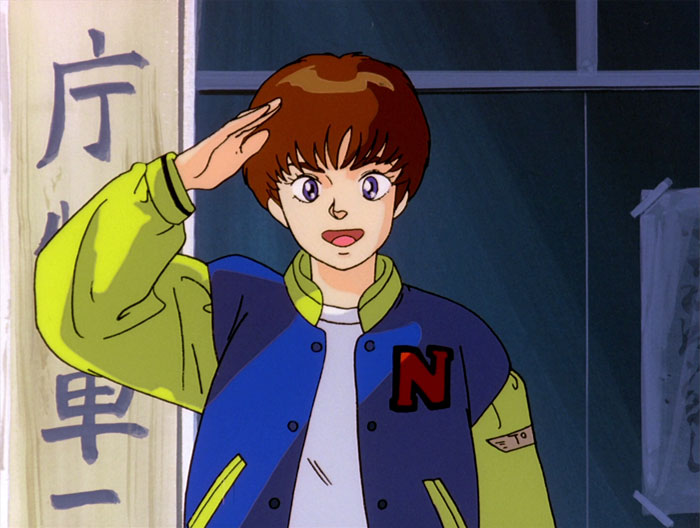
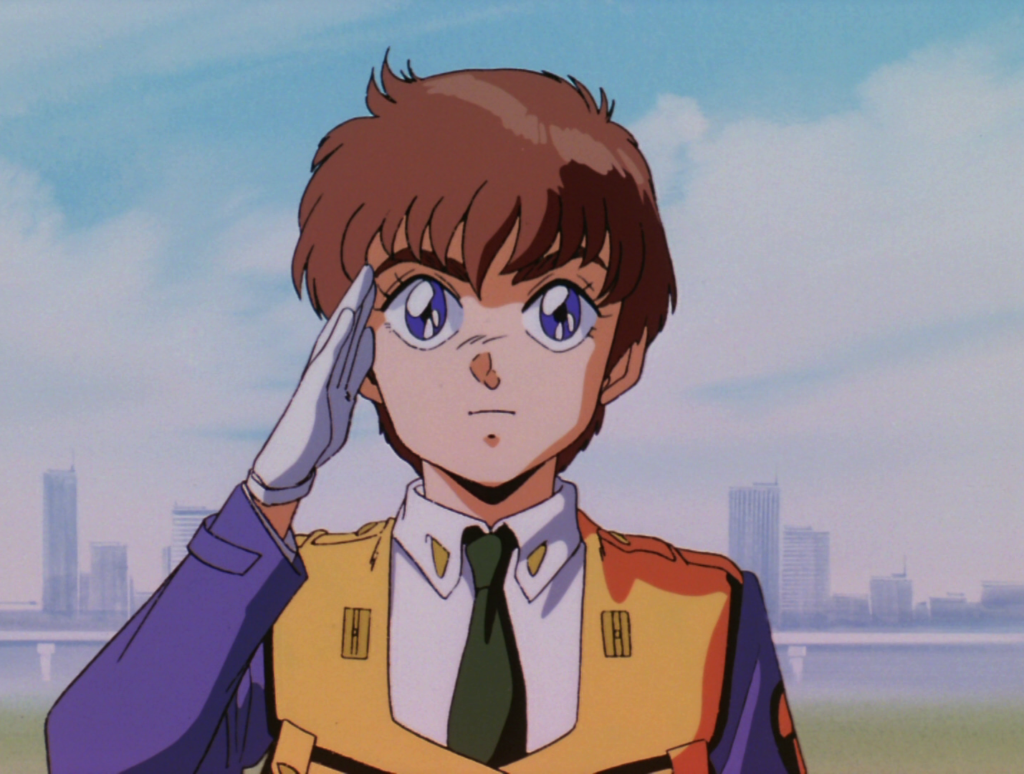
The lead image comes from the official Early Days first-episode page: Noa salutes in casual yellow-and-blue clothing. The second image below belongs to television episode one and shows her salute in formal uniform with a white glove, against the waterfront setting. They are deliberately labeled as different productions. Neither is evidence that one scene precedes the other in a shared timeline.
Our visual reading concerns how clothing changes the gesture's emphasis. The casual outfit makes enthusiasm conspicuous; the formal uniform makes institutional belonging conspicuous. The gesture is recognizable across both introductions, but a reader can see two different ways of presenting someone arriving at a job she cares about. This is a comparison of the inspected images, not a claim that the entire scenes have identical timing or dialogue.
The contrast gives a useful first question for either viewing route: what happens when affection for the machine meets the obligations of police work? A salute can signal excitement and compliance at once. Later episodes can complicate that tension through duties, colleagues and procedural consequences, while these two small visual references establish a concrete starting observation without disclosing an ending.
Original visual reference
The robot is equipment inside a service organization
The official introduction explains that industrial labors spread through construction and related work, with police labors answering the crimes that follow. That premise gives machinery a social location. An Ingram is not simply a heroic weapon waiting for a duel; it has to be transported, operated and used in situations where other people and public infrastructure are present.
The Early Days opening's delayed delivery is a particularly good premise-level example. Traffic can obstruct the arrival of equipment even before a unit gets to demonstrate its capabilities. Our interpretation is that logistics make technological power dependent on ordinary urban systems. A machine that looks impressive on a poster still needs a functioning route to the place where it is supposed to help.
This makes Patlabor a useful recommendation for viewers who enjoy workplace ensembles alongside mecha. Ask how a scene allocates responsibility among operator, supervisor and support staff. A failure can be comic, embarrassing or dangerous depending on that allocation. The story's appeal is not measured only by how much screen time the largest machine receives; the organization surrounding it can supply the more revealing conflict.
Personal attachment meets a system that learns behavior
The franchise introduction describes an operating system that accumulates an operator's usage data, giving machines individual behavioral characteristics. That detail helps explain why a workplace tool can become emotionally distinctive without becoming a separate mystical being. Our reading follows the overlap between a practical feedback system and the human tendency to name, favor and identify with equipment.
A viewer can ask whether an operator's confidence comes from the machine's advertised abilities, from familiarity with its responses, or from affection. Those are different reasons to trust it. The first film's official premise turns attention toward abnormal labor behavior and the systems behind it; watching the early branch makes that technological question relevant beyond a single individual's attachment.
The guide does not turn that premise into a disclosure of the film's solution. It also avoids using a real-world software analogy as proof of the fictional system's exact rules. The worthwhile comparison is internal: observe what a character believes the equipment will do, what the institution assumes, and what the story actually shows. That method keeps technical discussion anchored to the chosen production.
A shared creative project permits different narrative emphases
HEADGEAR is the creative identity credited by the official franchise. The manga's named author, the first Fujimi novel's writer and illustrator, and the animated-film contributors remain individual credits within that larger project. Listing one umbrella identity should not erase the people a visitor may want to follow into another medium.
The official introduction's separate axes explain why familiar characters can receive different emphasis without every difference being an error. Manga can build its own progression through Yuki's panel sequence, prose can redirect attention through narration, and an animated film can use duration and framing differently from a television episode. Specific differences should still be demonstrated from the editions being compared rather than guessed from medium stereotypes.
For reading discovery, use the Shogakukan first-volume page and the KADOKAWA book record to identify the actual starting edition and creator. For film discovery, our separate Patlabor 2 guide concentrates on the political and visual questions of that feature. The links connect complementary analyses while preserving the difference between a franchise entry guide and a single-film essay.
A score for Early Days is not a verdict on every Patlabor
The external audience score displayed here belongs to AniList's seven-part Early Days OVA entry from 1988. It does not average the 47-episode television series, films, novels and manga. A visitor choosing the television route should read the named scope before treating that figure as a preference signal. We have not added a local vote or presented the number as our own critical grade.
The franchise wiki and community discussions can be helpful for comparing editions and identifying a particular episode. Their complete character histories can also reveal the ending of a branch you have not selected. Use the route table first, then investigate a narrow question such as the contents of a particular OVA package, instead of opening an unrestricted timeline and assuming it applies universally.
Official sources establish the continuity boundaries used here. Community preferences can explain why someone enjoys workplace television or the films' concentration, but they cannot merge those branches. A future discussion section should name the production under discussion so that two people talking about episode one are not unknowingly referring to different introductions.
Choose a branch, then compare the actual edition
Patlabor's continuing official activity makes its archive worth revisiting, but a dated announcement about an event or a product is not a promise of availability in every country. For a viewing purchase, compare language options, subtitle coverage, region restrictions and the exact episodes or films included. A box labeled complete may be complete for one route, not for all four axes.
No audited franchise budget, production profit or current license valuation was verified for this guide. The variety of books, animation and merchandise demonstrates a range of products, not a financial total that can responsibly be invented. The reader's useful commercial question is whether a specific edition delivers the chosen route in a usable language and format.
Begin Early Days for the early-animation branch, television episode one for the longer workplace route, or manga volume one for Yuki's independent story. Return to the map when changing medium. Patlabor 2 offers a focused next analysis within the film branch; Mobile Suit Gundam offers a comparison with military machinery and civilian responsibility outside Patlabor continuity.
Primary sources and useful navigation
- Patlabor · official parallel axes and premise
- Patlabor · Early Days opening and original image
- Patlabor · television opening and original image
- Patlabor · first film premise
- Patlabor · second film premise
- Shogakukan · Masami Yuki manga volume one
- KADOKAWA · first Fujimi novel, Ito and Takada
- AniList · named anime audience score
Community and catalog routes
- MyAnimeList · named anime catalog
- Patlabor Wiki · franchise navigation, spoilers possible
- Reddit · Patlabor community
The production and publisher links support project facts. Catalog and community pages are secondary navigation and may reveal later events.
Explore related story guides
Original series imagery is reproduced under permission asserted by the site owner; the source and rights credits are retained. The route diagram is Animeteor’s own explanatory graphic.
Games and live-action adaptations
- The Next Generation Patlabor: Tokyo War — Live action: Film · 2015
- The Next Generation Patlabor: seven theatrical chapters — Live action: Theatrical chapters · 2014–2015
- PATLABOR the Case Files — Game: Labor combat action
Production and edition updates
- Patlabor EZY — three theatrical files
- Patlabor EZY File 1 — Japan, 15 May 2026
- Patlabor EZY File 2 — Japan, 14 August 2026
- Patlabor EZY File 3 — Japan, 5 March 2027
- Patlabor Case Files — Ingram Plus DLC planned for spring 2027
These separate records distinguish source editions, planned productions and dated exhibition or collaboration windows. Historical notices are not presented as new announcements; game and performed routes remain outside the core reading and viewing diagram.