Watch the original 26 episodes first. Hourglass is optional follow-up manga; Fam and its manga/theatrical versions are separately named later branches.
Reviewed 3 October 2026 · Opening premise and adaptation relationships. Major endings withheld; linked catalog summaries and discussions may contain spoilers. · Licensed access varies by country.

The source and screen branches

Manga branches are not source chapters for the 2003 anime. No exact TV-to-manga chapter handoff is certified; Fam recaps are not extra plot chapters. The two prose books novelize the original anime; they are not its source.
- WATCH · recommended first route: Last Exile · 2003 TV · 26 episodes → Fam · 21 story episodes + 2 recaps
- READ · optional original follow-up: Finish original television story → Travelers from the Hourglass · volumes 1–2
- READ · Fam adaptation: Fam manga · volume 1 → Continue through volume 3
- WATCH · optional Fam film: Fam · television context → Over The Wishes · named film presentation
- READ · optional novelization: Shuichi Kamiyama · upper / lower → Japanese books · 2003
Start with the 2003 series before choosing the later branches
For a first encounter with Last Exile, watch the complete 26-episode 2003 television series. GONZO’s official archive identifies that sequence and its opening premise: sky couriers Claus and Lavie inherit a dangerous delivery involving Alvis and the Silvana. The original series establishes a world through their work before asking viewers to navigate its larger conflict.
After that, Fam, the Silver Wing offers a later television entry with a different central cast. GONZO lists 21 story episodes and two recap episodes for that production. Preserve the release’s order and recognize the recaps as summaries; do not interpret a service’s 23 listed files as 23 new chapters of plot. The first series is the recommended introduction here.
Two manga titles need separate labels. Travelers from the Hourglass is Minoru Murao’s two-volume original story using the first series’ characters. Fam has its own three-volume manga by Robo Miyamoto. Neither is the source manga for the 2003 anime. Over The Wishes is a named Fam theatrical presentation, not episode 27 of the original television series.
| Entry | Relationship | Recommended placement |
|---|---|---|
| Last Exile · 2003 TV | 26-episode original anime | First encounter |
| Travelers from the Hourglass | Murao original manga; two volumes | After original TV; optional reading branch |
| Fam, the Silver Wing · TV | 21 story episodes plus two recaps | Later television route |
| Fam manga | Miyamoto adaptation; three volumes | Separate reading version of Fam |
| Over The Wishes | Fam theatrical presentation | Optional comparison, not original TV episode 27 |
A continuation manga and an adaptation manga answer different questions
KADOKAWA’s Travelers from the Hourglass records credit GONZO as original creator and Minoru Murao as manga artist. The second volume’s description calls it the conclusion of an original long-form episode. This distinguishes a new reading story from a page-for-page source for the anime. The original television encounter should come first because those characters and circumstances already have a history.
The publisher separately lists Fam’s third manga volume and credits Robo Miyamoto. Its summary identifies a concluding battle, while its series links show the first and second volumes. Read that version from volume 1. A person choosing manga is selecting a named adaptation of Fam, not resuming the original anime at a mechanically converted episode-to-chapter number.
Our map therefore keeps the two anime entries in one recommended viewing lane and gives each manga its own lane. The Hourglass branch is an optional follow-up after the original series; the Fam manga is an alternate medium. No exact cross-media handoff is certified. This avoids presenting every franchise product as a compulsory rung in one enormous ladder. The licensed film catalog describes Over The Wishes as a reconstruction of Fam with additional cuts and rerecorded dialogue; its six online chapters are delivery segments of a film, not six sequel episodes.
Visual case: the vehicle dominates the promise, the pilots ground it
The GONZO lead artwork places the ribbed front of a vanship across most of the composition, with two goggle-wearing pilots peering above it. Our reading is that the machine is more than a decorative means of travel. It is a shared working space whose scale, surfaces and maintenance shape how the characters are introduced to the viewer.
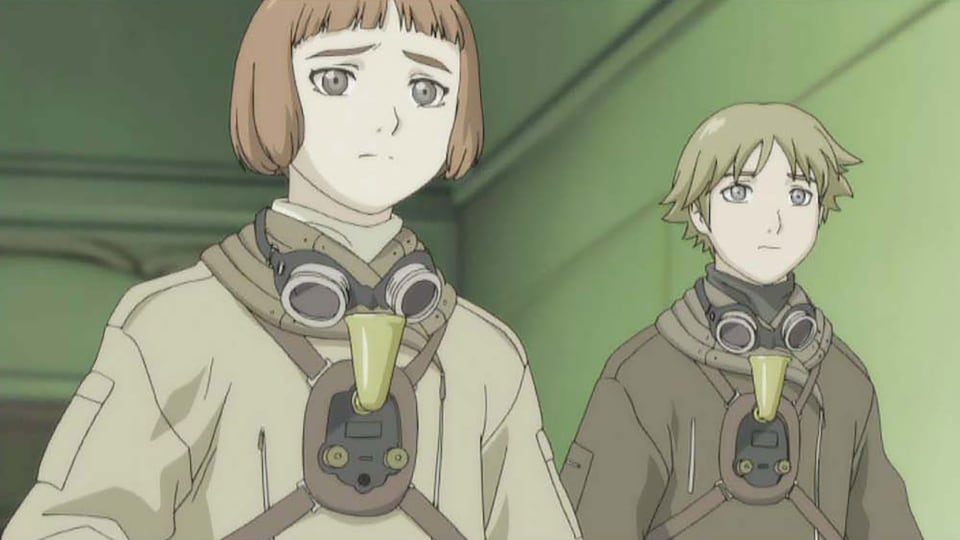
The original first-episode reference below shows the two young couriers with goggles at their necks and a green structural background. It redirects attention from the imposing exterior to the people operating it. That comparison supports a concrete viewing question: when an aircraft looks spectacular, what does the surrounding scene tell us about the skills and limits of its crew?
These images do not establish the full flight sequence, sound effects or a particular technical maneuver. The promotional artwork is not a literal frame, and the episode reference cannot prove how later digital shots were assembled. Use the pair to compare machine scale and human expression while leaving claims about motion to the moving scene itself.
Original visual reference
Courier work gives the world a human point of entry
The official original-series premise places Claus and Lavie’s livelihood before the larger struggle. Their aircraft is inherited, their work involves delivery and their aspiration involves crossing the Grand Stream. Our interpretation follows that practical entry point: the world becomes interesting when an ordinary assignment changes what two workers are expected to carry, risk and understand.
A courier can cross between parties without controlling those parties’ rules. That makes delivery a useful dramatic structure for examining unequal power. Ask who chooses a destination, who can alter the conditions of a job and who bears the cost when a supposedly limited task becomes political. These questions arise from the premise without requiring a late-season explanation of the world’s secrets.
Fam’s official introduction instead begins with a sky pirate deciding to seize a flagship and rescue threatened princesses. Compare the two opening roles—delivery and intervention—rather than measuring both protagonists against the same personality checklist. The change in central activity can alter how a viewer meets the world even when recognizable visual traditions continue.
The production archive reveals a collaboration around design
GONZO’s original-series archive credits Koichi Chigira as director, Range Murata for original character designs, and Mahiro Maeda and Makoto Kobayashi for production design. It names several animation character designers rather than treating original concepts and finished animated drawings as one job. These distinctions help readers attribute the work’s recognizability more precisely.
The Fam archive again credits Chigira and Murata while identifying Yukio Takahashi as chief of episode directors, Kiyoko Yoshimura for series composition and Hitomi Kuroishi for music. Creative continuity and changed responsibilities coexist. Shared names do not make a later production identical in pacing, characterization or emphasis, and a different audience response need not imply that all its makers changed.
Murao’s credited Hourglass manga creates another useful connection: a named artist associated with the original anime develops a later reading story. That is a documented production relationship. Claims that a particular manga panel repairs a specific television scene would require a direct comparison of those works; this guide does not invent that comparison from a cover or product summary.
Worldbuilding, digital imagery and character pacing can be judged separately
The linked June 2023 Reddit series discussion contains differing individual reactions. One participant valued the worldbuilding while criticizing the visible computer graphics; another remembered an uneven middle stretch despite liking the beginning. These are selected responses in a rewatch thread, not a poll establishing how all viewers feel. The link includes ending spoilers and is best opened after the original series.
Our recommendation is to separate three questions during viewing: does the environment feel coherent, do the action images communicate useful spatial information, and do the characters’ decisions feel earned? A viewer can answer those differently. A distinctive aircraft silhouette may be memorable even when a relationship scene is less persuasive; neither judgment automatically cancels the other.
The score panel applies only to AniList’s 2003 television record, normalized from 100 to 10 on the review date. It does not average that entry with Fam, either manga or the theatrical presentation. Separating those scopes keeps a franchise recommendation useful: the existence of a shared title is not enough to transfer an audience score between products.
Product dates and anniversary events need their own labels
The official archives document television entries and home-video products. FlyingDog lists an Over The Wishes Blu-ray released on April 20, 2016, including a booklet and promotional extras. That is a historical product date, not a new 2026 premiere or proof that the item is available in every territory. A cinema presentation and its disc release are different events.
Likewise, the manga records distinguish print and digital editions. A later electronic publication date can belong to the same story rather than announce a sequel. For a reader, identify the title, volume, creator and language before comparing editions. For a viewer, identify the original series or Fam before relying on a platform’s franchise grouping.
The sources reviewed here do not provide an audited production budget, gross revenue or profit statement. Our commercial analysis therefore describes the documented paths through television, books and home video without attaching invented returns. Current availability requires a dated territory-specific check; an archived product listing is evidence of a product, not a universal streaming recommendation.
Choose one follow-up instead of treating every format as mandatory
Finish the original 26 episodes, then decide what you actually want next. For more of the first cast in a reading format, investigate the separately named Hourglass manga. For a later television encounter, choose Fam and keep its recap labels visible. For a Fam reading alternative, begin Miyamoto’s manga at volume 1 rather than guessing a handoff from an anime episode.
Use the official studio and publisher records for credits and relationships, then consult the linked community discussion or wiki for questions after watching. A wiki can help locate a name, but complete character pages may resolve mysteries prematurely. The map is an orientation tool; it does not declare every release equally necessary or collapse alternate presentations into new events.
For another analysis of flight, technology and unequal institutions, continue to Macross Plus; for a more severe treatment of enclosed social systems, see Texhnolyze. These internal links follow a question a reader may find interesting. They are recommendations across separate stories, with no shared chronology or requirement to complete them before Last Exile can stand on its own.
Primary sources and useful navigation
- GONZO · original series, credits and 26 episodes
- GONZO · Fam and episode/recap scope
- Licensed Bandai Channel original catalog and imagery
- KADOKAWA · Hourglass volume 1
- KADOKAWA · Hourglass concluding volume 2
- KADOKAWA · Fam manga volume 3
- FlyingDog · Over The Wishes home-video edition
- AniList · named anime audience score
- Licensed Over The Wishes film and segmented delivery scope
Community and catalog routes
- MyAnimeList · named anime catalog
- Last Exile Fandom · character navigation; spoilers
- Wikipedia · franchise navigation; spoilers
- Reddit · selected 2023 series discussion; ending spoilers
The production and publisher links support project facts. Catalog and community pages are secondary navigation and may reveal later events.
Explore related story guides
Original series imagery is reproduced under permission asserted by the site owner; the source and rights credits are retained. The route diagram is Animeteor’s own explanatory graphic.
Optional prose adapted from the original anime
The original television series also has Shuichi Kamiyama’s two-part Japanese novelization. KADOKAWA dates the upper book to 30 August 2003 and the lower to 31 October 2003. These books adapt the anime; they are not its original source. They remain an optional reading branch, separate from the later Hourglass and Fam manga.