TV entry: 113 episodes. Film entry: 1979 → Adieu → Eternal Fantasy. Manga: choose a named edition. New film announced; date and placement not stated.
Reviewed 3 October 2026 · Opening premise and adaptation relationships. Major endings withheld; linked catalog summaries and discussions may contain spoilers. · Licensed access varies by country.
The source and screen branches

Films and television are alternative encounters. Toei places Eternal Fantasy after Adieu. The announced new film has no verified route placement.
- WATCH · television: 1978 TV · episodes 1–113 → Long-form alternative to first film
- WATCH · film route: Galaxy Express 999 · 1979 → Adieu · 1981 → Eternal Fantasy · 1998
- READ · Matsumoto manga: Andromeda · named Japanese edition → Eternal · separate continuation edition
Choose the long television journey or the film route
Galaxy Express 999 offers two useful first encounters: the 113-episode television series beginning in 1978, or the 1979 theatrical film. Both follow Tetsuro and the mysterious Maetel aboard a train crossing space, but the film is a separate adaptation rather than episode 114. Choose television for repeated encounters at different stops; choose the film for a concentrated introduction.
After the 1979 film, Adieu Galaxy Express 999 is its 1981 continuation. Toei’s description of Eternal Fantasy places that 1998 story one year after Adieu. Our map follows those explicit relationships. It does not require viewers to finish every television episode before beginning the movie route, and it does not combine different versions into one scene-by-scene timeline.
Leiji Matsumoto’s manga is a third entry. The named Japanese Andromeda edition below collects its first major reading route in ten volumes. Harlock and Emeraldas appear across related works, but recognizing a guest character does not make every associated series compulsory homework. Begin with the passenger’s journey, then investigate a particular relationship when it interests you.
| Entry | Recommended route | Boundary |
|---|---|---|
| 1978 television anime | Episodes 1–113 | Independent long-form adaptation |
| 1979 feature film | Then Adieu · 1981 | Do not insert as a television episode |
| Eternal Fantasy · 1998 | After Adieu in Toei’s stated placement | Later manga material; separate film presentation |
| Manga · Andromeda edition | Named Japanese edition, volumes 1–10 | Numbering differs across editions |
| New film announced July 2026 | Follow official production updates | Release date and continuity placement not stated |
Read by edition and arc, rather than matching television numbers
Shogakukan’s new Andromeda edition identifies Matsumoto as author, a ten-volume plan and inclusion of color pages from magazine publication. Volume one was issued in August 2023. This is a named Japanese manga edition, not a novel, and its cover is reproduced below. The edition’s volume number is a publishing boundary rather than a television season number.
The publisher also records an Eternal manga edition continuing the reading world beyond Andromeda. Toei identifies newly serialized material in Monthly Big Gold as the basis for the 1998 Eternal Fantasy film. That establishes a relationship to later manga without proving that one short film exhausts the entire later reading route or that its ending certifies completion of every manga thread.
We do not supply an exact chapter to begin after television episode 113 or the first movie. The adaptations select and frame encounters differently, while collected editions number their material differently. Start the chosen manga edition at its opening if comparison is your purpose. Japanese publisher availability is identified here; a complete, currently available English translation is not promised by that catalog.
Visual case: a familiar face can create familiarity without certainty
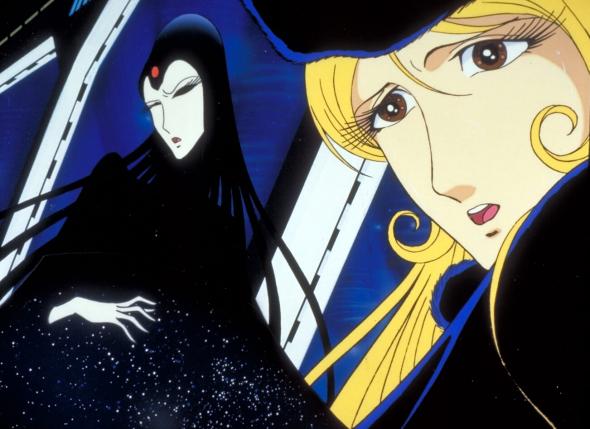
Toei’s original 1979 film image places a brightly lit blonde face near the viewer, with a darker, pale-faced figure farther back. Strong diagonal structures divide the composition, while the lower dark field carries points of light. Our reading is that proximity makes one figure emotionally immediate while the other remains harder to read. We do not disclose the surrounding scene’s revelations.
The Andromeda manga cover also makes Maetel’s long hair and face dominant, but uses a largely black field and a vivid green typographic border. Tetsuro is smaller behind her. The cover sells recognition and a relationship between figures; the film still stages an encounter through depth and contrast. They are different kinds of visual evidence, not matching panels from an asserted identical sequence.
Try asking what the frame permits you to know about a guide before you know her motives. A prominent face can invite trust, fascination or unease; prominence alone cannot settle which response the full scene intends. For timing, voice and movement, watch the actual sequence. These original images support composition analysis without substituting a promotional or catalog image for the entire work.
Original visual reference

Immortality is offered inside a world already divided by wealth
The opening premise makes mechanical bodies available to the wealthy while vulnerable people suffer under the resulting hierarchy. Tetsuro’s desire for a free mechanical body is therefore understandable before it becomes an abstract philosophical choice. Our central reading asks whether a promised escape from vulnerability can free a person when the promise itself belongs to an unequal system.
The train gives the story a useful structure: travelers pass through a society, see part of its rules and leave. Each stop can expose a different arrangement of labor, power or value. A visitor’s limited stay also creates an ethical problem. Witnessing suffering is not the same as changing the conditions that produce it, and a departure can carry unresolved responsibility.
Television’s repetition gives those questions room to vary across encounters, whereas a feature must concentrate them around selected events. Rather than calling every detour irrelevant, ask what assumption about progress a particular stop tests. Equally, length does not automatically make an episode insightful. The strongest comparison identifies how an encounter changes the traveler’s understanding, not just whether it advances a destination.
Matsumoto’s world passes through different screen teams
The television catalog credits Nobutaka Nishizawa as chief director, Shingo Araki and Shigeru Kogawa for character design, and Nozomi Aoki for music. The first film’s staff page separately names Rintaro as director, Kazuo Komatsubara as animation director and Aoki for music. Matsumoto’s original work and film planning credits establish a shared creative foundation without erasing those distinct production roles.
Eternal Fantasy has another named team, including director Konosuke Uda and screenwriter Junki Takegami. A viewer comparing editions should first identify which production is being discussed. A change in pacing, drawing or sound can arise from the demands of a different format and team; it is not adequately explained by assigning every decision to the manga creator.
For a focused comparison, examine a departure: how much space is given to a station, how quickly the destination becomes visible and whether music invites anticipation or loss. A steam-train silhouette can evoke familiar travel while its setting makes that familiarity strange. Follow the exact credited production when exploring those choices, rather than treating the whole Matsumoto universe as one unchanged directorial voice.
The shorter introduction and the longer journey answer different needs
The selected December 2021 Reddit discussion includes viewers preferring the film’s concentration and others valuing the television series’ many encounters. One participant describes returning to individual episodes despite knowing the larger mysteries. These are bounded personal reactions, with spoilers in the thread, rather than a representative vote establishing the best route for every new viewer.
Our recommendation depends on what you want to experience. If the destination’s mystery is your main interest, avoid reading catalog plot summaries or comparison discussions beforehand. If you enjoy societies built around a moral question, television’s episodic structure may be the attraction itself. Watching one adaptation can reveal mysteries shared with the other, so a comparison is not a spoiler-free reset.
The displayed 7.5/10 snapshot belongs to AniList’s 1978 television entry, normalized from its 100-point audience score. It is not a score for the 1979 movie, the entire manga or the new project. We do not collect local votes. The linked July 2026 discussion can help you see individual hopes for the announcement, but speculation there cannot certify its story placement.
A current announcement is evidence of production, not a completed release
On July 25, 2026, Toei Animation announced a new Galaxy Express 999 theatrical animation project, with Rintaro credited for the story concept and Toei handling animation production. The announcement reviewed here does not state a release date or establish where it sits relative to older adaptations. It remains outside the completed viewing route until primary information supports a precise placement.
Discotek’s licensed television Collection 1 explicitly contains episodes 1–39. That coverage is useful purchase information, but the collection is not the full 113-episode series. The Japanese Toei DVD archive documents older box coverage; an archive listing does not guarantee current stock or streaming access in your territory. Check the edition, language options and episode range before buying.
The publisher’s renewed manga editions and official exhibitions show continuing ways to encounter this work. They do not give us an audited production budget, current franchise profit or a reliable return-on-investment figure. We therefore discuss identifiable releases and production status without inventing financial numbers. A museum experience, remaster and newly announced film are different commercial forms and should be labeled accordingly.
Keep a destination without forcing the whole universe into one route
For television, begin at episode one and continue through the 113-episode adaptation. Our recommendation preserves the encounters rather than presenting a fan-created reduced episode list as official canon. For the films, begin with the 1979 feature, continue with Adieu and then explore Eternal Fantasy using Toei’s explicit story placement. Choose a branch before comparing it with another version.
For reading, start the named Andromeda manga edition and investigate the publisher’s Eternal continuation separately. The image credits and catalog links identify which publication our discussion uses. No exact anime-to-manga continuation point is certified. Related Harlock or Emeraldas appearances can lead to another guide, but shared names and imagery do not alone prove one consistent timeline across every production.
For future updates, the new film needs a dated official premiere announcement, exact title and adaptation relationship before entering a route. Our Yamato and Toward the Terra guides offer independent comparisons of survival and the promises made by technological power. They are thematic neighbors rather than sequels. Return to the source notice when planning a release; community excitement is useful context, not a substitute for confirmation.
Primary sources and useful navigation
- Toei · television catalog and staff
- Toei · original 1979 film and imagery
- Toei · 1979 film staff
- Toei · Adieu sequel description; spoilers
- Toei · Eternal Fantasy placement and manga basis; spoilers
- Toei · Eternal Fantasy staff
- Shogakukan · new Andromeda edition volume 1
- Shogakukan · Eternal edition volume 1
- Discotek · licensed television Collection 1 coverage
- Toei · Japanese television DVD archive
- Toei · July 25, 2026 new theatrical project announcement
- AniList · named anime audience score
Community and catalog routes
- MyAnimeList · named anime catalog
- Wikipedia · franchise navigation; spoilers
- Reddit · selected 2021 TV/film comparison; spoilers
- Reddit · July 2026 project reactions, unconfirmed speculation
The production and publisher links support project facts. Catalog and community pages are secondary navigation and may reveal later events.
Explore related story guides
Original series imagery is reproduced under permission asserted by the site owner; the source and rights credits are retained. The route diagram is Animeteor’s own explanatory graphic.
Games and live-action adaptations
- Galaxy Express 999 DS — Game: Simulation adventure and board game
Production and edition updates
Galaxy Express 999 — new theatrical anime project
Toei Animation’s 25 July 2026 announcement confirms a new Galaxy Express 999 theatrical animation project, with story concept by Rintaro and animation production by Toei. The inspected announcement supplies no release day or exact narrative placement.