Classic entry: 1974 TV, 26 episodes. Remake entry: 2199 → 2202 → 2205 → REBEL3199. Farewell and Yamato 2 are different continuation branches.
Reviewed 3 October 2026 · Opening premise and adaptation relationships. Major endings withheld; linked catalog summaries and discussions may contain spoilers. · Licensed access varies by country.

The source and screen branches

Farewell is an alternative classic continuation. Compilations, live-action and games are excluded from the primary route; REBEL3199 dates are territory-specific.
- WATCH · classic sequence: 1974 TV · 26 episodes → Yamato 2 · New Voyage · Be Forever → Yamato III · Final Yamato
- WATCH · remake sequence: 2199 · optional Ark film afterward → 2202 → 2205 → REBEL3199 · check current release
- READ · Matsumoto manga: The Classic Collection → Print collection / three digital volumes
- READ · Fujikawa prose: Yamato Library · Yamato volume 1 → Yamato volume 2 · same prose line
Choose the classic continuity or begin the remake with 2199
Begin the original Space Battleship Yamato with its 26-episode 1974 television series. For a modern retelling, begin with Yamato 2199 instead. The year in the remake title is a story-setting label, not a demand to watch every older production first. These two entry points should be offered clearly before a visitor chooses a continuation.
The classic route continues through Yamato 2, The New Voyage, Be Forever Yamato, Yamato III and Final Yamato. Farewell to Space Battleship Yamato is a separate continuation branch from the first story. The official 2202 introduction explains that Yamato 2 uses a different outcome and that later classic installments follow its timeline; this guide preserves that distinction without revealing the outcomes.
The remake route runs through 2199, 2202, 2205 and REBEL3199. Ark of the Stars is an optional additional 2199 film to explore after the main 2199 encounter. Compilation presentations revisit material and are identified as such. The 2010 live-action movie is a separate adaptation and is excluded from our anime/manga/prose route map.
| Choice | Placement | Important distinction |
|---|---|---|
| 1974 TV | 26-episode classic entry | Episodes 1–26 |
| Yamato 2 → New Voyage → Be Forever → III → Final | Classic continuation route | Yamato 2 differs from Farewell |
| Farewell · 1978 film | Alternative continuation after first story | Do not force its outcome into Yamato 2 |
| 2199 → 2202 → 2205 → REBEL3199 | Remake sequence | Separate from classic episode order |
| Matsumoto manga / Fujikawa prose | Independent reading editions | No verified post-anime chapter handoff |
Named reading editions are alternatives to compulsory backstory
Seven Seas publishes Leiji Matsumoto’s Space Battleship Yamato: The Classic Collection, combining the classic manga in one print collection and listing digital availability as three individual volumes. That is a usable English reading entry. It is not a volume-number conversion for the television sequels or a promise that reading the collection includes every later screen story.
KADOKAWA’s Yamato Library records separately identify prose books written by Keisuke Fujikawa, with Matsumoto credited for supervision and overall setting design and Akira Hio for illustrations. The first two named Yamato volumes form our limited prose reference. Do not confuse those book numbers with Yamato 2, which is the title of a television continuation.
This franchise grew through several screen and print forms, so a neat arrow from one entire medium to the next would conceal more than it explains. We do not certify a novel chapter to begin after episode 26 or treat the English manga collection as prerequisite lore for 2199. Compare named editions from their opening when investigating how each tells the shared journey.
Visual case: the familiar hull can frame different encounters
The licensed image identifying the 1974 television series shows Yamato from a low, front-quarter angle, with a bright beam crossing the dark starfield. The visible hull occupies much of the frame. Our reading is that the composition makes a naval-looking vessel seem both heavy and startlingly mobile in a space where it has no visible sea to support it.
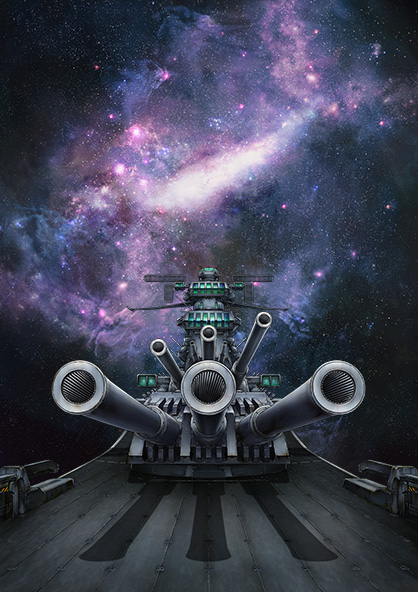
The official 2199 promotional artwork below instead looks along the deck toward large gun barrels beneath a dense, luminous sky. It invites the viewer to imagine a position aboard the ship rather than looking at a distant object. That difference supports a bounded comparison of viewpoint and scale; it does not establish how either production animates a specific battle.
The pair also demonstrates why a familiar silhouette cannot identify chronology on its own. Both productions can present Yamato as iconic while belonging to different adaptation routes. Ask where the viewer is positioned, what the frame makes large and whether the surroundings suggest menace or wonder. Sound, timing and crew dialogue would require the actual moving sequence.
Original visual reference
A rescue mission gives the weapons an uneasy purpose
The anniversary site’s opening premise gives Earth a limited time before extinction and sends the crew toward Iscandar in search of a means of recovery. The ship therefore carries a mission larger than defeating an opponent. Our analytical question is whether the use of overwhelming force helps that mission or begins to obscure the people and world it was meant to preserve.
The countdown also changes the meaning of delay. A detour can be costly without being morally simple, and a commander’s decision can protect the immediate crew while placing a larger responsibility at risk. Watch how a scene makes those competing obligations legible: who has the information, who bears the danger and who is allowed to object?
The old battleship shape should be discussed rather than treated as an innocent decoration or an automatic answer to the series’ politics. Our reading asks how a military vessel is reframed as a vehicle for planetary survival. Different viewers can find that transformation stirring, troubling or both. The premise establishes a rescue objective; it does not settle every historical association carried by the image.
A continuing franchise is not one unchanged production team
The original episode archive names individual screenplay and storyboard contributors, including Keisuke Fujikawa, Leiji Matsumoto and Noboru Ishiguro on the opening episode. The linked Columbia soundtrack record credits Hiroshi Miyagawa’s music for the first television series. These are specific production references, more useful than assigning every visual and dramatic decision to one franchise name.
The official remake introduction identifies 2199 as a new production based on the first television story. REBEL3199 has separately named contemporary leadership, including chief director Harutoshi Fukui and director Naomichi Yamato. Its music statement describes Akira Miyagawa working with Shu Kanematsu. Those credits should not be projected backward onto the 1974 series.
For comparison, choose a precise task: how a bridge conversation shares information, how music changes the feeling of departure, or how the camera positions us around the hull. A familiar theme or machine can remain recognizable while its arrangement and dramatic emphasis change. That is a stronger adaptation question than equating newer technical polish with an automatically superior moral or emotional interpretation.
Historical importance and first-viewing pleasure are separate judgments
The linked September 2023 overall-series Reddit discussion contains appreciation for particular crew members alongside criticism of animation, continuity and episode decisions. Some participants express interest in how the remake handles those difficulties. These are individual responses in a selected rewatch, with significant ending spoilers; they are not proof that modern viewers agree on one correct entry point.
Our recommendation is to choose the classic series when the historical presentation itself interests you, or 2199 when you want to encounter the central voyage through the remake route. Either choice can lead to a later comparison. Try to name the actual source of engagement or frustration: an information gap, a character decision, a visual limitation or the mission’s larger ethical framing.
The displayed external rating belongs only to AniList’s 1974 television entry, converted from 100 to 10. It does not describe the reception of REBEL3199’s unreleased final chapter or average all movies and manga. CosmoDNA is linked as a specialized English archive for further navigation; its detailed community chronology is not substituted for the official continuity statement used here.
Separate historical impact from the next dated release
The official 2202 retrospective, written by anime researcher Ryusuke Hikawa, reports an audience of four million for the 1978 Farewell film and describes its role in expanding anime’s public recognition. This is an attributed historical account, not an audited profit statement. It is useful commercial context because it identifies a particular film rather than treating all Yamato productions as one undifferentiated success.
For the current remake branch, the July 31, 2026 official announcement schedules REBEL3199’s seventh theatrical chapter in Japan for October 30, 2026. Its home-video volume covers episodes 23–26, with general Blu-ray/DVD release scheduled for December 23. On this guide’s October 3 review date those are announced future events, not completed premieres or worldwide English availability.
The publisher and soundtrack records offer identifiable reading and listening editions, while the licensed retrospective identifies older screen productions. They do not establish a budget for the original series or a return on investment for the remake. Compare the exact edition’s coverage, language and territory before buying; a remaster or compilation is a new presentation of material, not automatically a new story.
Keep the branch choice visible as the journey expands
For the classic entry, watch the first 26 episodes, then decide between examining Farewell as an alternative continuation and following Yamato 2 into the later classic sequence. The map summarizes that split and the comparison table names it explicitly. Resurrection and YAMATO2520 are later separately titled explorations; neither is required to begin the original rescue voyage.
For the remake, begin with 2199 and continue through 2202 and 2205 before REBEL3199. Verify which episode or theatrical-chapter presentation your service supplies so that chapter packaging does not create accidental repetition. The seventh REBEL3199 chapter is still scheduled after this review date; check the official notice before planning a viewing that assumes the whole release is already available.
The Matsumoto manga collection and Fujikawa prose are optional reading approaches with their own numbering. Our Gundam and Toward the Terra guides provide independent comparisons of survival, institutional authority and belonging. They do not extend Yamato canon. Future updates should name the affected continuity and edition first, so a new announcement never silently changes a visitor’s chosen route.
Primary sources and useful navigation
- Official 50th-anniversary first-series episode archive
- Official 2202 retrospective · classic continuity split
- Official 2199 introduction and original artwork
- Official 2205 introduction
- Official REBEL3199 introduction and staff comments
- Official July 2026 chapter-seven release announcement
- Seven Seas · Matsumoto Classic Collection
- KADOKAWA · Fujikawa prose volume 1 and credits
- KADOKAWA · Fujikawa prose volume 2
- Columbia · first television-series soundtrack credits
- Star Channel · licensed classic retrospective and imagery
- AniList · named anime audience score
Community and catalog routes
- MyAnimeList · named anime catalog
- Wikipedia · franchise navigation; spoilers
- CosmoDNA · specialized English community archive
- Reddit · selected 2023 overall-series discussion; ending spoilers
The production and publisher links support project facts. Catalog and community pages are secondary navigation and may reveal later events.
Explore related story guides
Original series imagery is reproduced under permission asserted by the site owner; the source and rights credits are retained. The route diagram is Animeteor’s own explanatory graphic.
Games and live-action adaptations
- Space Battleship Yamato — Live action: Film · 2010
Sixth-chapter rental window and a separate historical game
REBEL3199’s sixth chapter began regular Japanese digital rentals on 30 September 2026 at 00:00 JST. The distinct long-term-rental sales window ended on 29 September; it is not evidence that all previously purchased viewing periods ended that night. The already documented seventh-chapter theatrical date remains 30 October 2026.
Exact sixth-chapter rental record · Official edition and access page
Tenda’s 6 August 2015 release identifies the separate social game Space Battleship Yamato 2199: Iscandar e no Tabiji on TSUTAYA Online Game, operated with Yamato Crew. This historical distribution record does not certify a currently playable service or place the game in the anime route.