Five anime about finding another chance through school
An impossible teacher, a former biker, an adult experiment, an agricultural school and superhero training. Five ways education can change someone’s starting position.
Reviewed 2026-10-01 · Premise-level spoilers · Editorial selections, without a universal ranking.
Only ReLIFE offers a literal return with altered appearance. The other picks use a new teacher, school or training opportunity. Their comedy, violence and age suitability differ substantially.
Choose your starting point
Follow the branch that sounds most appealing. This is a selection map, not a shared universe or a chronology.
How we chose these five
Each selection needs a theme that shapes its premise, a distinct reason to choose it and a verifiable anime project. We distinguish films from television, explain tone differences and use official production, studio, publisher or licensed-distributor pages for project identity. The order groups viewing experiences; it is not a score based on popularity or a claim that one work is objectively better.
Assassination Classroom
TV anime · A rejected class receives an impossible teacher

Fuji Television’s synopsis places Koro Sensei with Class 3-E, whose students must try to kill their extraordinary teacher before graduation while also learning from him.
Why choose it?
Choose this when a school’s judgment of its students should meet a teacher with an unusual investment in them. The impossible assassination assignment is part of the starting contradiction: the person the class must defeat is also responsible for helping it learn. Compare GTO for a disruptive human teacher, or Silver Spoon for a student discovering a different educational environment. Our interest is how a classroom can become a place to develop after being marked as unsuccessful. The threat and violent comedy remain substantial, so the recommendation is not simply for a reassuring school story. Begin before later anniversary coverage, whose celebration of the complete series can disclose where the teacher-student relationship ends.
Where to start
Begin the original first TV season, then the second season. Compilation films, extra material and the separately presented Koro Sensei Quest! are not replacements for the initial classroom opening. The manga is by Yusei Matsui.
Tone & scope: Assassination attempts, weapons, threatening situations and emotional distress. Later graduation coverage contains major spoilers.
· Broadcaster’s original classroom premise
· Original anime introduction
· Find in MyAnimeList
Read the full Assassination Classroom guide & visual adaptation map →
Great Teacher Onizuka
TV anime · A former delinquent takes the teacher’s place
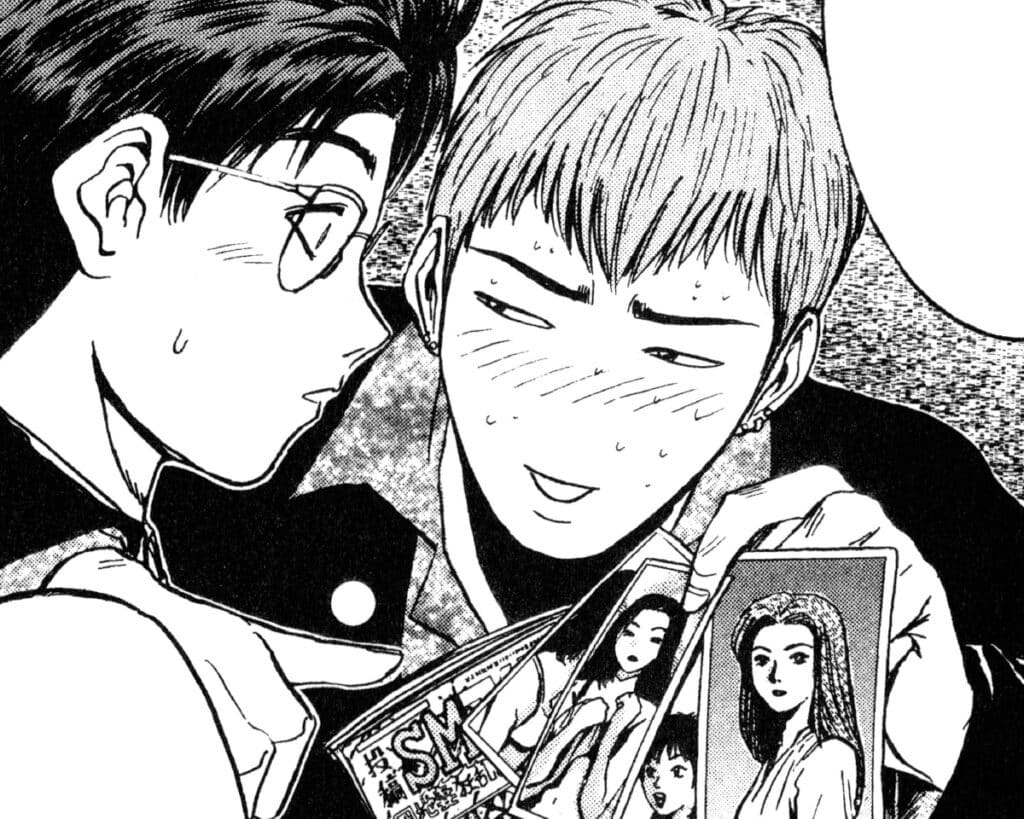
Kodansha’s licensed opening introduces Eikichi Onizuka, a former biker with an ambition to teach, facing students who challenge him through bullying and manipulation.
Why choose it?
Select this when a second chance belongs partly to the adult entering the classroom. A teacher’s unconventional past makes the question of who is fit to help other people part of the attraction. Compare Assassination Classroom for a fantastical outsider assigned to a rejected class; here the tone comes from an unruly human teacher and a confrontational school environment. Our lens is the possibility that someone’s past does not exhaust what he can contribute, while his conduct is still open to criticism. The crude humor and inappropriate situations should be considered before choosing it as a comforting school pick. The publisher itself warns about offensive material in the older localization, which should not be hidden behind an inspirational label.
Where to start
Begin the original television anime or Toru Fujisawa’s GTO manga at volume one. Live-action versions and related prequel or sequel manga are separate editions. The animation is not a substitute for every volume of the source.
Tone & scope: Bullying, sexual humor, harassment and dated offensive material. Kodansha labels the source for older readers.
· Licensed publisher’s premise and content note
· Find in MyAnimeList
Read the full Great Teacher Onizuka guide & visual adaptation map →
ReLIFE
TV anime · An adult is offered a school-year experiment

The official introduction gives twenty-seven-year-old Arata Kaizaki a research offer: a drug changes his appearance so he can spend a year in high school as part of the ReLIFE experiment.
Why choose it?
Choose this for a literal return to school with adult experience still shaping the participant’s reactions. That makes the second chance different from GTO’s teacher role or Silver Spoon’s ordinary change of school. Our reading focuses on the uncomfortable gap between being offered another setting and being able to use it differently. The experiment is fictional; it is not presented as a real treatment or a model that resolves unemployment. Classmates must remain people with their own situations rather than props in an adult’s recovery story. Start with the opening offer and avoid the official archive’s later reports, which disclose the experiment’s developments and relationships.
Where to start
Begin the thirteen-episode television series, then the four-episode Final Arc identified as reports 14–17. Yayoiso’s original comico comic is the reading route; the separate live-action film is another adaptation.
Tone & scope: Employment distress, social withdrawal, smoking and romantic complications. Experiment revelations and final-arc summaries contain spoilers.
Silver Spoon
TV anime · A new school challenges an old idea of success

Yugo Hachiken enters an agricultural high school in Hokkaido and encounters work, animals and classmates whose futures are tied to rural businesses.
Why choose it?
Choose this when a fresh start should come through an unfamiliar course of study rather than a magical reset. Agricultural school puts daily work and responsibility alongside classroom achievement. Compare ReLIFE for an adult’s experiment, or GTO for a teacher who brings an unconventional history into school. Our attraction is that a different environment can expose the limitations of the criteria someone previously used to judge himself. This is also why Silver Spoon appears in our countryside collection: its rural work has a second function here as a setting for reconsidering an educational path. The two recommendations address different viewing interests and do not make the same promise of comfort.
Where to start
Start with the first television season. The manga is a source route, not a bonus anime season; choose its licensed edition before relying on chapter counts.
Tone & scope: Animal husbandry and the realities behind food production can be uncomfortable. The official school premise does not promise an exclusively soothing show.
My Hero Academia
TV anime · An aspiration meets a training institution

Izuku Midoriya wants to become a hero in a world where extraordinary abilities are common. The manga and anime establish training and the path toward that public role.
Why choose it?
Choose this for a young person’s desired future becoming connected to formal training. Its superhero premise gives aspiration a fantastical form, while the school setting makes preparation and relationships visible. Compare Silver Spoon for a different educational path, or Assassination Classroom for a group placed outside a school’s preferred hierarchy. Our lens is access to a place where abilities can develop, rather than treating superhero success as a metaphor with one predetermined meaning. It belongs here as a new opportunity, not as a literal rewind of an adult life like ReLIFE. Later war and graduation publicity is outside this opening-level recommendation.
Where to start
Begin the main television series with season one, episode one, or the original manga with volume one. Our full Work guide separates main installments, films and the separately named Vigilantes project. A related title should not be inserted into the main school route without checking its identity.
Tone & scope: Action violence, injuries and later darker conflicts. The educational opening does not guarantee a gentle story throughout.
Case check: a second chance can belong to a student or a teacher
Fuji Television places the rejected Class 3-E with a teacher the students must defeat. Kodansha introduces Onizuka as the unconventional adult aspiring to teach, while ReLIFE’s official introduction gives an adult another school-year setting. Our interpretation is that the person receiving the opportunity changes what to look for: student development, adult responsibility or reconsideration of a past path. Silver Spoon provides an ordinary educational change, and My Hero Academia uses fantastical training. None of these premises proves that an institution automatically repairs a person’s difficulties; each gives a different question with which to begin watching.
Confirmed: the linked primary descriptions establish project identity and starting premises. Editorial reading: the thematic fit and comparisons are our interpretation. Not established here: exact adaptation endpoints, production costs, complete viewing availability or a scene-by-scene source comparison.
Discuss and continue
Community and catalog links are secondary navigation. They can help you find contrasting responses, but they are not evidence of audience-wide agreement. Discussion threads and later-season pages may contain spoilers.
Use official source pages for project identity and check your licensed service for regional availability.
Find community discussions on Reddit · Watch-order guides · Reading routes · Visual adaptation maps
Another experience to explore
- Farming & countryside life
- Food at the heart of the story
- Build, craft & organize
- Time loops & changing the past
- Life after battle
Review and artwork notes
This selection was reviewed on 2026-10-01. Original official or licensed images identify each project; later-season art is labeled where used. Artwork is reproduced under permission asserted by the site owner, with attribution and source links retained. This is not an open-license claim. Future revisions can replace a pick, improve source routes or add a maintained Work guide while preserving the selection’s published purpose.