Start the completed twenty-one-volume main manga or TV season 1, then season 2. The 2016 compilation and 2026 Minna no Jikan are companion films; Koro-tan combines optional prose with English study, not the source story.
Reviewed 2 October 2026 · Opening premise and format relationships; major ending revelations withheld. Linked publisher summaries and discussions may reveal later events. · Licensed access varies by country.
The source and screen branches

Main manga and television are the starting routes. Compilation, 2026 film and hybrid study/prose books are identified companions rather than invented seasons or compulsory chapter bridges. Live action and games are excluded.
- READ · main source: Main manga · volume 1 → Complete numbered series · 21
- WATCH · main story: 2015 TV season 1 → Television season 2
- WATCH · optional films: 365 Days’ Time · 2016 recap + framing → Minna no Jikan · separate 2026 companion
- READ · prose / study companion: Koro-tan · prose and vocabulary → Optional · not the original source
The main story comes before the reunion films and alternate comedy
Assassination Classroom begins with Yusei Matsui’s completed twenty-one-volume manga. For animation, watch the first television season followed by the second. The two seasons introduce and develop the unusual relationship between a class of students and the teacher they are assigned to kill. The premise is violent, but the reading route should still remain clear.
The 2016 film 365 Days’ Time is a compilation with new framing material. Its retrospective position makes it a companion after the television route, rather than an extra season that continues every unresolved source chapter. Koro Sensei Quest is a separate comic-fantasy spin-off; its alternate presentation is optional and does not replace the main introduction.
The 2026 theatrical release Minna no Jikan, or Everyone’s Time, is another named animated project. Keep it as a separately identified companion after the main route, avoiding an unverified claim that it is season three. Live-action versions and games remain outside the novel–comic–anime map even when they reuse the cast or premise.
| Format | Start | Then |
|---|---|---|
| Manga | Main volume 1 | Through final main volume 21 |
| Anime | 2015 TV season 1 | Season 2 |
| 2016 film | 365 Days’ Time | Optional retrospective after TV |
| 2026 film | Minna no Jikan | Separate companion, not labeled season 3 |
| Companion reading | Koro-tan prose-and-English study books | Optional, not the original source |
A final manga book and an educational companion are different products
VIZ records the final English main book as volume twenty-one, released on 3 April 2018 with ISBN 9781421593395. That book’s place in the main series is independent of a later film anniversary. A new adaptation date does not change the published source’s completed status or add a twenty-second main volume.
Shueisha describes the first Koro-tan book as a combination of prose and English-vocabulary study. It credits Matsui for original work, Joro Kuma for prose and Kodai Abe for English supervision, with a 4 August 2014 print release and ISBN 9784087033274. That precise hybrid description is more useful than calling it the novel from which the manga was adapted.
The current official screen site records Minna no Jikan’s Japanese theatrical release on 20 March 2026 and announces a Prime Video streaming start on 7 August. Both dates are past at this guide’s October review. They are Japanese release records; neither establishes that the film is available in every territory or with every subtitle language.
A threatening premise sits inside an image of a shared class
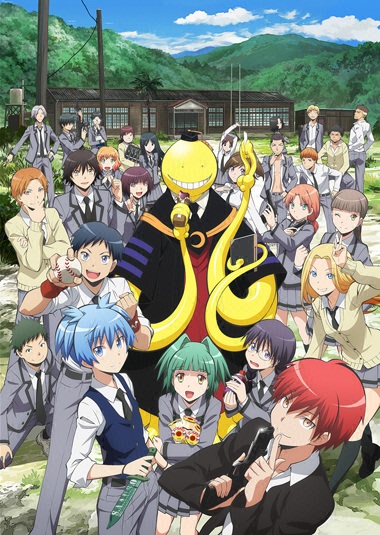
The selected original television illustration places the yellow, smiling Koro Sensei in the center of students distributed among trees and branches. Nagisa occupies the foreground, while several classmates carry the property’s distinctive green weapons. It is a promotional ensemble composition rather than a frame proving that one depicted confrontation occurred exactly this way.
Our visual reading concerns the coexistence of danger and familiarity. The teacher’s smile and central position create an organizing presence, while the surrounding students preserve many separate faces and activities. The illustration offers a group whose purpose cannot be explained simply by assuming that everyone holding a weapon feels the same way.
The image does not reveal the resolution of the assignment or certify the legality, safety or realism of any depicted object. Its value here is as original visual context for the premise. The analysis asks how the fictional relationship makes individual students visible, without transforming stylized assassination equipment into a practical guide.
Original visual reference

A class label can hide the differences among its students
Our central reading starts with the contradiction between being classified as a failing group and receiving close attention from an extraordinary teacher. A collective label can make students seem interchangeable. Individual instruction challenges that simplification by asking what a particular person understands, fears or can contribute.
The unusual assignment supplies repeated occasions for observing those differences. The analytical question is not only whether a plan succeeds, but whether preparation reveals a capacity that an ordinary assessment overlooked. A student’s role in a coordinated attempt can become a way of describing intelligence without requiring everyone to excel at the same task.
This interpretation does not claim that fictional danger is an acceptable educational method. It concerns the narrative use of a strange premise to expose assumptions about ability. A careful discussion separates the dramatic mechanism from any real-world judgment about how teachers should treat children or how schools should organize assessment.
A person can occupy incompatible roles in the same relationship
Koro Sensei is both instructor and assigned target. Our analysis treats that double position as an obstacle to simple emotional categories. Learning from somebody can increase trust, while the official task still demands opposition. The story can therefore make progress in one relationship appear to complicate another obligation rather than resolve it.
A close reading should track who defines the assignment and what information the students possess at a particular moment. Institutional authority, personal understanding and group loyalty may point toward different actions. Declaring the entire class morally unanimous in advance would erase the dramatic work through which individual responses become visible.
This also explains why retrospective films belong after the main route. A reunion frame presumes a shared history whose meaning is already charged by the television experience. Starting there risks receiving an interpretation of the year before seeing how the relationships were formed, even when much of the footage revisits earlier events.
A school year gives small changes a shared deadline
The premise connects classroom life with a limited period before a threatened catastrophe. Our interpretation is that this gives ordinary educational moments unusual weight. A lesson, examination or disagreement does not exist in an unlimited serial present; it takes place within a year whose passing matters to the students’ relationships and task.
That structure can join individual growth to collective memory. Different students may attach significance to different moments, while the class still experiences a common sequence of seasons and milestones. A strong scene analysis asks what changes for the named student and how the rest of the group can witness or support that change.
The same structure makes spoiler control especially useful. The emotional meaning of an early lesson can change after later revelations. This guide remains with premise-level questions; detailed ending comparisons should be separately labeled so that a first-time viewer can choose the correct route without accidentally being given the conclusion.
Source, television and companion-book credits remain separate
Matsui created the source manga. The official 365 Days’ Time production lists Seiji Kishi as director, Makoto Uezu for series composition and script, Kazuaki Morita for character design and Lerche for animation. Its notice also identifies Matsui’s script cooperation on new material. Those credits concern named production work rather than a blanket claim that one person performed every role.
The Koro-tan book adds a different kind of collaboration: prose writing and educational supervision. A publisher’s classification and contributor list are needed to explain that product accurately. Having a prose component warrants a companion-reading branch, but it does not turn the main manga or television series into an adaptation of a vocabulary workbook.
Community links can help readers discuss favorite lessons and adaptation choices, with major spoilers possible. They do not establish a new season or a film’s current worldwide availability. The displayed AniList score of 7.9 out of 10 is scoped to the twenty-two-episode 2015 first television entry, excluding the second season and theatrical companions.
An anniversary release is activity around a completed story
The main catalog, compilation film and 2026 project demonstrate several distinct release strategies around the property. An anniversary can invite established viewers to revisit a class while also providing a new product. That is a verifiable publishing and production pattern, not proof that the original story has resumed serialization.
No audited title-level profit or complete animation-budget figure was verified here. A film’s ticket receipts, licensed streaming arrangements and manga circulation would represent different measures and periods. General publisher results should not be attributed to this title, and a current retail price should not be described as money earned by Matsui or the animation staff.
Begin the main comic or first television season, finish that route, and choose the retrospective or companion branches deliberately. Future updates can record regional streaming, new edition information and production announcements without changing the source root. Exact chapter handoffs require inspected source evidence; none is certified merely from a remembered fan summary.
Primary sources and useful navigation
- VIZ · main series
- VIZ · final English main volume
- Official original television archive and selected artwork
- Official 365 Days’ Time · compilation and credits
- Official Minna no Jikan · 2026 theatrical and streaming records
- Shueisha · prose-and-vocabulary companion classification
- Shueisha · companion credits
- AniList · named adaptation audience score
Community and catalog routes
- MyAnimeList · named adaptation catalog
- Reddit · discussion search, ending spoilers possible
- Wikipedia · secondary format navigation
The production and publisher links support project facts. Catalog and community pages are secondary navigation and may reveal later events.
Find this work in our thematic collections
Original series imagery is reproduced under permission asserted by the site owner; the source and rights credits are retained. The route diagram is Animeteor’s own explanatory graphic.
Games and live-action adaptations
- Assassination Classroom: Graduation — Live action: Film · 2016
- Assassination Classroom — Live action: Film · 2015
Production and edition updates
Assassination Classroom Assassin Training Plan — Japan 3DS
Bandai Namco’s verified official play video, dated 16 March 2016, identifies Assassin Training Plan for Nintendo 3DS and its 24 March 2016 Japanese release. The described premise makes the player a Class 3-E student, developing a character through missions and battles across the school-year experience.