Start the completed twenty-five-volume main manga or the forty-three-episode 1999 anime. The Early Years and nine-volume 14 Days in Shonan are separate related routes; collected bindings and digital releases have their own numbering.
Reviewed 2 October 2026 · Opening premise and format relationships; major ending revelations withheld. Linked publisher summaries and discussions may reveal later events. · Licensed access varies by country.
The source and screen branches

Main GTO is the recommended starting route. Earlier history and 14 Days are optional separate books, not a fabricated second TV season. Live-action adaptations are excluded.
- READ · main comic: Standard main manga · 1–25 → Collected bindings differ
- WATCH · 1999 adaptation: Television episode 1 → Forty-three episodes
- READ · earlier history: The Early Years → Optional broader context
- READ · teacher-era companion: 14 Days in Shonan · 1–9 → Separate series · no exact insertion certified
The teacher-era manga is an accessible starting point
Great Teacher Onizuka begins here with Toru Fujisawa’s main GTO manga, complete in twenty-five standard volumes. The forty-three-episode 1999 television adaptation is another entry route. Choose either from its beginning; this guide does not claim that finishing the animated version substitutes for reading every part of the completed comic.
Related titles explore Onizuka’s life in other settings. The Early Years belongs to his earlier delinquent history, while 14 Days in Shonan is a distinct teacher-era companion. For a first reading, our recommendation is to understand the main GTO introduction before branching. That is a reading recommendation, not a claim that every related book occurs after the main finale.
The live-action adaptations are excluded from this core roadmap. They are not additional seasons of the 1999 animation. No source novel was verified for this guide, and an exact chapter insertion for 14 Days is not certified. Readers seeking strict chronology should use a separately evidenced scene concordance rather than a guessed volume number.
| Route | Begin here | Companion choice |
|---|---|---|
| Manga | Main GTO volume 1 | Complete standard sequence 1–25 |
| Anime | 1999 television episode 1 | Forty-three episodes |
| Earlier history | The Early Years | Optional broader character context |
| Teacher-era companion | 14 Days in Shonan volume 1 | Separate nine-book series |
| Live action | Separate adaptation coverage | Outside this map |
Twenty-five main volumes do not mean twenty-five books in every binding
Kodansha’s main-series archive labels GTO complete and lists twenty-five volumes. Its Japanese final-book catalog explicitly marks volume twenty-five as the conclusion. A collected edition may package several of those volumes into one product; the Japanese large digital collection’s fifth book contains standard volumes twenty-one through twenty-five.
14 Days in Shonan has its own completed nine-volume catalog. The final English product distinguishes its 28 May 2013 print edition, ISBN 9781935654636, from its 1 February 2022 digital edition, ISBN 9781684911516. A later digital release is not evidence that Fujisawa wrote a new tenth installment.
The main English archive includes an editorial note about the older localization and material that may remain offensive. Edition history matters when comparing wording. This guide does not promise current print stock from an archived listing, and it does not treat a modern digital storefront date as the original publication year of the story.
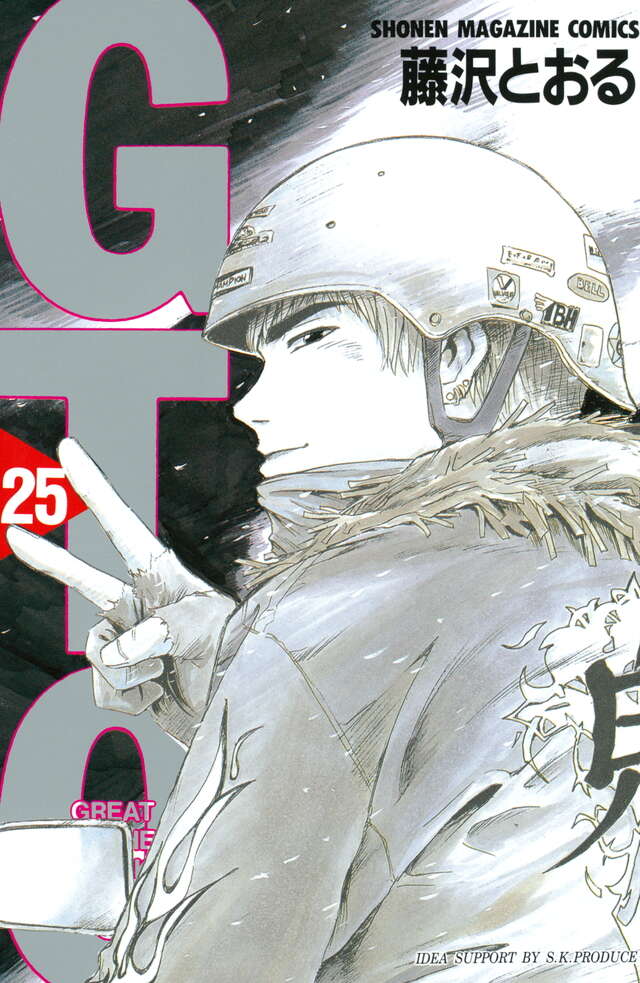
The final-book cover carries an earlier identity into the teacher story
The selected original Kodansha cover is for Japanese main volume twenty-five. It shows Onizuka wearing a helmet and patterned clothing, turning toward the viewer and making a two-finger gesture. Large GTO lettering and the visible volume number identify the product. It is an intact book cover, not an illustration newly generated for this guide.
Our reading of that visual is about continuity of identity. The helmet connects the teaching protagonist with the delinquent persona built into the premise. The cover does not dress him as a conventional institutional authority, which makes the question of how somebody earns trust more useful than judging him by a professional-looking costume.
The cover alone cannot prove the outcome of the final chapters, the meaning of the gesture in a particular scene or that a real teacher should imitate Onizuka’s methods. It provides original visual context. The analysis distinguishes a fictional character’s disruptive dramatic role from an endorsement of every action he takes.
Original visual reference
An outsider can expose what an institution has stopped noticing
Our central interpretation is that Onizuka’s outsider position makes the school’s routines available for scrutiny. Someone unfamiliar with the institution’s preferred language can notice a practical problem that a polished explanation has normalized. The dramatic question is whether his response helps the student or simply replaces one form of domination with another.
A close reading should therefore identify whose account of a problem is heard. A student labeled troublesome, an administrator worried about reputation and a teacher trying to maintain control can describe the same incident differently. Their explanations may each protect something, and the story becomes richer when those interests remain visible.
Disruption is not automatically wisdom. An unconventional response can reveal a neglected need while also creating new consequences. The useful analytical task is to follow those consequences for the named people involved, rather than awarding moral correctness to the loudest character because the scene is energetic or comic.
Credibility can be earned through action without erasing responsibility
The premise gives Onizuka little of the conventional appearance associated with respectable authority. Our reading asks how a student evaluates someone whose surface is unpromising but whose action may be protective. A promise becomes meaningful when it costs the adult something and when the student can recognize what was actually done.
That structure makes trust a relationship rather than a credential. It may grow through a specific encounter and remain limited in another area. A student accepting help does not necessarily approve of every joke, motive or decision. Avoid writing a whole class as instantly converted by one dramatic gesture.
There is also an important asymmetry: the teacher has adult power even when he presents himself as a rebellious peer. Analysis should preserve that responsibility. Treating the school as a comic battleground should not make a student’s embarrassment or vulnerability disappear merely because an adult wins the confrontation.
A joke can challenge authority and still deserve criticism
GTO’s comedy is part of its identity, including crude behavior and uncomfortable situations. Our interpretation separates the question of what a joke accomplishes in a scene from whether a reader finds its target acceptable. A sequence can puncture an official’s pretension while also relying on a dated assumption about gender or social standing.
That distinction supports discussion without requiring universal approval or universal rejection of the work. Name the actual situation, who receives the joke and what changes after it. A publisher’s localization note supplies useful edition context, but it is not a substitute for a reader’s analysis of the particular passage.
For adaptation comparison, inspect a named comic scene and its animated presentation. Timing, voice and reaction shots can change how an uncomfortable joke lands. This guide does not claim to have audited every dialogue change, and it does not infer that two editions have identical wording simply because their story outline is similar.
The source and the 1999 animated production have distinct records
Fujisawa created the manga. Studio Pierrot’s official archive identifies the television production’s 1999–2000 broadcast run and forty-three episodes, with Noriyuki Abe directing, Masashi Sogo handling series composition and Koichi Usami credited for character design. Historical production records should not be presented as announcements of a new animated sequel.
The displayed AniList score of 8.4 out of 10 is an observation for the 1999 television entry only. It is not a combined score for the manga, The Early Years, 14 Days in Shonan or any live-action adaptation. A future edition-specific comparison should preserve those boundaries even if audiences use GTO as shorthand for the larger property.
The linked Fandom and community destinations support navigation and discussion of related books, with spoilers possible. They do not control publisher completion status or certify a precise chapter bridge. Where fans disagree about reading order, distinguish a convenient first-reading recommendation from a documented claim about in-story chronology.
Digital republishing makes an older work accessible in a different form
The main and companion catalogs show how an established comic can remain available through digital editions and alternate bindings. Those products have their own identifiers and release dates. Their existence establishes distribution activity; it does not reveal whether every old print edition remains in stock or how much revenue the author receives from a sale.
No audited title-level profit or complete 1999 animation budget was verified for this guide. A collector’s asking price is not publisher revenue, and publisher-wide results cannot be assigned to one series without a reporting basis. Future numerical coverage should name the period, territory and measure before drawing commercial conclusions.
Begin the main comic or television introduction, then explore related teacher-era or earlier-history books deliberately. This stable guide can accept new catalog evidence and adaptation announcements later. It preserves the completed main source, avoids an invented prose route and leaves live-action developments in their separate coverage rather than inserting them among comic chapters.
Primary sources and useful navigation
- Kodansha · completed main-series archive and localization note
- Kodansha · final Japanese main book and selected cover
- Kodansha · main-series collected editions
- Kodansha · completed nine-volume companion
- Kodansha · companion final book print/digital records
- Studio Pierrot · historical television production record
- AniList · named adaptation audience score
Community and catalog routes
- MyAnimeList · named adaptation catalog
- Fandom · related-book navigation, spoilers possible
- Reddit · GTO discussion
- Wikipedia · secondary adaptation navigation
The production and publisher links support project facts. Catalog and community pages are secondary navigation and may reveal later events.
Find this work in our thematic collections
Original series imagery is reproduced under permission asserted by the site owner; the source and rights credits are retained. The route diagram is Animeteor’s own explanatory graphic.
Games and live-action adaptations
- GTO: the 1998 drama — Live action: Series · 1998
- GTO: the 2012 drama — Live action: Series · 2012
- GTO: the 2026 drama — Live action: Series · 2026
- GTO (2014) — Live action: Series · 2014
- GTO Revival (2024) — Live action: TV special · 2024
- GTO (1999 film) — Live action: Film · 1999