Phantom: 2000 TV, episodes 1–12. Optional foundation: first novel or 2019 episodes 1–3. 2019 anime: separate 18-episode route. English prose: two Omnibus books covering 1–6.
Reviewed 3 October 2026 · Opening premise and adaptation relationships. Major endings withheld; linked catalog summaries and discussions may contain spoilers. · Licensed access varies by country.
The source and screen branches

Watch each anime in its supplied order. The 2019 adaptation changes arc order and omits a named Pandora arc; prose and manga numbering cannot be exchanged.
- WATCH · Phantom: Optional foundation: And Others → 2000 television · episodes 1–12 → Separate original anime project
- WATCH · 2019: And Others · 1–3 → Imaginator · 4–9 → At Dawn · 10–13 → Distortion · 14–18
- READ · prose: Omnibus 1–3: Others + Imaginator → Omnibus 4–6: Pandora / Overdrive / Dawn → Not a complete Japanese-series claim
- READ · manga: Doesnt Laugh · volumes 1–2 → Other named manga: Imaginator / Dawn
Phantom and the 2019 series are different projects
Boogiepop Phantom is the twelve-episode 2000 television production. Boogiepop and Others is the eighteen-episode 2019 adaptation with its own official episode guide. They are not season one and season two, and the later title is not a remaster of Phantom. A first encounter should identify which story and presentation you are selecting before a service’s shared franchise label obscures that distinction.
Our recommended foundation is the first novel, Boogiepop and Others, or the first three episodes of the 2019 series, which present the similarly titled opening arc. You can then choose Phantom as a separate screen project and watch its twelve episodes in their supplied order. This is our editorial route for building context, not a claim that the later adaptation must be watched in full before the earlier production.
For the 2019 series, retain the broadcast order through episode eighteen. Its official guide places the opening arc at 1–3, VS Imaginator at 4–9, At Dawn at 10–13 and King of Distortion at 14–18. Do not move the prequel-labeled arc to the beginning for a first viewing. The English novels and the two-volume Doesnt Laugh manga provide different reading entries; live-action is excluded from this core map.
| Route | Sequence | What it does not mean |
|---|---|---|
| Phantom, 2000 TV | Optional foundation → episodes 1–12 | Not the first season of the 2019 anime |
| 2019 Boogiepop and Others | Episodes 1–18 in broadcast order | At Dawn does not require an opening reorder |
| English prose Omnibus 1–3 | And Others → VS Imaginator parts 1 and 2 | Three novels, not three anime seasons |
| English prose Omnibus 4–6 | Pandora → Overdrive → At Dawn | Not proof that the whole Japanese series ends here |
| Doesnt Laugh manga | Volumes 1 → 2 | Named manga route, not all Phantom episodes |
The 2019 order does not simply reproduce novel numbers
Seven Seas identifies the first English Omnibus as the first three prose books: And Others and the two VS Imaginator parts. The second collected edition contains books four through six. Pandora is book four, Overdrive: The King of Distortion is five and At Dawn is six. Keep those titles beside the numbers when discussing what a viewer has and has not encountered.
The 2019 episode guide puts At Dawn before King of Distortion and does not list a Pandora arc among its four groups. That makes a mechanical instruction to finish the anime and continue at novel seven misleading. Read the books in their published sequence if you want the prose route, including material not represented by a named anime arc. This guide supplies no fabricated final-episode-to-page conversion.
The official books page also distinguishes manga versions: Ogata’s Doesnt Laugh, Naoki Koshimizu’s VS Imaginator and Yoshihiro Kawabata’s At Dawn. Seven Seas lists its Doesnt Laugh edition in two volumes. These are separate named adaptations, not one manga whose volume numbers can be substituted for the prose omnibus numbers. Phantom is identified as an original anime project in the publisher’s licensing announcement, rather than a direct twelve-part version of the first novel.
Visual case: an identifying costume can also conceal a person
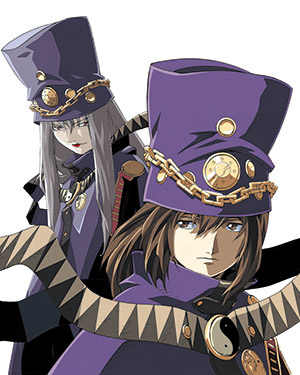
The rights-holder’s Phantom image places two hat-and-cloak figures against a mostly white background. Purple hats carry gold chains and circular ornaments; the rear face is pale and partly covered by light hair, while the foreground figure has brown hair and a more direct gaze. Recognizable costume links the figures visually, but the different faces stop the design from functioning as a simple portrait of one uncomplicated identity.
The original 2019 key visual instead sets a cloaked figure above a city at night. A small bright moon hangs in a large green-black sky, scattered light flecks cross the scene, and illuminated building windows give the figure a scale and location. The costume is familiar, but the surrounding city makes looking and being looked at part of the composition.
Our reading is that the first image concentrates recognition in a repeated emblem, while the second makes that emblem an interruption in ordinary urban space. Neither image tells the viewer how to place every event chronologically. Both offer a useful question: when a community recognizes a hat and a name, how much does it actually know about the person or force to which it attaches them?
Original visual reference

Nonlinear storytelling makes uncertainty a shared responsibility
The premise turns an urban legend into a way people explain alarming events. Students, adults and institutions can circulate a story before they understand it. That makes the central analytical problem more specific than asking whether a mystery is confusing: whose explanation becomes accepted, and what observations were left out when that explanation spread?
A story told through overlapping perspectives can make a later account revise an earlier inference without making the earlier account dishonest. Someone may have reported what was visible from a restricted position. Our suggested viewing notes separate observed action, a character’s explanation and the viewer’s inference. These three columns make a repeated encounter useful without reducing the experience to an elaborate chart of spoilers.
The rights-holder frames Phantom around pain and the uncertain promise of release from it. Our interpretation asks what kind of comfort a threatening legend can offer to someone already distressed. A frightening name may become attractive if ordinary support has failed. That is an analytical question about the work’s premise, not a diagnosis of viewers or proof that the story offers a healthy solution to real suffering.
Credit the source illustrator separately from the later anime designer
Kouhei Kadono is the novelist and Kouji Ogata the source illustrator. The English first-Omnibus record credits Andrew Cunningham for translation and Patrick King for adaptation. Those edition credits matter because the prose a reader encounters has a particular English presentation; differences in terminology should be checked against named releases rather than treated automatically as contradictory story facts.
The 2019 official staff page names Shingo Natsume as director, Tomohiro Suzuki for series composition and scripts, Hidehiko Sawada for character design and Kensuke Ushio for music, with MADHOUSE animation. Ogata is separately credited for source illustrations. A recognizable original costume does not mean the illustrator is the same person responsible for every animated model or shot.
The manga books page likewise names different artists for different arcs. Those contributions are worth comparing as choices in framing, page turns and the visibility of thought, without presuming that every manga is illustrated by Ogata. Our Serial Experiments Lain guide offers an independent comparison of identity and mediated knowledge; it does not establish a connected universe or make one production a necessary prequel to the other.
Atmosphere and clarity can produce different starting recommendations
The selected 2026 community version-preference discussion includes individual enthusiasm for Phantom’s atmosphere and another perspective favoring what animation, music and movement can bring to the premise. A December 2020 starting-order discussion makes different practical recommendations. These are named viewer experiences, frequently containing spoilers; they are not a representative survey proving that one version is the correct experience for everyone.
Our recommendation depends on the reader’s question. If you want the source’s initial construction, choose And Others in prose. If you want a modern animated presentation of several named arcs, choose the 2019 broadcast route. If you want the older, separate atmospheric screen project, choose Phantom and preserve its delivered order. Rewatching with a different question can be more useful than reconstructing all events before a first encounter.
The external 7.1/10 snapshot shown here belongs specifically to AniList’s twelve-episode Boogiepop Phantom entry, normalized from its 100-point audience average. It is not the 2019 adaptation’s score, a rating for Ogata’s manga or our own vote. Novel Updates is linked as a separate prose catalog; a score for one novel there would need its own scope rather than being averaged silently with Phantom.
A six-book English package is not evidence of franchise completion
The publisher’s March 2018 licensing announcement introduced a plan covering the first six English prose novels, including Pandora and Overdrive. The final first-Omnibus product record gives October 16, 2018, superseding the announcement’s earlier planned date. The second collected product record gives February 5, 2019. This is why a publication guide checks the actual edition record instead of treating an initial schedule as the final release.
The 2019 Japanese anime products page lists five disc volumes covering episodes 1–3, 4–6, 7–9, 10–13 and 14–18. That package contains the eighteen-episode screen route; it does not imply five novels were adapted in the same order or that Phantom is included. Historical retailer extras and initial-production benefits should not be promised with every current purchase.
No audited animation budget, profit or current total sales is established in this guide. A limited English catalog cannot by itself prove poor sales, a canceled Japanese series or a definitive final story. Check current publisher and licensed-service records for the actual language and territory you need. A fan’s explanation of why translations stopped remains speculation unless the publisher confirms it.
Use a route to preserve the mystery, not to solve it in advance
Start with the first novel or the opening 2019 arc if you want a foundation, then choose the separate Phantom production. Watch Phantom 1–12 in order before experimenting with chronology on a rewatch. A first-time reader should not need an ending diagram to understand which release to select; the route map therefore shows format relationships and edition boundaries while keeping resolutions undisclosed.
For a sustained prose route, read the two named English collections as books 1–3 and 4–6. Do not label the second collection the complete Japanese franchise, and do not jump to a later number solely because the anime ends. For manga, identify the adaptation title and artist first. Two Doesnt Laugh manga volumes are an edition choice, not a substitute for every other illustrated arc.
Future updates should be triggered by an actual new licensed volume, a confirmed screen project or a correction to source coverage. A fan-made chronology or a new preference debate should not manufacture a sequel announcement. Our Lain and Haibane Renmei guides offer other approaches to uncertain identity and painful belonging, while keeping each work’s creators, source relationships and chronology independent.
Primary sources and useful navigation
- d-rights · Phantom rights-holder catalog and original artwork
- 2019 anime · official site and original visual
- 2019 anime · official arc and episode guide; spoilers
- 2019 anime · named staff credits
- 2019 anime · disc-volume episode coverage
- 2019 anime · original books and distinct manga artists
- Seven Seas · prose and manga edition catalog
- Seven Seas · first Omnibus final release and named contents
- Publisher/distributor · Omnibus 4–6 coverage
- Seven Seas · 2018 licensing announcement and original-anime distinction
- Seven Seas · Doesnt Laugh manga volume 1
- AniList · named anime audience score
Community and catalog routes
- MyAnimeList · named anime catalog
- Wikipedia · Phantom navigation; spoilers
- Boogiepop Wiki · manga navigation; spoilers
- Novel Updates · And Others prose catalog and reader responses
- Reddit · selected 2026 version preferences; spoilers
- Reddit · selected December 2020 starting-order discussion; spoilers
The production and publisher links support project facts. Catalog and community pages are secondary navigation and may reveal later events.
Explore related story guides
Original series imagery is reproduced under permission asserted by the site owner; the source and rights credits are retained. The route diagram is Animeteor’s own explanatory graphic.
The Japanese prose line continued in June 2026
Dengeki Bunko released Boogiepop Crucify: Limit Gray no Yosei Gyakusetsu on 10 June 2026. The exact Japanese edition is ISBN 9784049522365, 296 pages, with Kohei Kadono credited as author and Kouji Ogata as illustrator. It is a current prose-line volume rather than a second season of Boogiepop Phantom or a continuation episode of the 2019 anime.