Classic entry: 1978 TV, 42 episodes. Alternate earlier-story branch: Arcadia of My Youth → SSX. Manga editions and the 2013 reboot/prose are separate choices.
Reviewed 3 October 2026 · Opening premise and adaptation relationships. Major endings withheld; linked catalog summaries and discussions may contain spoilers. · Licensed access varies by country.
The source and screen branches

SSX follows the Arcadia film. Toei positions this branch earlier than 1978 television; this map does not claim universal continuity. Games and live-action are excluded.
- WATCH · classic TV: 1978 television → Episodes 1–42
- WATCH · Arcadia: Arcadia of My Youth · 1982 → Endless Orbit SSX · 22 episodes
- READ · classic manga: Classic Collection → English volumes 1–3
- READ · new manga: Dimensional Voyage → Modern retelling · volumes 1–10
- WATCH / READ · 2013: CG reboot film → Takeuchi novel · same reboot premise
Start with 1978 television, or choose the Arcadia branch
The classic entry is Space Pirate Captain Harlock’s 42-episode 1978 television series. It introduces Tadashi Daiba, an Earth unwilling to confront danger and the outlaw captain aboard Arcadia. You do not need to study the whole Matsumoto universe first. Begin with the first episode if the original screen presentation is what you want to experience.
Another useful route begins with the 1982 film Arcadia of My Youth and continues with the 22-episode Endless Orbit SSX. Toei explicitly calls SSX a sequel to that film and describes its setting as earlier than the 1978 story. Our recommendation presents the film/SSX pair together, without claiming that every detail of its origins joins every other version seamlessly.
The 2013 computer-animated film is a reboot, with the infiltrator Yama providing a different entry into Harlock’s crew. It has an associated prose version, distinct from the original manga. Later titled productions such as Harlock Saga and The Endless Odyssey are optional investigations after an entry route; this guide does not force them into a single compulsory chronological chain.
| Choice | Entry and continuation | What it is not |
|---|---|---|
| 1978 television | Episodes 1–42 | Not dependent on the 2013 reboot |
| Arcadia of My Youth · 1982 | Then Endless Orbit SSX · 22 episodes | Not a promise of universal continuity |
| 2013 CG film | Separate reboot; associated prose optional | Not live-action or a 1978 sequel |
| Classic manga | Seven Seas Classic Collection 1–3 | Not the same numbering as Japanese originals |
| Dimensional Voyage manga | Modern retelling; volumes 1–10 | Not volume four of the Classic Collection |
Separate the classic manga, the modern retelling and reboot prose
Seven Seas identifies the Classic Collection as Matsumoto’s original manga and lists three English collected volumes. That is the named reading edition used here. Starting volume one gives you the manga’s own presentation of Daiba and the captain, rather than a chapter handoff assumed from the television finale. A collected volume is not automatically equivalent to an original Japanese volume.
Dimensional Voyage is a separate modern manga retelling credited to Matsumoto and Kouiti Shimaboshi, with ten volumes in the English publisher’s catalog. Read it from its first volume if you choose that approach. It does not follow simply because you have finished the third Classic Collection book, and its modern drawing should not be used to illustrate an alleged original manga panel.
KADOKAWA’s Captain Harlock prose record credits Harutoshi Fukui for story, Matsumoto for original work and Kiyoto Takeuchi for the novel. Its Yama infiltration premise belongs with the 2013 reboot. The paperback and digital edition have different release records. This novel is optional alongside that screen version; it is not certified as the source of the 1978 television series or its next chapter.
Visual case: the captain’s silhouette carries a claim to independence
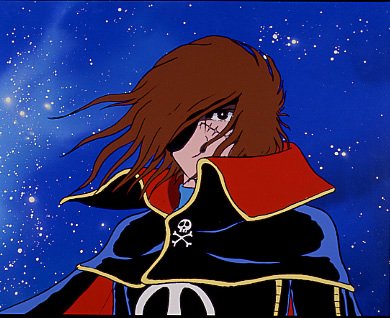
The first original television image shows Harlock’s brown hair sweeping across his face, an eye patch and a sharply raised red collar against a blue starfield. The skull on his chest is readable without a dialogue caption. Our visual reading is that the costume makes an outlaw identity immediate while the partially concealed face makes emotional access less straightforward.
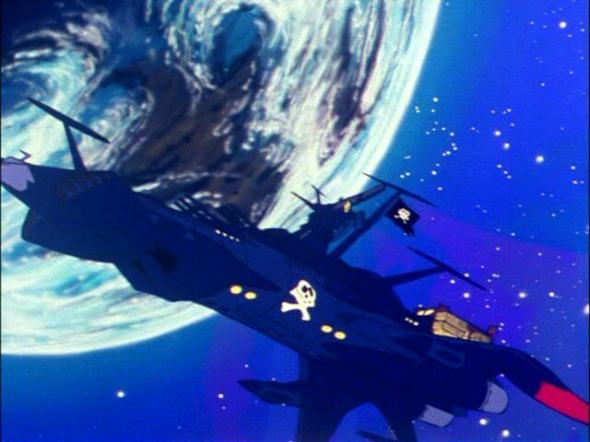
The second Toei television image places the ship diagonally beneath a huge planet. A skull emblem and dark hull keep a pirate vocabulary recognizable in space, while the planet’s scale prevents the vessel from owning the entire environment. This is a composition comparison between character and ship, not evidence that the images occur in adjacent shots or carry the same dramatic intention.
Ask whether the emblem announces freedom, danger or both to the people who see it. The same sign can mean solidarity to a crew and threat to an authority. We can identify that visual tension in these images; to assess how the series resolves it, examine the surrounding action, sound and decisions. Iconic recognition should start analysis rather than replace it.
Original visual reference
The outlaw’s freedom is measured by whom he remains responsible for
The opening television premise sets Harlock against an Earth that dismisses a looming invasion. That makes refusing institutional authority appear necessary, but refusal alone is not a complete ethic. Our central question is what responsibilities the captain accepts after rejecting the government’s priorities. A pirate can be free from official orders while still being accountable to people placed in danger by his choices.
Toei notes television-original elements such as Mayu and Commander Kiruta, while Japan’s National Film Archive highlights Mayu’s role in the captain’s attachment to Earth. That adaptation choice gives an abstract relationship to a planet a personal point of contact. It asks viewers to compare public declarations of independence with the effort required to keep a specific vulnerable person safe.
Daiba also provides a useful test of charisma. A confident leader may deserve trust, but a newcomer should not become convinced merely because the audience recognizes an impressive silhouette. Watch how information, evidence and lived encounters alter his judgment. The story becomes more interesting when loyalty is something a character must work through, rather than a costume’s automatic reward.
A recognizable captain has several distinct production histories
Toei’s television staff record names Rintaro as chief director, Kazuo Komatsubara for character design and Seiji Yokoyama for music. Its original-work credits include Matsumoto and Studio Nue. The staff and story pages together support a discussion of a manga adaptation with original screen elements; they do not support assigning every screenplay, drawing and musical choice to one individual.
Arcadia of My Youth has a separately credited director, Tomoharu Katsumata. The 2013 production names Shinji Aramaki as director and Kiyoto Takeuchi with Harutoshi Fukui for screenplay. Toei calls that full-CG film a reboot. A familiar ship or captain therefore does not imply one visual method or one unchanged narrative premise across these versions.
Compare a precise task when looking across them: how a captain enters a room, how a bridge distributes attention or how silence makes a command feel decisive. A painted starfield and a computer-rendered space can each support dramatic weight, but technical complexity does not automatically create a compelling character. The scene’s allocation of information and responsibility matters as much as its surface detail.
A viewer’s first version can shape expectations of the next one
The selected December 2024 Reddit post describes an individual discovering the first three television episodes after disliking the 2013 film, and finding the older captain more engaging. That is an early viewing response, not a review of the complete 42-episode series or evidence that every audience prefers it. It is useful as a prompt to ask what makes charisma visible in a scene.
A separate selected 2019 review values some character relationships while criticizing parts of the supporting cast. It contains significant spoilers, so use it after viewing if those debates interest you. We do not adopt its conclusions as verified production facts or turn a particular reviewer’s frustrations into a universal list of episodes that can safely be removed.
The displayed 7.3/10 score is AniList’s named 1978 television average converted from 100 to 10 on our review date. It does not grade the manga, SSX, reboot or prose edition. Our recommendation is to sample the classic opening if you want to understand its screen identity, then compare a chosen alternative with the format and audience scope kept visible.
An attributed budget belongs to one film, not the whole franchise
Toei’s 2013 film description states a total production cost of US$30 million. We report that as the production’s own published claim for the CG reboot, rather than an independently audited number or a budget for the 1978 television series. It establishes an identifiable scale claim; it cannot establish profit without comparable revenue, distribution and expense information.
Discotek’s licensed classic DVD catalog specifies all 42 television episodes, Japanese audio and English subtitles in a six-disc North American release. That is a concrete edition reference. It does not guarantee current stock, worldwide playback compatibility or a streaming service’s present rights. Likewise, Seven Seas’ collected manga listings describe editions rather than proving continuous retailer availability everywhere.
The National Film Archive’s 2026 program offers historical curatorial context for the original television production. A retrospective screening is evidence of continuing presentation, not a new season announcement. We keep those kinds of events distinct from production and avoid inventing a premiere for a future Harlock continuation. Follow the named primary catalog when comparing a purchase or a screening.
Explore another interpretation without pretending every origin agrees
For the classic television route, begin with episode one and continue through episode 42. For the Arcadia branch, watch Arcadia of My Youth before Endless Orbit SSX, following the official sequel relationship. Although Toei positions that branch earlier in story time, release-based entry avoids demanding that newcomers reconcile every recurring character’s history before they can enjoy a first encounter.
For reading, choose either the original Classic Collection or Dimensional Voyage and start the chosen edition at volume one. For the reboot, encounter the 2013 film and explore Takeuchi’s associated prose if you want that version in another medium. No exact television-to-manga or television-to-novel continuation chapter is certified. These are distinct approaches rather than a single completion checklist.
Our Galaxy Express 999 guide can help investigate Harlock’s appearances in another Matsumoto setting; Yamato offers a separate comparison of a ship, mission and collective responsibility. Such connections are invitations to explore, not proof that these stories share one chronology. Later updates should identify the production and reading edition affected before changing this map or a visitor’s chosen path.
Primary sources and useful navigation
- Toei · classic television catalog
- Toei · television story and original adaptation elements
- Toei · television staff
- Toei · Arcadia of My Youth film; story spoilers
- Toei · SSX sequel and earlier-story relationship
- Toei · SSX episode archive
- Seven Seas · original Classic Collection
- Seven Seas · Dimensional Voyage modern retelling
- Seven Seas · Dimensional Voyage volume catalog
- KADOKAWA · 2013 prose credits and edition records
- Toei · 2013 CG reboot and attributed production cost
- Discotek · complete classic DVD edition
- National Film Archive of Japan · 2026 television retrospective
- AniList · named anime audience score
Community and catalog routes
- MyAnimeList · named anime catalog
- Wikipedia · classic manga and adaptation navigation; spoilers
- Reddit · selected 2024 first-three-episodes response
- Reddit · selected 2019 television review; major spoilers
The production and publisher links support project facts. Catalog and community pages are secondary navigation and may reveal later events.
Explore related story guides
Original series imagery is reproduced under permission asserted by the site owner; the source and rights credits are retained. The route diagram is Animeteor’s own explanatory graphic.
Production and edition updates
- Captain Harlock × AstroKings — April–May 2026 event
- Captain Harlock — Japan-only rolling YouTube window in 2026
These separate records distinguish source editions, planned productions and dated exhibition or collaboration windows. Historical notices are not presented as new announcements; game and performed routes remain outside the core reading and viewing diagram.