2007 TV: episodes 1–24. The 1980 film is an alternative adaptation. Read Takemiya’s manga from volume 1; Keith’s spin-off and box extras are optional.
Reviewed 3 October 2026 · Opening premise and adaptation relationships. Major endings withheld; linked catalog summaries and discussions may contain spoilers. · Licensed access varies by country.

The source and screen branches

Anime versions are alternatives. Keith’s manga and named Blu-ray extras are optional; no exact post-anime chapter handoff is certified.
- WATCH · television adaptation: 2007 TV · episode 1 → Continue through episode 24
- WATCH · theatrical alternative: 1980 Toei feature film → Separate telling · not a TV sequel
- READ · original Takemiya manga: Chuko paperback edition · volume 1 → Volumes 2–3 · same named edition
Choose the manga, the 1980 film or the 2007 series as separate entries
Toward the Terra has two animated approaches to Keiko Takemiya’s manga: the 1980 theatrical film and the 2007 television series. The television route comprises 24 episodes. The film is not its pilot, and the series is not a sequel that requires the film’s ending. Choose one primary encounter and compare the other afterward if the premise interests you.
For reading, begin Takemiya’s original manga at volume 1. Our edition reference is Chuko’s three-volume Japanese paperback set, whose publisher records identify each numbered book. Those are comics despite being listed under a paperback imprint; the word bunko does not make them prose novels. Other editions can package the same material differently, so identify publisher and language before comparing numbers.
The official 2023 Blu-ray presentation includes the complete television series and lists optional extras, including an unbroadcast epilogue added to the finale. That is an edition detail worth checking after the main route, not a new season to insert between episode 23 and 24. A Keith-focused spin-off manga has its own creator and title.
| Material | Relationship | First encounter |
|---|---|---|
| Takemiya original manga | Story source; Chuko edition 1–3 | Begin volume 1 |
| 1980 Toei film | Alternative animated adaptation | Complete film; not TV prerequisite |
| 2007 television anime | 24-episode adaptation | Episodes 1–24 |
| Keith of the Blue Light manga | Fumino Hayashi spin-off | Optional after source/TV context |
| 2023 box extras | Pilot, epilogue and other named materials | Check edition; do not invent a season |
Comparison is more useful than an invented post-anime handoff
Aniplex’s official introduction identifies the 1977 manga, the 1980 film and the later television adaptation. Each gives an audience a different amount of time and a different visual presentation with which to meet the premise. Our map draws alternative adaptation routes rather than suggesting that the manga resumes automatically after episode 24.
The original manga and Keith of the Blue Light should also remain distinct. Square Enix credits the spin-off’s art to Fumino Hayashi and describes it as an exploration of Keith Anyan’s past. Its first volume was released in September 2007 and the publisher lists a second volume in April 2008. A familiar franchise title on the cover does not make it Takemiya’s original volume 4.
This guide does not certify a source chapter that an anime viewer can safely skip to. Begin the manga from the start if you want to examine how it handles viewpoint and transitions. For the named Chuko edition, the publisher lists volumes 1, 2 and 3 separately; those records verify the selected reading package without claiming that every English edition shares its numbering.
Visual case: a collective destination and one surprised face
The official Blu-ray artwork places an Earth-like planet behind a layered cast. A pale-haired woman with closed eyes occupies the upper composition, while a blond figure extends a hand toward the viewer from below. Our reading is that the image turns the destination into something shared but experienced through different people, rather than presenting the journey as the possession of one uncomplicated hero.
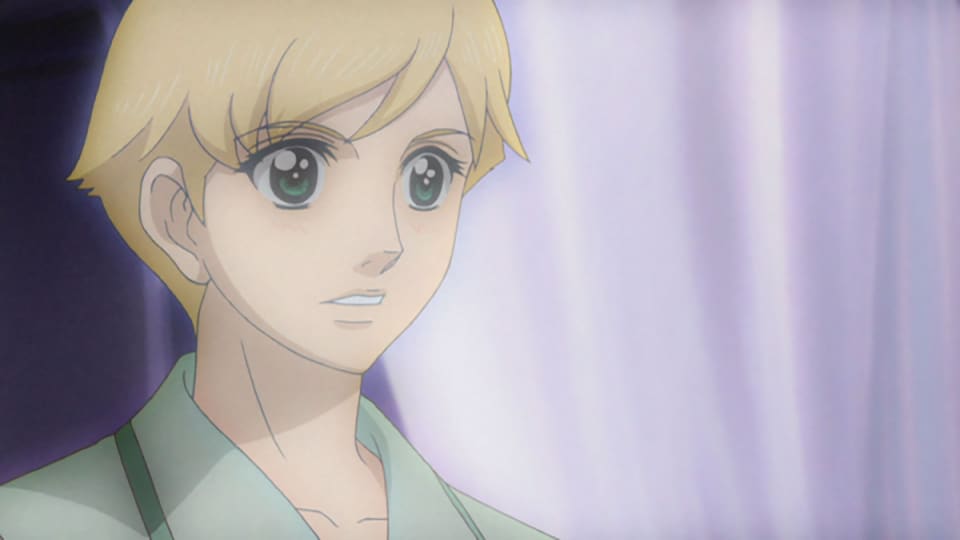
The original first-episode reference below shows a blond boy against a softly lit curtain-like background. His parted mouth and wide eyes reduce the large promotional ensemble to a particular moment of attention or surprise. The pairing suggests a useful viewing question: how does a collective promise become an individual responsibility before a character fully understands it?
These two images have different functions: one promotes a home-video presentation, while the other is a licensed episode reference. They do not establish a full exchange, a psychic effect or a later decision. Keep the visual observation limited to scale, gesture and expression, then use the scene’s actual dialogue and sequence when forming a stronger interpretation.
Original visual reference
The promise of home is shaped by exclusion
The official television premise describes humanity leaving an environmentally damaged Earth and living on colonized worlds under computer administration. The Mu, people with special abilities, face persecution and dream of returning to Earth. Soldier Blue chooses Jomy as a successor. Those facts frame a conflict in which being classified as different changes who can participate in the apparent social order.
Our analytical question is who gets to define restoration. A system can describe its decisions as necessary for humanity’s survival while excluding some humans from the category it protects. Watch how the story distinguishes an administrative judgment from a character’s lived experience. An orderly environment is not evidence that its rules are just, and an exceptional power is not automatically political freedom.
The desire to return also deserves scrutiny as an emotional relationship rather than only a destination marker. People can inherit a longing for somewhere they have not personally inhabited. Ask how leadership translates that longing into practical decisions, and how a younger person can carry a promise without simply reproducing every expectation placed upon them. This keeps the discussion anchored to the opening conflict without revealing the resolution.
The two animated productions require separate credits
Takemiya supplies the original manga. Toei’s film record identifies Hideo Onchi as director and Masami Suda as animation director, with music by Masaru Sato. Aniplex’s television credits instead identify Osamu Yamasaki as director, Nobuteru Yuki as character designer, Yutaka Izubuchi for concept design and Yasuharu Takanashi for music. Tokyo Kids and Minamimachi Bugyosho are credited for television animation production.
This separation prevents a common comparison error: attaching the film studio or composer to the television series because the franchise title is the same. It also makes a visual comparison more precise. Ask how each production presents a crowded social environment, an unfamiliar technological space or an expression of distress before deciding that a difference must be a change in the underlying story.
The 2023 official box attributes its new outer-case art to Yuki and its digipak artwork to Takemiya. That offers a concrete way to distinguish animated character design from source-artist presentation within one edition. Packaging can invite comparison, but does not by itself prove that a particular television sequence reproduces a manga page or was personally directed by the manga creator.
A divided older discussion gives useful viewing questions
The linked October 2020 Reddit discussion contains an appreciative response to the characters’ intersecting development alongside criticism of narrative consistency and pacing. Another participant preferred aspects of the film’s visual presentation while finding it compressed. These are individual assessments in a selected discussion of an older work, not a consensus score or a guarantee of how a new visitor will react.
Our recommendation is to separate three tests when watching: whether a relationship develops convincingly, whether an institution’s actions follow the rules established for it, and whether a transition gives an emotional change enough time. Liking the premise does not require approving every plot decision. Conversely, a difficult transition does not mean that every character interaction has stopped being meaningful.
The external score displayed here belongs to AniList’s 2007 television entry and is normalized from 100 to 10. The 1980 film and original manga have separate entries and are not folded into that number. The discussion links contain spoilers; use them after the main story if you want to compare a specific objection with what you actually observed.
A 2023 box is a dated edition, not a new 2026 broadcast
The official site announces the Blu-ray box for March 29, 2023 and specifies four main discs with the complete 24 television episodes plus a bonus CD. Its subtitle specification is Japanese, with an on/off option. That record does not promise English subtitles, current retail stock or access in every territory; those details need checking against the edition somebody intends to obtain.
The extras include a pilot, clean openings and endings, TYPE BLUE and the unbroadcast epilogue incorporated into the finale. A booklet and illustration book are also listed. These are useful distinctions for a collector comparing an edition with a basic viewing route. They should not be converted into a count of additional full television episodes or a newly announced adaptation.
The source and edition records reviewed here do not establish production profit or an audited budget. The defensible commercial account is that the manga has separately documented editions and the television series received a named collector presentation. A current purchase decision should compare format, language and completeness, rather than interpreting an older product’s list price as the franchise’s present market value.
Follow one complete telling before examining another
For our television entry, follow episodes 1–24 and check whether your edition includes the listed epilogue at the finale. For the historical film approach, select the 1980 Toei movie by year and director. Neither route requires switching to the other midway through. Their common source is the reason to compare them, not evidence of a single interleaved timeline.
Read Takemiya’s manga from volume 1 when you want to explore its visual storytelling directly. Verify edition numbering first, then use the Keith spin-off as a separately credited optional perspective after you know the main context. Publisher summaries of later volumes can expose major events, so avoid reading every catalog description merely to find the next numbered book.
Our Crest/Banner and Last Exile guides provide further comparisons of institutional belonging and inherited journeys. They are independent stories. Return to this guide when a verified edition or release changes the available choices; the update should name precisely what changed, whether it alters the core route, and which language or territory the new information concerns.
Primary sources and useful navigation
- Aniplex · introduction and television production credits
- Official television Blu-ray presentation and extras
- Toei · 1980 movie record and staff
- Chuko · original manga paperback volume 1
- Chuko · original manga paperback volume 2
- Chuko · original manga paperback volume 3
- Square Enix · Hayashi’s Keith spin-off
- Bandai Channel · licensed television record and imagery
- AniList · named anime audience score
Community and catalog routes
- MyAnimeList · named anime catalog
- Wikipedia · edition background navigation; spoilers
- AniList · original manga catalog, separate score scope
- AniList · 1980 film catalog, separate score scope
- Reddit · selected 2020 discussion; spoilers
The production and publisher links support project facts. Catalog and community pages are secondary navigation and may reveal later events.
Explore related story guides
Original series imagery is reproduced under permission asserted by the site owner; the source and rights credits are retained. The route diagram is Animeteor’s own explanatory graphic.