Watch Crest 13 → Banner 13 → Banner II 10 → Banner III 2. Read Crest novels 1–3, then Banner; manga and recap editions are separate branches.
Reviewed 3 October 2026 · Opening premise and adaptation relationships. Major endings withheld; linked catalog summaries and discussions may contain spoilers. · Licensed access varies by country.

The source and screen branches

Birth and compilation specials are optional. Exact post-anime source chapter is not certified; catalog numbering differs by medium.
- WATCH · main anime sequence: Crest · 13 episodes → Banner · 13 → II · 10 → III · 2
- READ · source novels: Crest novels · volumes 1–3 → Banner novels · restart at volume 1
- READ · Yonemura adaptation: Crest manga · volume 1 → Reviewed publisher catalog · through volume 8
Begin with Crest, then follow the numbered Banner productions
Crest of the Stars introduces the political and personal conditions that Banner of the Stars develops. Our first viewing route starts with the 13-episode Crest television series, continues through the 13 episodes of Banner, then the 10 episodes of Banner II and the two-part Banner III. These are separately named productions, not four interchangeable starting points.
The short Birth installment and the compilation specials are optional branches. A compilation revisits material already covered; it should not inflate the continuation count. For a first encounter, keep Birth until after Crest so that an earlier setting detail does not displace the introduction the main series gives you. The official archive identifies each production separately.
Readers should begin with Hiroyuki Morioka’s three Crest novels and then move to the Banner novels, whose volume numbering restarts at one. J-Novel Club lists both sequences together. A page headed Crest can therefore contain Banner books farther down; check the subtitle before treating its second Volume 1 as a duplicate purchase.
| Route | Verified scope | How to use it |
|---|---|---|
| Crest TV → Banner → II → III | 13 → 13 → 10 → 2 episodes | Recommended viewing sequence |
| Crest novels → Banner novels | Crest 1–3; Banner 1–6 in reviewed catalog | Source reading; numbering restarts |
| Yonemura manga | Volumes 1–8 in publisher listing | Separate visual adaptation |
| Birth / compilation specials | Optional short and recap material | Do not count as new Banner continuation |
The source continues beyond the available animated route
The novels are the underlying story source, while the animated productions select and dramatize material from that larger sequence. This distinction matters most at the end of Banner III: the final available installment in this viewing map is not a certification that the prose series ends there. The reviewed English catalog includes six Banner volumes after the three Crest volumes.
This guide recommends reading from Crest volume 1 when comparing media. It does not certify a precise chapter at which an anime viewer can skip into the prose without encountering adaptation differences. The official Banner III interview describes a change from the earlier television-length treatment of a novel to a two-part video presentation, which is useful context but not a chapter conversion chart.
Koichiro Yonemura’s manga is another adaptation, credited by COMIC Meteor to Morioka’s source. Its publisher page lists eight collected volumes and displays an April 28, 2021 chapter update. That is a historical timestamp on the page, not a fresh 2026 announcement. The list alone does not establish a complete adaptation of every Banner novel.
Visual case: personal faces carry a large political premise
The licensed Crest promotional illustration places two faces against a dark starfield. The larger brown-haired face and the blue-haired figure occupy different depths, while the title and stars provide very little architectural context. Our reading is that the image presents the relationship as a point of orientation before asking the viewer to understand a vast interstellar political system.
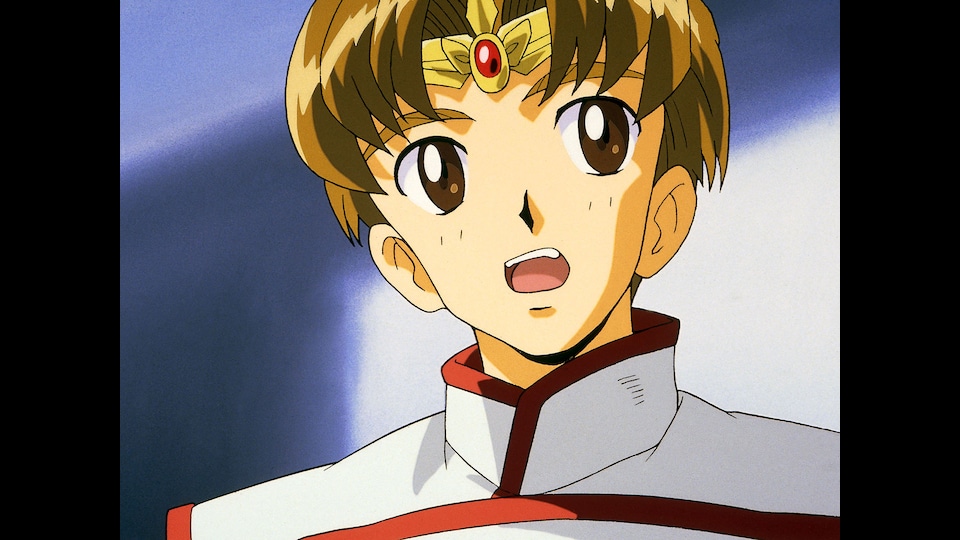
The original first-episode reference below narrows attention to a brown-haired figure wearing a pale uniform and an ornate headband. Compared with the promotional pair, it emphasizes the tension between an individual expression and formal insignia. That visible contrast offers a useful question for watching: when does a title or uniform tell us who somebody is, and when does their reaction complicate it?
The still does not establish the character’s complete emotional arc or prove a claim about an empire’s legitimacy. Follow how scenes introduce rank, address and unfamiliar words instead of turning an expression into a whole plot summary. The two images support an analysis of presentation; the official premise supplies the separate factual account of conquest and aristocratic status.
Original visual reference
Belonging is assigned before it is understood
J-Novel Club’s premise describes Jint’s home being conquered by the Abh Empire and his resulting position in its aristocracy. This is not the usual adventure invitation in which a protagonist freely joins an exciting organization. Our analytical starting point is the gap between a political identity imposed on somebody and the cultural understanding required to inhabit it.
Communication then becomes an action with consequences. A courteous address, a misunderstood term or an explanation of rank can affect how people interpret one another. Watch whether Jint is asking for information, negotiating his position or trying to make another person comfortable. A conversation can perform several of those jobs at once without becoming an interchangeable pause between space battles.
The relationship with Lafier is a useful scale at which to test the larger premise. Personal cooperation does not automatically justify imperial expansion, and criticism of an institution does not erase the people living within it. Asking how friendship and formal authority overlap gives the series a more productive discussion frame than selecting a faction as wholly admirable or wholly monstrous.
Invented language is also a production task
The official staff record credits Morioka’s novels, director Yasuchika Nagaoka, character designer Keisuke Watabe, visual concept artist Takami Akai and composer Katsuhisa Hattori. J-Novel Club separately identifies its translator, Giuseppe di Martino, and illustrator Akai. These credits let readers distinguish source writing, English rendering, character construction and the animated performance.
A production report dated May 20, 2005 describes Morioka coaching performers in the invented Abh language and translating lyrics for an anime-original song. The director also discusses adjusting the treatment for a two-part video release. These specific tasks show how a fictional linguistic system becomes something actors must pronounce and a production must schedule, rather than remaining decorative terminology.
Our viewing question is how that effort changes the experience of an unfamiliar culture. Listen for who explains a term, who assumes it is obvious and who must ask for help. The report documents particular production work; it does not make every later line a faithful transcription of the novels. English readers may also encounter Jint/Lafier where anime references use Jinto/Lafiel: spelling differences alone do not identify new characters.
Relationship and worldbuilding appeal do not guarantee the same reaction
The linked March 2024 Reddit discussion includes participants interested in the character relationship and political setting, alongside reservations about aspects of the presentation. The later whole-series discussion brings together people who chose to continue across multiple installments. These are selected conversations with spoilers, not a representative measurement of everybody who tried the first episode.
Our recommendation is to sample the opening for its communicative rhythm. If a discussion of titles and cultural expectations engages you, the series offers a different route into space opera than a guide centered entirely on machine combat. If it frustrates you, ask whether the problem is information density, pacing or the characters’ relationship before treating all three as the same objection.
The displayed external rating is AniList’s named 1999 Crest television entry, converted from its 100-point scale to 10. It is not an average of Crest, Banner sequels, manga and novels. The novel and manga catalog links are there for source navigation; community scores are not evidence for the correct reading order or a production’s commercial return.
Collection contents and continuing books answer different questions
The official archive separates original productions from compilation editions, and the publisher catalogs identify collected manga and prose volumes. A visitor can therefore compare what an edition actually includes instead of assuming that a larger package contains an additional sequel. The short Birth installment and recuts should be named when included, so episode totals remain meaningful.
For reading, compare Crest and Banner subtitles, volume numbers, language and format. For viewing, verify subtitles and territorial availability with the actual retailer or service. A Japanese licensed catalog confirms the identity and episode record used here; it does not promise that the same stream is available in an English-speaking visitor’s country.
The sources reviewed for this guide do not supply an audited production budget or profit figure. A long-lived catalog and multiple adaptations show identifiable forms of publication, but cannot establish a return-on-investment percentage. The manga publisher’s optional papercraft downloads are a concrete extra for interested readers; they are not another narrative installment or a required purchase.
Choose one primary route before comparing the branches
For watching, start with Crest and move through Banner, Banner II and Banner III in that order. Consult the optional short or compilations after the first series if their presentation interests you. This route keeps the initial encounter intact and avoids forcing recap material into a continuation sequence that already has clearly named stages.
For reading, follow Crest 1–3 before Banner 1 onward. Use the reviewed catalog to verify each next volume rather than extrapolating a release that is not listed. The Yonemura manga can be compared as a separate visual treatment, with its own volume numbers; it is not automatically a substitute for all the source prose or the later animated productions.
Our Gundam and Macross guides offer different approaches to military institutions and character relationships. They are independent works, not additions to this map. Return here when a verified book, adaptation or edition announcement changes the available routes: the guide can then name the new item and its placement without rewriting an optional product into mandatory chronology.
Primary sources and useful navigation
- Official Seikai production archive
- Official Crest episode list
- Official Banner episode list
- Official Banner II episode list
- Official Banner III staff and 2005 production interview
- Official Banner III episode list
- J-Novel Club · Crest and Banner English novels
- COMIC Meteor · Yonemura manga and original source credits
- Hayakawa · Banner VI source book
- Bandai Channel · licensed Crest record and imagery
- AniList · named anime audience score
Community and catalog routes
- MyAnimeList · named anime catalog
- Wikipedia · Crest background navigation; spoilers
- Novel Updates · source-novel catalog navigation
- Reddit · selected 2024 Crest discussion; spoilers
- Reddit · selected whole-series discussion; spoilers
The production and publisher links support project facts. Catalog and community pages are secondary navigation and may reveal later events.
Explore related story guides
Original series imagery is reproduced under permission asserted by the site owner; the source and rights credits are retained. The route diagram is Animeteor’s own explanatory graphic.