Begin the 1983 television series at episode 1 and finish its 52 episodes. Explore the prequel afterward for first discovery; prose and AT Stories begin independently.
Reviewed 3 October 2026 · Opening premise and adaptation relationships. Major endings withheld; linked catalog summaries and discussions may contain spoilers. · Licensed access varies by country.
The source and screen branches

Release order and story chronology differ. The new Die Graue Hexe film project is linked separately; an exact episode interleave is not certified.
- WATCH · main entry route: 1983 television · episode 1 → Continue through episode 52 → Choose named OVA expansion
- WATCH · retrospective prequel: The Root of Ambition → Earlier story · recommended after TV
- READ · television novelization: Takahashi · I: Udo → Continue named four-volume sequence
- READ · separate side comic: AT Stories · first collection → No certified post-TV chapter handoff
Start with the 52-episode television story, then choose an expansion
Armored Trooper VOTOMS begins with Ryosuke Takahashi's 1983 television series, a 52-episode route documented by the official archive. Chirico Cuvie participates in an operation against forces that should be on his own side, witnesses a military secret and becomes a hunted soldier. Start at episode one and follow the broadcast sequence for the mystery's intended introduction.
The Root of Ambition is an optional prequel released after the television production. Its official page explicitly places its story before television, while also describing information about Chirico that the main series gradually reveals. Our first-view recommendation is therefore television before that retrospective expansion. Story chronology and a useful discovery order answer different questions here.
The archive also lists The Last Red Shoulder, Big Battle, Pailsen Files and several later projects. Treat them as named expansions with individual relationships, not 52 additional numbered television episodes. The map gives a safe starting route and separates prose and side comics. It does not promise a complete spoiler-free interleaving of every OVA into individual television episodes.
A television novelization and AT Stories have different reading roles
The official archive's September 30, 2003 book announcement identifies volume IV, Quent, as the completion of the television novelization and credits Takahashi with illustrations by Kunio Okawara and Norio Shioyama. KADOKAWA separately identifies the Udo opening volume. These records support starting the prose version at volume I, not at the final book merely because its announcement is easiest to find.
AT Stories is a separate comic product. The new film's official staff announcement confirms Yoshihiro Sono's association with its art, while the linked bookseller record names Sono and Masaaki Okajima and identifies Futabasha's comic edition. Begin its first collection independently. The bibliographic record does not certify that one of its chapters continues exactly where television ends.
For an animation set, compare the listed 52 television episodes with OVA titles and compilation presentations. A package advertising Red Shoulder may contain a later expansion rather than the whole original series. Likewise, an old October 1 book announcement is dated 2003; it must not be converted into an upcoming October 2026 release on a current calendar.
| Presentation | Start | Relationship |
|---|---|---|
| 1983 television | Episode 1 → 52 | Primary animated entry route |
| The Root of Ambition | After television for first discovery | Earlier story, later-produced prequel |
| Takahashi prose | I: Udo → named volume sequence | Television novelization |
| AT Stories comic | First named collection | Separate reading; no certified TV handoff |
| Die Graue Hexe | Separate new-film project | First film announced for Japan, 20 Nov 2026 |
The soldier and the command room occupy different visual positions
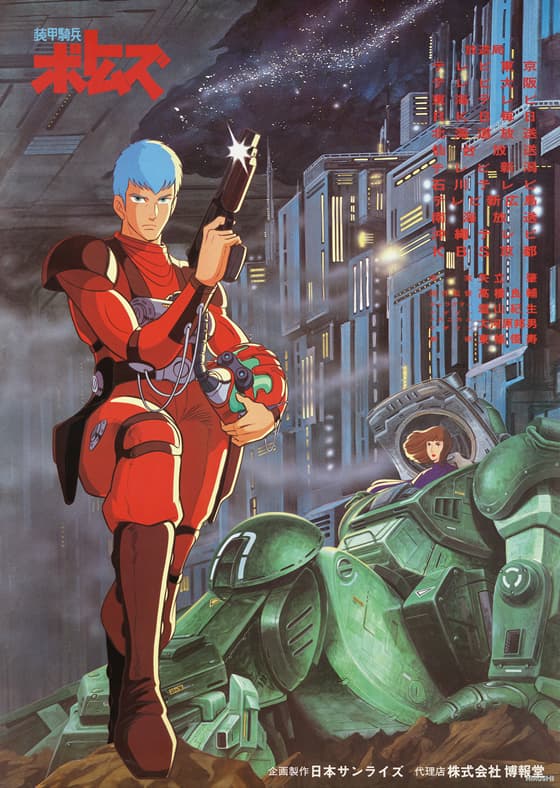
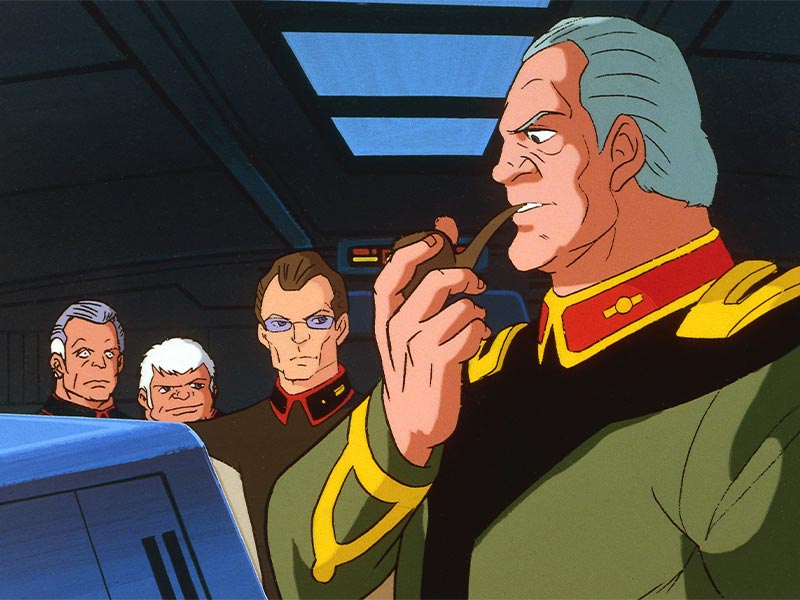
The official television poster places a red-suited, blue-haired soldier with a raised firearm beside green armored machinery against a dense industrial city. The opening-episode reference below instead gives a pipe-smoking officer a large foreground position, with other uniformed men behind him and a console at the edge of the frame. These are different original images with different functions.
Our interpretation follows the contrast in access to power. The poster's soldier is exposed as a full figure among machinery and buildings, while the command-room image concentrates attention on people evaluating something from within an enclosed working space. Clothing, equipment and position create the distinction; the still alone cannot establish what order is being given or how every participant feels about it.
That contrast introduces a useful question for the series: who experiences an operation as a decision, and who experiences it as a physical risk? A soldier may be visually central on the poster while lacking the institution's control over the situation. Following that gap gives the mecha action a human and organizational context without needing to disclose Chirico's later identity revelations.
Original visual reference
An armored trooper is a military tool that places a person inside risk
The official terminology guide describes armored troopers as compact, single-operator combat machines. Our reading treats that design as a relationship between machinery and a vulnerable body. Enclosing a pilot in armor does not remove the person's dependence on orders, maintenance and the environment in which the tool is used.
The poster makes this relationship visible by placing a human figure beside the machine rather than replacing him with its silhouette. Mechanical scale remains important, but the soldier's exposed posture supplies another measure of danger. A viewer can ask whether a sequence emphasizes the operator's judgment, the equipment's capabilities or the pressures that make a risky engagement unavoidable.
This differs usefully from a story built around a uniquely sacred robot. For a focused comparison, follow a particular machine's damage and replacement rather than assuming its continued presence guarantees safety. The archive supplies terminology, while an actual episode supplies the evidence for what happens in combat. We do not infer armor performance specifications or survival probabilities from a promotional illustration.
The end of a war does not end the structures that shaped its soldiers
The official television premise places Chirico's pursuit across the closing stage of a century-long war and its aftermath. A formal change in hostilities does not immediately give the protagonist a secure civilian identity. Our analysis asks how secrets, military organizations and personal survival continue to structure life after the conflict's official boundary.
The opening operation against supposed allies makes institutional loyalty uncertain at the point where a soldier would normally rely on it. Who is protected by a secret, and who becomes disposable because they have seen it? Those questions can guide a first viewing without explaining the secret's ultimate place in the series' larger mystery.
The command-room reference makes that uncertainty tangible as a hierarchy of people and information. A close officer's composure may suggest authority to the viewer, but the image cannot prove the authority's legitimacy. Follow how the series distributes knowledge between commands and those subjected to them. The protagonist's survival and the institution's account of an operation need not describe the same experience.
Takahashi’s original project and Oshii’s new film should keep their identities
The official television archive credits Takahashi as original creator, director and series organizer. Its prose announcement also names him as author, with Okawara and Shioyama illustrations. Those connections let readers follow a creator across animation and prose while still distinguishing the work of direction from a book's narration and illustration.
The May 12, 2026 official announcement for Die Graue Hexe identifies Mamoru Oshii as director, Takahashi as original creator and supervisor, and Kenji Kawai for music. It describes a two-part theatrical project and announces its first Japanese film for November 20, 2026. That is a dated, territorially scoped release fact, not an international streaming promise.
The new project's official introduction describes new central characters within the wartime world. This guide links its current source separately rather than assigning it an unverified exact position among Chirico's individual episodes. A completed future film can receive its own analysis and external rating scope; the classic television score displayed here should not be reused as a score for an unreleased presentation.
Separate a chronological debate from a first-view recommendation
The AniList figure on this page belongs to the original 52-episode television entry. It does not pool the prequel, later OVAs, prose and AT Stories into a franchise average. Readers comparing a short OVA with the original run should account for that scope before using the number as a guide to the time commitment they want.
Community discussion can help identify compilation names, physical editions and different translation choices for the same title. For chronology, the official Root of Ambition page provides the crucial earlier-story relationship. A fan's preference for watching the prequel first is a viewing recommendation; it is not proof that doing so preserves the television mystery's reveal order.
The franchise wiki and broader mecha community are optional exploration links. Their character pages and complete timelines can disclose Chirico's history immediately. Stay with the opening operation, branch table and the original first-episode reference for a spoiler-bounded entry, then return after television if you want to debate how retrospective material changes the initial reading.
Dated product activity cannot replace edition contents or financial evidence
The official archive preserves older book releases and the new film project maintains current announcements. These offer useful checkpoints for revisiting VOTOMS, but they describe different products at different dates. Before buying, identify the particular television or OVA presentation, available language, region and contents. A toy or collector release does not establish access to the animation.
No audited production budget or net-profit total was verified for the original series or new film. Merchandise variety and a long archive demonstrate ongoing products, not an arithmetic basis for inventing financial success. A reader can make a more grounded decision by comparing the edition they will receive with the route they have chosen.
Finish the original television story, then choose The Root of Ambition for retrospective context or begin Takahashi's prose for a medium comparison. Explore AT Stories as its own comic collection. Patlabor offers a separate view of mecha as institutional equipment, while Mobile Suit Gundam supplies another war-and-pilot entry route outside VOTOMS continuity.
Primary sources and useful navigation
- VOTOMS · official original television archive
- VOTOMS · original opening-episode reference
- VOTOMS · official terminology
- VOTOMS · Root of Ambition prequel
- VOTOMS · 2003 final novelization volume announcement
- KADOKAWA · Takahashi Udo opening novel
- Rakuten Books · AT Stories bibliographic edition
- Die Graue Hexe · official new-project introduction
- Die Graue Hexe · dated first-film announcement
- AniList · named anime audience score
Community and catalog routes
- MyAnimeList · named anime catalog
- VOTOMS Wiki · franchise navigation, spoilers possible
- Reddit · mecha discussion
The production and publisher links support project facts. Catalog and community pages are secondary navigation and may reveal later events.
Explore related story guides
Original series imagery is reproduced under permission asserted by the site owner; the source and rights credits are retained. The route diagram is Animeteor’s own explanatory graphic.
Separate film project and Phantom Arc distribution
The already announced Die Graue Hexe animated film project now has its own linked adaptation record; it does not become a live-action product. Separately, the official 1 August 2026 notice says the existing six-episode Phantom Arc began rolling out across named Japanese streaming services that day. This distribution notice does not add a new OVA episode or establish international access.
Die Graue Hexe adaptation record · First-film Japanese release record · Official Phantom Arc distribution notice