Start the 1979 television route or the compilation film trilogy. The Origin manga and Tomino’s prose book are parallel reinterpretations, not post-anime chapter continuations.
Reviewed 3 October 2026 · Opening premise and adaptation relationships. Major endings withheld; linked catalog summaries and discussions may contain spoilers. · Licensed access varies by country.

The source and screen branches

Television and the compilation films are alternative screen routes. The manga and prose are separate reinterpretations; continue the main Universal Century screen discovery toward Zeta after the original route.
- WATCH · original television: 1979 anime · episode 1 → Original production catalog · 43 episodes
- WATCH · alternative films: Compilation film I → Film II → Film III
- READ · comic reinterpretation: The Origin · volume 1 → English hardcover sequence · 12 volumes
- READ · prose reinterpretation: Awakening, Escalation, Confrontation → Complete the prose presentation
Begin with the original war story, not a franchise-wide checklist
Mobile Suit Gundam is the 1979 television production that begins the animated franchise. Sunrise’s production catalog identifies 43 original episodes, Yoshiyuki Tomino as director and Hajime Yatate and Tomino as original-story creators. Start at episode one when choosing the television route, and follow the numbered sequence supplied by your legitimate edition.
The compilation film trilogy is another presentation of that opening war story. Its three films are an alternative viewing route, not three sequel installments to place after television episode 43. For a newcomer who wants the longer character rhythm, choose the television series; for a more compact presentation, choose the film trilogy in its own release sequence.
Universal Century is a fictional chronology label, while 1979 is a production date. The story’s calendar and the order in which audiences encountered the productions answer different questions. This page recommends beginning with the original presentation before pursuing prequels and side stories, so that learning more history does not replace the experience of meeting the characters in their first main narrative.
The Origin manga and Tomino’s prose book are reinterpretations
Vertical’s English publisher page identifies twelve hardcover volumes of Yoshikazu Yasuhiko’s Mobile Suit Gundam: The Origin. It describes a comic treatment of the classic narrative by one of the original creators. Begin its first volume independently; a volume number in this manga is not a marker telling a television viewer where to continue after the anime.
Stone Bridge Press publishes Tomino’s Mobile Suit Gundam: Awakening, Escalation, Confrontation in English, translated by Frederik L. Schodt. The publisher describes a reimagining of the original events. Read it from the beginning as its own prose presentation rather than assigning its events automatically to the television sequence.
These distinctions are especially important when collecting products bearing the same prominent Gundam name. Check whether the object is a television set, a compilation movie, a manga volume or a prose book. A shared character or machine on the cover establishes a connection, but it does not establish identical continuity, contents or a direct handoff between formats.
| Presentation | Start | Relationship |
|---|---|---|
| 1979 television anime | Episode 1 · original catalog 43 | Original screen route |
| Compilation film trilogy | First film → second → third | Alternative condensed presentation |
| The Origin manga · Vertical | Hardcover volume 1 → 12 | Comic reinterpretation |
| Tomino prose · Stone Bridge Press | Beginning of the collected book | Separate prose reinterpretation |
The promotional robot towers over the inexperienced people
The official 1979 promotional visual puts the Gundam at the center, with a raised shield, weapon and companion machines surrounding it. Amuro and Fraw occupy much smaller figures near its lower edge. That scale relationship is visible in the inspected poster and offers a concrete way to discuss the invitation made to an audience.
Our reading starts with a tension: the image sells a powerful machine, while Sunrise’s premise introduces an inexperienced boy and refugees forced into a military escape. A robot’s commanding visual presence does not erase the vulnerability of the people who have to operate and live alongside it. The contrast is useful before any detailed discussion of battles or later character outcomes.
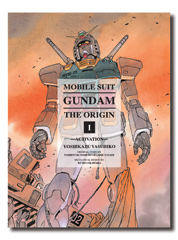
The Origin cover below is publisher-supplied manga artwork, not a television still. Its separate book identity matters because Yasuhiko’s return to the material invites another telling. We retain the publisher’s small cover resolution and label it precisely, instead of using the comic image as evidence of how a particular 1979 shot was staged.
Original visual reference
The escape premise turns a war machine into a responsibility
Sunrise’s synopsis begins with war reaching Amuro’s home and the inexperienced group escaping aboard White Base. Our interpretation treats the ship as more than transport between battles. When civilians and unprepared personnel share a military vessel, the action can continually ask who makes decisions, who performs necessary work and who bears the consequences.
That lens helps a newcomer follow the story without memorizing every mobile suit designation first. Watch for the difference between possessing equipment and knowing how to use it reliably. A powerful prototype can create an immediate advantage while leaving the human organization around it fragile. The practical conflict then includes exhaustion, authority and trust as well as weapon range.
A later scene comparison can examine who occupies the foreground, who speaks and whether civilian reactions interrupt the apparent triumph of a successful sortie. Those observations need actual scene evidence. The poster alone cannot prove them; it supplies the introductory visual question, while the viewer’s experience of the numbered route provides the material for answering it.
A rival can expose a protagonist’s limited understanding
The familiar Amuro and Char names recur across Gundam discussions, including the prose publisher’s description. Rather than beginning with a ranking of their combat abilities, a useful first-reading question is what each person knows about the conflict and what each assumes about the other. Unequal knowledge can make an encounter matter beyond the visible outcome.
Our interpretation distinguishes tactical rivalry from moral understanding. Predicting another pilot’s next move is not necessarily understanding that person’s motives or the institutions behind them. This distinction gives a reader a way to discuss the developing opposition without revealing its later history or treating a slogan about heroes and villains as sufficient analysis.
It also explains why a reinterpretation deserves its own route. If a prose or comic version changes the information supplied to a reader, the relationship can feel different even when recognizable names and machines remain. The correct comparison begins with what that version actually presents, rather than importing every detail remembered from another medium.
Zeta is a later Universal Century work; other Gundam worlds are different starts
Sunrise’s Zeta Gundam record describes events seven years after the One Year War and links the original Mobile Suit Gundam as a related television production. Zeta therefore belongs to the next main discovery step for someone continuing this Universal Century screen route. Its own article will distinguish the original television series from its later film presentation.
Iron-Blooded Orphans and The Witch from Mercury are already represented elsewhere in our library. They offer other Gundam starting experiences and should not be inserted as missing episodes of Amuro’s original journey. A franchise brand can unite design interests and audiences while individual settings require separate reading and viewing maps.
The map intentionally shows a manageable first decision: television or the compilation films, with the manga and prose as parallel reinterpretations. It does not pretend to be an exhaustive Universal Century chronology. Once the original route is complete, a reader can expand into later works using their own named guide rather than having dozens of optional titles crowd the first entrance.
A franchise recommendation needs a named adaptation and an edition
The AniList audience score shown here is for the original 1979 television anime. It is not the score of the compilation trilogy, The Origin manga or the entire Gundam franchise. Keeping that boundary visible matters because a recommendation attached to one production can otherwise appear to endorse every product carrying the same name.
Community questions about whether to begin with a prequel or the original series reveal a real discovery problem. The practical answer in this guide is to choose an original-war presentation first, then explore alternate tellings. That is an editorial entry recommendation, not a claim that every chronological-first viewer is following an invalid personal route.
The Gundam Wiki and subreddit are useful places for machinery details, edition comparisons and discussion after the first viewing. Character biographies often disclose relationships and later outcomes immediately. Use the official production and publisher records to identify the presentation before following those deeper navigation links, particularly when a search result uses only the franchise name.
Gundam’s wider business cannot be assigned to this one television title
Bandai Namco’s official franchise explanation places the original television series at the beginning of a much larger body of productions. That context explains why books, model kits and later animation can all appear beside the same recognizable machine. It does not supply a title-level profit account for the 1979 production.
No audited original-series budget or net-profit figure was verified for this guide. A franchise revenue figure or a current collectible’s asking price should not be substituted for that missing evidence. For a viewer or reader, the useful comparison is the actual presentation being purchased: episode or film contents, language, region restrictions and the specific edition’s specifications.
Finish the chosen original-war route, then continue toward Zeta if you want that screen continuity or begin The Origin or Tomino’s prose for a second perspective. Outlaw Star offers a different shipboard adventure, and Macross will provide another relationship between military machinery and civilian life. Those are discovery comparisons, not claims that the worlds share canon.
Primary sources and useful navigation
- Sunrise · original television production
- Bandai Namco · compilation-film trilogy release
- Vertical · The Origin manga volumes and creators
- Stone Bridge Press · Tomino’s prose reinterpretation
- Sunrise · Zeta’s later Universal Century setting
- Bandai Namco · official franchise introduction
- AniList · named anime audience score
Community and catalog routes
- MyAnimeList · named anime catalog
- Gundam Wiki · original television entry
- Reddit · starting-point discussion
The production and publisher links support project facts. Catalog and community pages are secondary navigation and may reveal later events.
Explore related story guides
Original series imagery is reproduced under permission asserted by the site owner; the source and rights credits are retained. The route diagram is Animeteor’s own explanatory graphic.
Games and live-action adaptations
- Mobile Suit Gundam Battle Operation 2 — Steam — Game: Online team battle action
- Mobile Suit Gundam Battle Operation Code Fairy — Game: Single-player mission action
- Gundam — Jim Mickle live-action project — Live action: Film · in production · premiere unannounced
Production and edition updates
- Mobile Suit Gundam — original-series remaster planned for 2029
- Gundam The Origin Deluxe — six-volume English edition
- Gundam The Origin — six-part animated prehistory
- Gundam live-action project — January 2025 co-financing agreement
These separate records distinguish source editions, planned productions and dated exhibition or collaboration windows. Historical notices are not presented as new announcements; game and performed routes remain outside the core reading and viewing diagram.