Bloodlust: independent feature entry, based on novel 3. Prose: volume 1 onward; Omnibus Book One collects novels 1–3. Takaki manga: separate numbered reading route.
Reviewed 3 October 2026 · Opening premise and adaptation relationships. Major endings withheld; linked catalog summaries and discussions may contain spoilers. · Licensed access varies by country.
The source and screen branches

Bloodlust adapts novel 3, not a complete novel series. The 1985 film is another encounter. Fortress of Blood is scheduled future comic material, not a released sequel.
- READ · novels: Volume 1 → Raiser of Gales → Demon Deathchase · novel 3 → Omnibus Book One collects all three
- WATCH · 1985: Earlier animated feature → Doris Lang hires D · separate encounter
- WATCH · Bloodlust: Source: Demon Deathchase → Complete animated feature → Remasters are new presentations
- READ · manga: Kikuchi / Saiko Takaki → Named manga volumes from 1 onward
Two films are two encounters with D, not a complete adaptation of the novels
Bloodlust is a practical screen entry for someone seeking gothic pursuit, elaborate creatures and a morally uncertain rescue. You can watch the feature without completing the 1985 animation first. Its source is Hideyuki Kikuchi’s third novel, Demon Deathchase, as the English publisher explicitly identifies. That does not mean two previous films adapt the first two books or that Bloodlust completes the novel series.
The 1985 feature follows the opening situation of Doris Lang hiring D after a vampire threatens her. Ashi Productions identifies that production and its staff separately from Bloodlust. Watch it for an earlier animated interpretation, rather than treating its visual style as an inferior draft of the later film. These are distinct encounters with the same traveling hunter; neither is a television season.
For prose, start Vampire Hunter D volume one and continue with Raiser of Gales and Demon Deathchase. Dark Horse’s first Omnibus collects exactly those three novels. Saiko Takaki’s manga is a separate illustrated reading route, offered in named volumes by eManga. Games are excluded from our core map. Newly announced comics are labeled as future publications rather than silently added to a completed reading sequence.
| Entry | Recommended start | Keep separate |
|---|---|---|
| Bloodlust animated feature | Watch the whole film | Based on novel 3; not a full-series conclusion |
| 1985 animated feature | Watch the whole film | Different production and opening encounter |
| Original novels | Volume 1 → Raiser of Gales → Demon Deathchase | Omnibus Book One contains these three |
| Saiko Takaki manga | Named manga volume 1 onward | Not novel numbering or the new Western comic |
| Fortress of Blood comic | Issue 1 scheduled December 16, 2026 | Future four-issue project, not a released manga sequel |
Find the source story by title before choosing an omnibus
The first prose Omnibus offers a clear starting package: three early novels, illustrated by Yoshitaka Amano and translated into English by Kevin Leahy. Its 2021 publication date belongs to that collected English edition. It is not the date the character was invented, and a retailer category containing comics does not change these illustrated prose books into manga.
Demon Deathchase is the source comparison for Bloodlust. Read it from its opening when examining what prose narration, explanations and interior perspective contribute beside an animated performance. The film’s existence is not evidence that every passage was reproduced, and our guide gives no invented page at which the animation stops. A film can reshape a novel into a different dramatic unit while retaining its central pursuit.
The manga listings credit Kikuchi and Takaki. Volume three describes a competing bounty hunt involving a vampire noble and the Marcus family, while volume one introduces the human settlements and the Nobility. Those publisher descriptions help identify the books without certifying identical chapter-to-shot coverage. Later collected editions must be checked individually: the first prose Omnibus containing three novels is not a universal conversion formula for every numbered collection.
Visual case: the hunter’s silhouette and the novel’s ceremonial figure
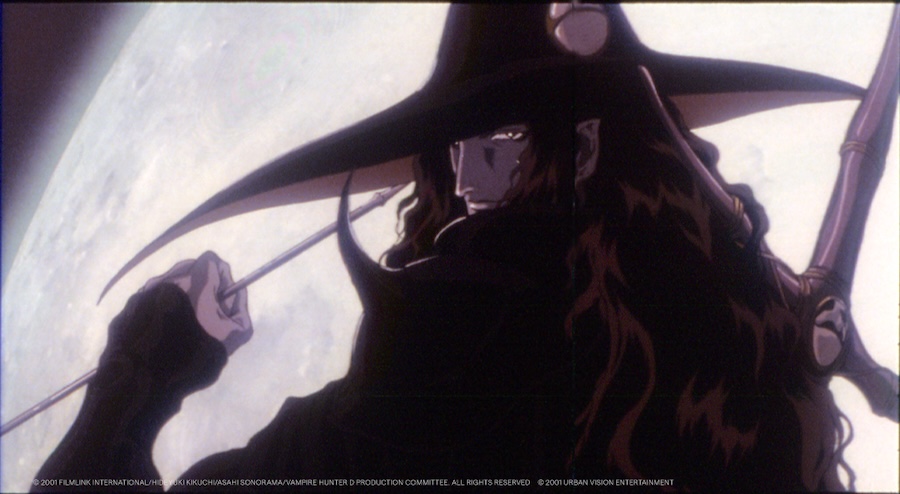
The original Bloodlust image supplied by GKIDS places D against a large pale moon. His wide hat cuts across the luminous background, while dark clothing and long hair leave the face partly obscured. A raised hand holds a thin line near the face, and a weapon rises behind his shoulder. The image makes recognition depend on silhouette before it offers a readable expression.
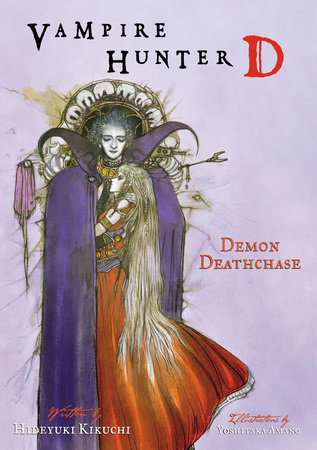
Amano’s Demon Deathchase cover uses another visual language: a pale face, an ornate circular structure, a high purple collar and long light hair occupy a lavender field. Orange fabric supplies a concentrated warm contrast. The figure is presented with ceremonial detail rather than the film image’s strong dark mass. We do not identify this cover figure as D merely because D’s name appears above it.
Our comparison asks how costume can make someone legible while a face remains emotionally distant. The film image gives the hunter an imposing edge against the moon; the cover asks the eye to inspect decoration and elongated shapes. These are two original promotional or cover compositions, not a certified sequence of matching panels. They support a visual argument without revealing the pursuit’s resolution.
Original visual reference
A rescue contract is also a claim about who owns another person’s choice
The premise of Bloodlust begins with an apparently abducted woman, a father who hires D and rival mercenaries pursuing the same target. A straightforward bounty story would let the contract define justice in advance. The more interesting analytical question is what happens when the hired hunter discovers that the employer’s description may not capture the wishes or circumstances of the people being pursued.
D’s position between human and vampire categories makes that question sharper. Communities need his power while the visible signs of his identity can also make him suspect. Acceptance based only on usefulness is fragile: the same outsider can be welcomed during a crisis and excluded when the crisis ends. Examine whether a character listens to him as a person or merely purchases what he can do.
The frontier setting combines old aristocratic power with a world whose remnants do not belong to ordinary medieval history. That mixture matters more than simply calling it a vampire western. A journey can cross institutions that define danger differently, and a beautiful or frightening appearance can distort moral judgment. Our reading keeps the final choices undisclosed while asking which assumptions the opening contract encourages the viewer to make.
Amano’s source imagery meets two different animation teams
Kikuchi writes the novels and Amano supplies their illustrations and original character imagery. The 1985 production record names Toyoo Ashida as director and Tetsuya Komuro for music. Those credits identify a particular earlier screen treatment. They should not be transferred to Bloodlust merely because both productions carry Vampire Hunter D in their titles.
Avex’s Bloodlust record names Yoshiaki Kawajiri for direction, screenplay and storyboards, with animation by MADHOUSE. It credits Yutaka Minowa for character design and Marco D’Ambrosio for music, alongside Amano’s original character role. The distinction lets a reader separate the source illustrator’s contribution from the decisions needed to make designs move through a film.
Kawajiri also directed Ninja Scroll, making our guide to that film a useful independent comparison of a traveling fighter, dangerous encounters and visual spectacle. It is not part of D’s continuity. The forthcoming Fortress of Blood comic names Chris Condon, Kikuchi, artist Filipe Andrade and colorist Jordie Bellaire. Its different team and comic format deserve their own coverage when the publication actually arrives.
A preferred first encounter does not determine every later reading choice
The selected December 2023 community starting-order discussion contains individual suggestions about novels, films and where to begin. Readers sometimes describe the books as approachable through particular encounters, while others favor starting with the early volumes. These are useful accounts of reading experience, not primary evidence that all entries are interchangeable or that a new reader can ignore edition titles.
Our recommendation is Bloodlust for a concentrated animated encounter, and prose volume one for a sustained introduction to the novel route. Someone drawn mainly to Amano’s images may choose the illustrated books; someone drawn to timing, voices and movement may choose the feature. A useful comparison names what each format can do rather than ranking them by the amount of plot they contain.
The displayed external 7.9/10 snapshot belongs to AniList’s Bloodlust feature entry, normalized from its 100-point audience average. That catalog uses a 2000 festival-premiere year; GKIDS identifies its Fantasia debut in that year. The later Japanese release and the image’s 2001 copyright are separate records. This score is neither the 1985 film’s rating nor an average of the novels and manga.
Restoration, new rights and a future comic are different kinds of updates
Avex lists a Japanese remastered Bloodlust Blu-ray for March 26, 2025, based on the original 35mm negative. That changes the presentation of an existing film. It does not create a sequel, replace the source novel or add a missing chapter to the story map. Check a particular package’s language and extras instead of assuming every release has identical contents.
GKIDS announced North American theatrical and home-video rights on August 22, 2026. Its notice plans selected screenings that autumn and a broader theatrical and home release in 2027, with a new HD master and Japanese-audio subtitled presentation. No exact wider-release date is given there. The older Discotek catalog is useful historical edition evidence, rather than proof of the current offer after that rights announcement.
The official distributor catalog schedules Fortress of Blood issue one for December 16, 2026 and describes a four-issue original comic project. That is future reading material as of this review, not an already available continuation of Takaki’s manga. No audited film budget or franchise profit is established here. Continuing editions and licensing activity demonstrate maintenance and new publication plans, without supplying a reliable return-on-investment calculation.
Choose an encounter, then compare its named source rather than inventing a third film
Watch Bloodlust as a complete feature, then read Demon Deathchase from its beginning if you want the source comparison. Alternatively, watch the 1985 production for the earlier screen interpretation. Release order offers a historical comparison of animation approaches, but neither option requires pretending that an absent film adapts Raiser of Gales between them.
For a longer reading route, start the first prose volume or Omnibus Book One and follow the publisher’s individual contents. Choose Takaki’s manga explicitly if sequential artwork is the experience you want. Do not buy manga volume three expecting it to be the third prose collection. The map labels formats and editions so a recommendation remains understandable after a cover or retailer presentation changes.
The confirmed 2027 Bloodlust plan and December 2026 comic listing should be checked again when exact screenings, editions or availability are announced. They are deliberately kept outside a completed watch sequence. Our Hellsing guide offers a separate vampire adaptation comparison, while Ninja Scroll offers another Kawajiri film. Both links extend a visual or ethical question without claiming shared canon or making every dark fantasy one continuous universe.
Primary sources and useful navigation
- Ashi Productions · 1985 feature and staff
- Sentai · licensed 1985 animation catalog
- Avex · Bloodlust staff and Japanese remaster
- GKIDS · August 2026 rights and future release announcement
- Publisher/distributor · Demon Deathchase and film relationship
- Publisher/distributor · first prose Omnibus contents
- eManga · Saiko Takaki manga volume 1
- eManga · manga volume 3 and competing hunt
- Official distributor · Fortress of Blood future comic issue 1
- Discotek · historical 2015 Bloodlust edition
- AniList · named anime audience score
Community and catalog routes
- MyAnimeList · named anime catalog
- Wikipedia · franchise navigation; spoilers
- Vampire Hunter D Wiki · first novel navigation; spoilers
- Reddit · selected December 2023 starting-order discussion; spoilers
The production and publisher links support project facts. Catalog and community pages are secondary navigation and may reveal later events.
Explore related story guides
Original series imagery is reproduced under permission asserted by the site owner; the source and rights credits are retained. The route diagram is Animeteor’s own explanatory graphic.