Read Trigun before Trigun Maximum. For animation, start the 1998 series or choose TRIGUN STAMPEDE followed by TRIGUN STARGAZE. The animated routes are separate presentations, and neither supplies a certified shortcut into a manga chapter.
Reviewed 3 October 2026 · Opening premise and adaptation relationships. Major endings withheld; linked catalog summaries and discussions may contain spoilers. · Licensed access varies by country.

The source and screen branches

STARGAZE continues STAMPEDE; the 1998 anime is a separate screen route. Deluxe book numbers do not match single-volume numbers. The diagram does not certify episode-to-chapter coverage.
- READ · source: Trigun / Trigun Deluxe → Trigun Maximum · chosen edition
- WATCH · classic: Trigun · 1998 television → Finish that separate presentation
- WATCH · newer: TRIGUN STAMPEDE → TRIGUN STARGAZE
Read Trigun into Maximum, or choose one screen continuity
For the manga, begin Trigun and then continue Trigun Maximum. Dark Horse’s distributor explicitly describes Maximum as the sequel series. For animation, choose the 1998 Trigun television opening or the newer TRIGUN STAMPEDE opening. The older television series is not required preparation for STAMPEDE.
STARGAZE continues STAMPEDE within the newer animated route. The official production site places its story later than STAMPEDE and provides an episode archive for the finished broadcast material. Those official pages contain substantial spoilers, so a first-time viewer should use the route labels before opening later episode summaries.
Our recommendation is the source from its beginning for Nightow’s manga narrative, the 1998 anime for the classic screen treatment, or STAMPEDE followed by STARGAZE for the newer route. Switching from an animated finale to a similarly named Maximum volume is not a verified continuation method. This guide does not certify an exact chapter handoff.
Trigun Deluxe and Maximum Deluxe have different starting points
The publisher’s Trigun Deluxe Edition record says that it collects original Trigun volumes one and two. Maximum Deluxe Edition volume one instead collects the first three volumes of the sequel series. These are two products with different scope; buying the latter first does not make it the source’s original opening.
That distinction also matters when tracking progress across formats. A deluxe book is not interchangeable with one smaller paperback volume. Use the collection statement and ISBN rather than relying on the largest number on the cover. A translated edition’s page count and release date describe that edition, not a universal story chapter numbering system.
Keep the 1998 television series on its own branch. The official newer production presents STAMPEDE as a renewed version and identifies STARGAZE as its concluding chapter. Do not label STARGAZE a third season of the 1998 anime. Shared characters and source authorship do not erase an adaptation’s independent setup.
| Route | Begin | Continue |
|---|---|---|
| Source manga | Trigun / Trigun Deluxe | Trigun Maximum in the chosen edition |
| Classic screen | Trigun television · 1998 | Finish that production before selecting extras |
| Newer screen | TRIGUN STAMPEDE | TRIGUN STARGAZE in the same continuity |
A wanted gunslinger makes nonviolence difficult to maintain
The Dark Horse book description places a large bounty on Vash and identifies him as a gunman committed to nonviolence. The official newer anime introduction likewise emphasizes his refusal to kill. These descriptions establish a conflict between reputation, danger and a chosen principle without proving that the manga and newer anime stage an opening encounter identically.
Our interpretation asks what a public bounty does to an ethical decision. It attracts people who may treat somebody’s body as a payday before learning anything about them. Refusing to kill in that setting is an active choice made under pressure. The premise creates a reason to examine how protection, escape and responsibility interact.
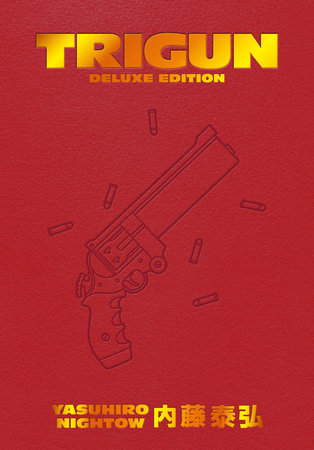
The STARGAZE campaign visual shown above belongs to the newer continuity. The original Trigun Deluxe cover shown here identifies the collected source edition. Both have been inspected as promotional references, but neither is presented as an opening scene. This bounded case does not claim a licensed panel-to-shot comparison or disclose the later story’s resolution.
Original visual reference
A principle is interesting when keeping it has a cost
Vash’s stated commitment gives our reading a more useful question than whether he can outshoot an opponent. What must he risk to avoid an outcome he rejects? A character’s skill can make a principle look easy; a story becomes more challenging when skill cannot guarantee that everybody remains safe.
The distinction between intention and consequence matters here. Wanting to protect people does not mean every action succeeds, and a failure does not automatically prove that the intention was meaningless. A careful reading should hold both facts together rather than declaring the ideal foolish or flawless before a situation has been examined.
In an adaptation comparison, look for who is given time to react to Vash’s choice. A pause, a response from a bystander or a shift in viewpoint can change the audience’s sense of its cost. This is a method for close reading; the guide does not claim that one entire animation style always communicates the dilemma better.
A desert setting turns survival into a shared problem
The licensed manga description identifies a forbidding desert planet. The newer anime’s official introduction also presents a desert-world setting. That common premise allows the environment to matter beyond the appearance of a western: distance, shelter and the difficulty of sustaining a settlement can shape the meaning of somebody’s actions.
Our interpretation treats a damaged place as more than a backdrop for a spectacular confrontation. People have to continue living there after a traveler leaves. This question changes how a viewer assesses destruction. A striking display of power can solve an immediate danger while creating obligations that are less visually dramatic.
The exact technology, history and rules of the setting should be checked within the selected continuity. A term explained in STAMPEDE should not be imported into the older anime as if the same exposition had occurred. Comparing worldbuilding means examining what each version supplies and when, rather than assuming a shared name guarantees identical information.
Changing disclosure order changes the audience’s relationship to Vash
The official interview with Nightow and STAMPEDE director Kenji Muto provides production context for the newer adaptation’s development. It is a useful primary route for questions about design and the process of shaping material. It should be read alongside the finished work, rather than used as permission to imagine unseen scenes.
Our central comparison question is information order. If a viewer learns a person’s background early, later behavior may be read as the consequence of that knowledge. If a version withholds the background, the same outward behavior can initially appear mysterious, comic or threatening. Disclosure is part of storytelling, not merely a checklist of included facts.
This is why our map gives the two animated starts separate branches. Watching both can be rewarding, but merging their episodes creates a new composite that neither production actually presents. For a newcomer, choose a version and let its own sequence work. For a returning fan, compare a clearly bounded event before generalizing about fidelity.
Nightow’s source and each production’s audience remain separate
The Dark Horse publication record credits Yasuhiro Nightow for the manga and identifies the English deluxe edition’s translation and lettering. The newer anime supplies its own staff records, including animation production by Orange. Its source credit does not make Orange the producer of the classic 1998 series, whose catalog entry identifies MADHOUSE.
The external score above is the AniList entry for the 1998 television anime, checked on 3 October 2026. It is not a score for Maximum, STAMPEDE or STARGAZE. We retain that scope even when a newer official visual appears on the page. A picture used for franchise navigation cannot change which production an audience number describes.
The linked Trigun community is useful for discussions of format preferences and edition collecting. It may contain major spoilers. Community opinions should be read as individual responses, not proof of official chronology or a publisher’s plan. The edition links below provide a way to check the product behind a recommendation before following it.
A deluxe reissue and a new animation are different commercial events
A deluxe hardcover reissue serves source readers and collectors; a new animated continuity introduces another audiovisual product. The publisher and official anime listings establish those products, not a combined financial account for the franchise. Their audiences can overlap without their revenue, costs or rights arrangements being identical.
No audited title-level profit or complete animation budget was verified for this guide. A bestseller label, retailer price and audience score cannot fill that gap. Likewise, the fictional bounty is a narrative device rather than a box-office statistic. Commercial analysis should retain a named reporter, territory, date and metric before adding numerical conclusions.
Begin Trigun before Maximum for the source route, or choose the classic television opening or STAMPEDE as your screen start. STARGAZE belongs after STAMPEDE. The author’s other works can be explored independently; a shared creator is a discovery connection, not evidence of a common canon or mandatory viewing order.
Primary sources and useful navigation
- Dark Horse / Penguin Random House · Trigun Deluxe contents and credits
- Dark Horse / Penguin Random House · Maximum as sequel and collected volumes
- Official newer anime · continuity introduction and original visual
- Official STAMPEDE production archive
- Official STARGAZE episode archive · later spoilers
- Official anime · Nightow and Muto interview
- Official newer anime · production credits
- AniList · named anime audience score
Community and catalog routes
- MyAnimeList · named anime catalog
- Wikipedia · secondary franchise navigation
- Reddit · Trigun reader and viewer discussion
The production and publisher links support project facts. Catalog and community pages are secondary navigation and may reveal later events.
Explore related story guides
Original series imagery is reproduced under permission asserted by the site owner; the source and rights credits are retained. The route diagram is Animeteor’s own explanatory graphic.