Start the 26-episode television series. The 2000 film is an alternate story, and Yamaguchi’s identified novel adapts that film; it is not the source of the television route.
Reviewed 2 October 2026 · Opening premise and format relationships; major ending revelations withheld. Linked publisher summaries and discussions may reveal later events. · Licensed access varies by country.

The source and screen branches

Television and film are alternatives, not consecutive chapters. The identified prose branch adapts the film. Dates label editions rather than narrative chronology.
- WATCH · television: 1996 TV · 26 episodes · Television story route
- WATCH · alternate film: 2000 theatrical interpretation · Separate setting / story
- READ · film prose: Yamaguchi film novelization · 2000 print / 2016 digital
- READ · associated manga: Katsu Aki comic · own settings · Separate interpretation
The television series and film are different interpretations
Begin The Vision of Escaflowne’s twenty-six-episode television series for the 1996 screen route. Sunrise’s official record identifies its production and episode count. The film titled Escaflowne is a separate interpretation, not episode twenty-seven or a required conclusion after the television ending.
A 2026 Bandai Namco announcement explicitly describes the 2000 film as a new production with substantially renewed setting and story. That makes the safe comparison route straightforward: finish the named television version, then choose the film if you want another treatment. Watching both is a comparison of versions rather than a continuous chronology.
Prose and manga products also need their own edition labels. KADOKAWA identifies Ryota Yamaguchi’s Escaflowne book as a novelization of the theatrical film. Do not place that prose before the television series as though it were the original source from which all screen material descended.
A 2016 digital date does not move the story’s origin
KADOKAWA’s film-novelization record gives a paper-edition date of 30 June 2000 and an electronic-edition date of 26 August 2016. The later date marks that digital product, not a newly written sequel or a newly premiered film. Keeping both dates visible prevents an edition from becoming a fictional extra installment.
Sunrise credits Hajime Yatate and Shoji Kawamori for the television original and identifies Kazuki Akane as director. Kawamori’s own work record is another primary route to the project. Associated books can adapt a screen-origin idea; a manga’s earlier shop listing does not by itself prove that it is the narrative source.
Choose a named manga or prose product by its actual author, language and description. KADOKAWA identifies Katsu Aki’s manga as having its own settings. Treat that comic as a distinct interpretation, not a missing television episode. The screen decision is verified more narrowly: television and film remain separate routes, with the identified prose book attached to the film.
A girl’s unfamiliar viewpoint meets an inherited machine
Sunrise’s television introduction places Hitomi with Van in the world of Gaea and identifies the conflict around his kingdom. The selected official television poster joins human figures and mecha imagery. Its composition introduces a combination of personal and military concerns without documenting one precise scene.
Our visual reading asks how a human viewpoint changes the meaning of an enormous armored figure. The machine is not only an instrument for winning a fight; it can also represent inheritance, responsibility and expectations that its pilot did not personally create. A newcomer can notice that tension before knowing the larger setting.
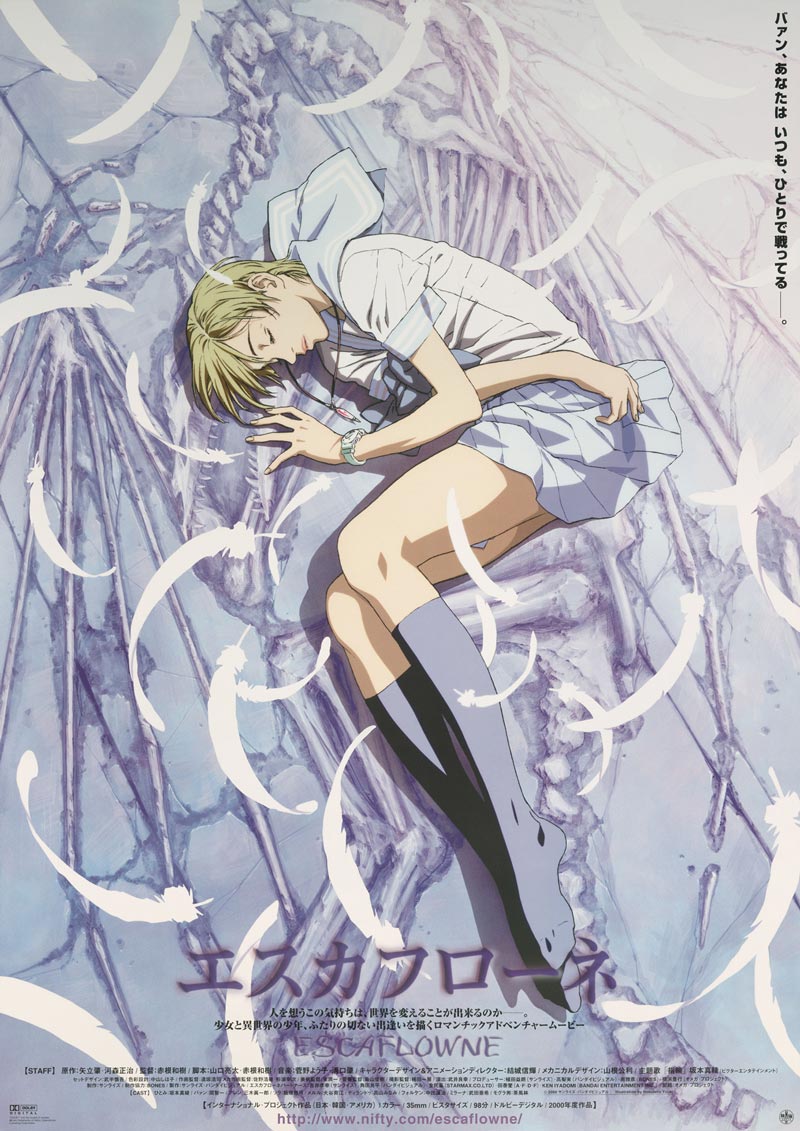
The companion original film poster is explicitly labeled as film artwork. Comparing their promotional emphases can suggest different entry moods, but it does not establish identical scenes or a sequel relationship. This bounded case avoids the final explanation of Gaea and does not substitute a poster comparison for licensed episode analysis.
Original visual reference
Knowing a possible future does not settle what to do with it
Our interpretation focuses on the relationship between anticipation and choice. Information about what might happen can make a person feel more powerful while also narrowing the options they think are available. A prediction becomes consequential when people change their conduct because they believe it.
To analyze a particular scene, separate the prediction from the response. Was an action taken because an outcome seemed inevitable, because somebody hoped to prevent it or because another person misunderstood what was said? The same information can produce very different forms of agency depending on who hears it.
That reading is a framework, not a claim that every event follows one metaphysical rule. The production record identifies themes of fate and desire, but a complete account of the fictional mechanism requires the actual work. The introductory guide therefore preserves uncertainty and withholds the story’s major explanatory revelations.
An inherited weapon can make a private relationship political
Our reading of Escaflowne’s mecha asks what a pilot inherits besides machinery. A name, a kingdom’s expectation and an enemy’s attention can come with the same object. Operating it successfully does not automatically resolve the duties attached to it.
This changes the scale of a character decision. A conflict that feels personal may become a public event because others interpret the pilot as a representative of something larger. Look at who supplies that interpretation and whether the person being represented accepts it. Loyalty, possession and legitimacy should not be treated as interchangeable.
The blend of fantasy and mecha makes those questions visible through a striking physical form. It does not require treating every mechanical detail as a real engineering specification. A useful review examines what the object does in the story’s relationships while keeping technical catalog facts separate from symbolic interpretation.
A film can revise the starting conditions instead of summarizing a series
The verified distinction between screen versions allows a richer comparison than asking how many episodes the film compresses. Our interpretation asks how a changed starting point affects sympathy, urgency and the relationship between the central figures. A character carrying a different burden may make a familiar encounter feel different.
Compare what each version tells a newcomer first. Which uncertainty is emphasized? How much time is available before the setting demands action? What kind of relationship is offered as an emotional anchor? These questions help describe the film as its own work rather than a defective container for everything in a television series.
The guide does not claim to have completed a shot-by-shot comparison. The production announcement establishes a rewritten setting and story; individual changes should be demonstrated with the corresponding licensed scenes. Keep the film novelization attached to the film when exploring how prose handles that alternate presentation.
Use the original production credits before assigning a source
Sunrise’s records identify the television original, screen staff and associated music. Kawamori maintains a project entry for the television work. KADOKAWA separately credits Yamaguchi for the film novelization and Yuki for its illustration. These are distinct creative responsibilities, not a single novelist-to-manga-to-anime chain.
The displayed AniList score belongs to the 1996 television series, checked on 2 October 2026. It is not transferred to the film or a prose product. A comparison of audience reception would require a separately matched film entry and should still identify the different voting audiences.
The linked Reddit discussion asks which screen version to watch first. Its replies are preferences, not proof of the film’s chronology. The official production distinction supplies the practical answer; reader commentary can then help explain which tone or presentation someone enjoyed, without becoming an unsupported audience-wide verdict.
An anniversary announcement may concern access rather than new narrative
The 2026 corporate announcement is useful evidence about how the property is being presented and its relationship between television and film. It should not be read as a new continuation unless the producer explicitly identifies one. An anniversary campaign can revisit an existing production.
No audited title-level net profit or complete production budget was verified. Music links, disc editions and associated books identify products, not their financial contribution. A future business comparison should retain territory and the particular release being measured rather than combine unrelated retail listings.
Begin the television series for its complete named route, then choose the film as an alternative interpretation. Read the identified theatrical novelization if that version interests you. Further manga editions can be expanded after their source relationship is directly checked, without changing this page’s core separation of the two screen stories.
Primary sources and useful navigation
- Sunrise · television production and original credits
- Sunrise · theatrical film record
- Shoji Kawamori · television work record
- KADOKAWA · Katsu Aki manga with independent settings
- KADOKAWA · film novelization and paper/digital dates
- Bandai Namco · 2026 announcement explaining revised film setting
- AniList · named adaptation audience score
Community and catalog routes
- MyAnimeList · named adaptation catalog
- Reddit · movie versus television viewing choices
- Wikipedia · secondary manga navigation
The production and publisher links support project facts. Catalog and community pages are secondary navigation and may reveal later events.
Explore related story guides
- Code Geass · personal choices and mecha conflict
- The Twelve Kingdoms · another unfamiliar-world route
Original series imagery is reproduced under permission asserted by the site owner; the source and rights credits are retained. The route diagram is Animeteor’s own explanatory graphic.
Separate products and edition details
Escaflowne Memorial Blu-ray BOX — Japan, 25 March 2026
Bandai Namco Filmworks dates Escaflowne Memorial Blu-ray BOX, product BCXA-2010, to 25 March 2026. Its limited production period runs through 24 March 2027. The set collects all 26 television episodes and the separately reimagined 2000 film, with new interview and discussion extras. A 24 March corporate notice independently confirms the release. The official page also dates a Japanese film revival to 20 March 2026; those are different exhibition and retail events.