For a first viewing, watch Rebellion’s 25 episodes, then R2’s 25. For the film route, watch Initiation → Transgression → Glorification → Re;surrection. Manga, prose and related screen projects have their own branches.
Reviewed 1 October 2026 · Opening-premise analysis; source and community links may reveal later outcomes · Licensed access varies by country.

The source and screen branches

TV and reconstruction routes are separated. Akito is an optional side story; our first-viewing recommendation is after main TV. Aspal is announced without an assigned chronology here. No exact chapter handoff is asserted.
- Original television: Rebellion: 25 episodes → R2: 25 episodes
- Reconstructed film route: I Initiation → II Transgression → III Glorification → Lelouch of the Re;surrection → Rozé: separate 12-episode story
- Associated reading: Magico! manga adaptation OR Iwasa Stage / Turn prose
An original television story, with a separate film route
Code Geass: Lelouch of the Rebellion begins with Lelouch, a student hiding his imperial identity in occupied Japan, renamed Area 11. His encounter with C.C. gives him Geass, a power that makes his attempt to challenge Britannia possible. The opening places his former friend Suzaku on the other side of a military confrontation. Their relationship makes a political conflict personal without making the two positions interchangeable.
Our first-viewing recommendation is the original television series followed by R2. Sunrise’s records list twenty-five episodes for each: a fifty-episode main television route. The film trilogy is another presentation of the material, with new cuts and restructuring. Follow that film sequence toward Lelouch of the Re;surrection instead of treating every movie as an extra episode inserted into the television story.
This distinction is the main job of the guide’s map. It lets a visitor choose a route before encountering a detailed difference list that could reveal character outcomes. Manga and prose are associated reading branches, not the source from which the original television production was adapted. Starting with them is a choice of medium rather than a prerequisite for understanding episode one.
Television: Rebellion, then R2
The original Rebellion television production began in October 2006 and its final episodes aired in July 2007. R2 followed in April 2008 and ended in September 2008. Watch each series in its numbered order. The R2 label identifies the second main television series; it is not the title of the second reconstruction film.
For a newcomer, keeping this route uninterrupted preserves the order in which the television production introduces its relationships and uncertainties. Akito the Exiled is an optional related story, so our recommendation is to explore it after completing the two main series. This is an editorial first-viewing order rather than an assertion that its events take place after every event of R2.
The official Akito project has five chapters and a different central cast. It widens the setting without replacing Lelouch’s opening. Bonus picture dramas, special editions and other associated products also require their own labels. A new cover, disc box or anniversary broadcast does not by itself identify a third main television season.
| Route | Order | Relationship |
|---|---|---|
| Original TV | Rebellion 1–25 → R2 1–25 | Main television sequence |
| Reconstruction films | Initiation → Transgression → Glorification | New cuts and restructured presentation |
| Film continuation | Trilogy → Re;surrection | Follow the film presentation |
| Akito the Exiled | Chapters 1–5 | Optional related side story |
| Rozé of the Recapture | Its own twelve-episode sequence | Later related production with a new central cast |
The trilogy leads toward Re;surrection
The three reconstruction films are Initiation, Transgression and Glorification, corresponding to Kōdō, Handō and Ōdō. Follow that order. Sunrise’s Transgression record explicitly describes new cuts, including more Suzaku perspective, and a major restructuring of material from both television series. Calling the trilogy a condensed version is useful shorthand only if the visitor also knows that its presentation changes.
The official Re;surrection event report provides a concrete example of that preparation. Jun Fukuyama discusses changes to C.C.’s depiction in the trilogy as groundwork for the later film. Goro Taniguchi also explains specific choices about her behavior in Re;surrection. The report supports treating the films as a deliberately arranged route, rather than assuming that all their scenes can be substituted into the TV sequence unchanged.
Our recommendation is to watch the trilogy before Re;surrection when following that route. Some viewers choose a summary of differences after the television series; that is a shortcut with spoiler consequences. This guide does not reproduce the character-outcome list in its opening or collapse the TV and film endings into a single seamless line. You can complete the original TV story and decide separately whether to explore the film presentation.
Rozé has its own cast and release history
The maintained Rozé of the Recapture site identifies twelve episodes and a premise involving the mercenary pair Ash and Rozé in the former Hokkaido block. Sunrise’s July 2026 introductory column places the story five years after Re;surrection. It belongs on the later film-related route, with a separate starting point and its own central conflict.
The project’s Japanese theatrical presentation used four acts, while the episode version has twelve installments. Those are packaging differences, not sixteen separate chapters that need to be watched consecutively. The current site also records the July 2026 Japanese television broadcast and Disney+ distribution. That does not establish availability in every visitor’s country.
The franchise portal announced a teaser for Hoshioi no Aspal on 26 September 2026. Its dedicated site credits Kazuya Nomura for direction, Mado Nozaki for series composition and Sunrise for original work, planning and animation. This guide lists it as a newly announced project; the inspected teaser is not enough to assign an episode count, release date or precise continuity position.
Manga and novels follow their own edition records
KADOKAWA’s Magico! manga record calls the book a comic adaptation of the anime. The first Japanese collected volume appeared on 21 December 2006, with the story credited to Ichiro Okouchi and Goro Taniguchi. The publisher also maintains a separately dated digital edition. A digital-release date should not be copied as the original publication date.
The eight-volume digital listing belongs to that named manga adaptation, not to every Code Geass comic. Other comics can tell different stories or use different protagonists. Choose the artist and subtitle together when buying or cataloging an edition. The existence of a manga called Rebellion does not mean every sequence, machine or outcome is interchangeable with its television counterpart.
Mamoru Iwasa’s Stage-0: Entrance is verified Japanese prose, with illustrations credited to Takahiro Kimura; its original paperback appeared on 28 April 2007. The publisher links Stage-1 through Stage-4 and separately lists R2 Turn books. These are associated prose products. Their numbering should not be used as an anime-to-novel handoff, and this guide does not promise a currently available licensed English edition from the Japanese listing alone.
CLAMP’s design concepts are different from animation authorship
The original staff page credits story concepts to Okouchi and Taniguchi, series composition to Okouchi and direction to Taniguchi. CLAMP supplies the original character-design concepts, with Kimura responsible for the animation character designs. These are related contributions with different responsibilities; describing the television series simply as a CLAMP manga adaptation would misidentify its origin.
The first television staff lists Kotaro Nakagawa and Hitomi Kuroishi for music. Knightmare design credits include Akira Yasuda, Eiji Nakata and Junichi Akutsu, with Kenji Teraoka separately credited for mechanical and concept design. The cast includes Fukuyama as Lelouch, Takahiro Sakurai as Suzaku and Yukana as C.C. These records offer starting points for exploring creators’ other work without assigning every image to one famous name.
The Re;surrection staff page again credits Taniguchi, Okouchi and Kimura in their central roles, while its music credit identifies Nakagawa. A later production’s staff should be checked through its own record. Continuity of a franchise name does not justify copying every earlier music, animation or writing credit into a new article.
Case check: protection and surprise in the opening encounter
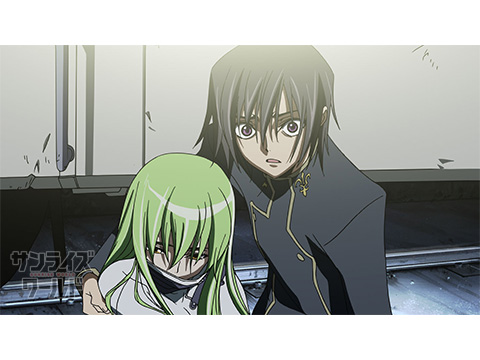
The original Sunrise scene image below shows Lelouch holding C.C. in a damaged interior. His widened eyes and open mouth face an offscreen direction while her green hair fills the foreground. The supplied 480-by-360 image includes white margins and a Sunrise watermark; we retain those features and the complete image rather than removing attribution or presenting a crop as an original frame.
Our reading focuses on the interruption of composure. A student who will be associated with planning and command is shown responding physically to an immediate danger. The official premiere account establishes a violent encounter and an unexpected grant of power. This image gives that opening a bodily scale: someone is being held, debris is visible, and the people in the frame do not occupy a safe abstract strategy board.
The still cannot prove Lelouch’s full motivation, identify everything happening outside the frame or explain Geass’s rules. Its value is narrower: it supports discussion of posture, proximity and surprise. The intact first-series promotional poster above supplies a different kind of image, organized to advertise the work rather than document one moment.
Original visual reference
Command, consent and the appeal of a controlled outcome
Our analysis starts with a tension in Lelouch’s project: resistance to domination is pursued using a power associated with compelling obedience. That makes a useful question for each early decision. Does an action create room for another person to choose, or does it transfer control from one authority to another?
The chess motif is a useful interpretive tool, but it needs limits. A board offers visible positions and rules; the social world contains people with histories, loyalties and information the strategist does not possess. Calling someone a piece can reveal a commander’s attitude, yet it should not replace analysis of the person’s actual options or the consequences of an order.
When examining a confrontation, separate the immediate tactical objective from its moral justification. A successful maneuver can still depend on deception or impose a cost on people who did not choose it. This keeps the discussion more precise than declaring that intelligence makes every decision correct or that every victory proves a political argument.
Lelouch and Suzaku make disagreement personal
The former friends’ opposing positions give an opening viewer two different relationships to the same political order. Our reading asks how that familiarity changes an exchange: knowledge of another person can encourage empathy, enable manipulation or make a disagreement harder to express honestly.
Rather than ranking one protagonist as the sensible one in advance, track what each person believes an institution can do. Then test that belief against the situation shown. The distinction between seeking change through an organization and challenging it from outside matters, but neither description automatically resolves the costs of a specific action.
This is also why the work appears in both pilot-burden and revenge-cost collections. The former examines responsibility distributed between operators, leaders and institutions. The latter asks what pursuing a personal grievance demands from other people. Two thematic placements should give a reader two questions to explore, rather than repeat the same recommendation paragraph.
A dated box-office milestone, with clear limits
The official Re;surrection report on its 13 April 2019 stage event states that the film had exceeded JPY 1 billion in box-office receipts by 24 March. This is a documented milestone, reported by the project, and a more useful financial fact than an unsourced claim that the franchise is profitable.
The number is not the film’s final lifetime gross, the production budget or the amount retained by Sunrise. Ticket receipts pass through commercial arrangements, and production, distribution and promotion carry costs not disclosed in this event report. The record does not support calculating a profit margin or adding later merchandise sales to the milestone.
Official video, art-book and music catalogs establish additional product categories. A historical preorder deadline should remain historical, and a listed item does not establish that stock is available now. Financial updates should name the product, reporting date and measure; box office, circulation, licensing sales and group revenue answer different questions.
| Evidence | Measure | Limit |
|---|---|---|
| Official April 2019 event report | Film exceeded JPY 1 billion by 24 March 2019 | Historical milestone, not final gross |
| Video / soundtrack / art catalogs | Documented product categories | Not verified unit sales |
| No title-specific cost statement inspected | Production costs unknown here | No profit or ROI calculation |
Movie-order questions are useful; outcome lists can spoil the TV route
The reviewed r/CodeGeass thread asks what order to watch the movies after a television rewatch. A reply gives the three film titles followed by Re;surrection and explains that the reconstruction changes material. It also reveals a character outcome. We link the discussion with a spoiler label instead of reproducing that detail in our quick answer.
This is a concrete use of community reading: it identifies where a visitor’s uncertainty lies. It does not establish that every fan recommends the same shortcut or that anonymous comments determine official continuity. The route recommendation above draws on named project records and the official production discussion.
Future maintenance should check the new Aspal project for dated announcements, keep regional availability separate from Japanese releases and expand edition comparisons before offering exact reading shortcuts. The core TV and film routes can remain stable while those supplementary records change.
Primary sources and useful navigation
- Sunrise original television record: premise, 25 episodes and scene imagery
- Sunrise R2 record: 25 episodes; later spoilers
- Official premiere account and episode credits
- Official original television staff
- Official trilogy introduction and creator roles
- Sunrise Transgression: new cuts and restructuring; plot spoilers
- Official Re;surrection staff and cast
- Official April 2019 event report: production remarks and box-office milestone; spoilers
- Official five-chapter Akito project
- Official Rozé: twelve episodes and region-specific distribution
- Sunrise Rozé introduction: five years after Re;surrection
- KADOKAWA original Magico! manga volume 1 and edition dates
- KADOKAWA Magico! digital volume 8; ending spoilers
- KADOKAWA Stage-0 prose, artist and linked editions
- KADOKAWA separately labeled R2 Turn-1 prose
- Official Re;surrection product catalog; historical offers
- Official franchise portal and dated project news
- Official newly announced Aspal teaser and staff
Community and catalog routes
- Reviewed film-order discussion; important character spoilers
- MyAnimeList original television catalog
- Code Geass fan wiki; secondary navigation and ending spoilers
The production and publisher links support project facts. Catalog and community pages are secondary navigation and may reveal later events.
Find this work in our thematic collections
- Pilots under pressure: five anime about institutions, loyalty and war
- Five anime about revenge, recovery and the cost of opposition
Original series imagery is reproduced under permission asserted by the site owner; the source and rights credits are retained. The route diagram is Animeteor’s own explanatory graphic.
Games and live-action adaptations
- Code Geass: Lost Stories — Japanese Edition — Game: Knightmare Frame battle RPG and story adventure
Production and edition updates
Code Geass joins LINE Rangers until 30 October
The official Code Geass portal announced the LINE Rangers collaboration on 30 September 2026. Its stated window runs from after maintenance on 30 September until maintenance on 30 October. Lelouch, Suzaku, Kallen, C.C. and Li Xingke appear as collaboration Rangers. Exact maintenance hours are not supplied. The announcement also identifies themed equipment and a login reward; present details should be checked in the game notice.
See the separate production record →
Code Geass Rozé Blu-ray BOX — Japan, 28 October 2026
The franchise portal’s 10 July 2026 notice dates the Japanese Rozé of the Recapture Blu-ray BOX to 28 October 2026. This is a home-video edition of the already identified twelve-episode production, which began Japanese television transmission in July 2026 after its 2024 theatrical/streaming presentation.
See the separate production record →
Code Geass Aspal — announced anime production
The official Aspal teaser identifies the anime as in production, with director Kazuya Nomura, series composition by Mado Nozaki, character design by Rolua and animation production by Sunrise. The Japanese title is コードギアス 星追いのアスパル. The checked teaser supplies no premiere date or episode total.
See the separate production record →
Code Geass musical 2 — Japan, January–February 2026
The official second musical, 正道に准ずる騎士 2, lists Osaka’s COOL JAPAN PARK TT Hall for 23–25 January 2026 and Hulic Hall Tokyo for 29 January–1 February. Ryotaro Akazawa plays Suzaku and Koji Kominami plays Lelouch. These performance dates have passed at review.