Quick answer: Begin with manga volume 1 or the first anime episode; both establish information that later installments depend on. A separately published light novel is related material, not a substitute for the opening manga volume.
Spoiler scope: opening premise and format relationships. Fan wikis, official volume catalogs and discussions may reveal later events. Case sources checked 30 September 2026; access varies by region.
Edition and adaptation map

Check each lane: Original manga, Television anime, Spica: The First Star novel. The Spica novel is related prose, not a replacement for manga volume one. Anime episodes and manga chapters keep separate numbering.
Edition details and access
Begin with manga volume 1 or the first anime episode; both establish information that later installments depend on. A separately published light novel is related material, not a substitute for the opening manga volume.
Start with an official edition: Yen Press manga. Availability and chapter access can vary by region or subscription.
Publication and edition check · 2 October 2026
The official fourth-season teaser labels the project Final Season without specifying a broadcast day. Spica: The First Star is related prose, while Aka Akasaka and Mengo Yokoyari’s manga remains the anime’s source branch. Source record →
Yen Press schedules English manga volume 14 for 24 November 2026: paperback ISBN 9798855439687 and digital ISBN 9798855439694. That English edition date is not the original Japanese publication date. Source record →
Edition records and release calendar
Choose a route before you continue
Start with manga volume one or the anime premiere and avoid later character pages until completing that opening. Choose related prose as an additional branch, with its own spoiler scope. A chronological rearrangement can reveal family information earlier than the main story intends; release discovery is the safer first-experience route.
Case check: Ai as an image, Goro as a viewer
Confirmed by primary sources: The official premiere synopsis introduces doctor Goro as a fan of idol Ai, brings Ai to his workplace, and describes an attack before childbirth. The opening therefore brings a public performer into a private setting. The related Spica prose book is separately cataloged by Yen Press and does not replace this opening.
Official image and premise source · Yen Press manga · Yen Press related light novel
Look at the original presentation
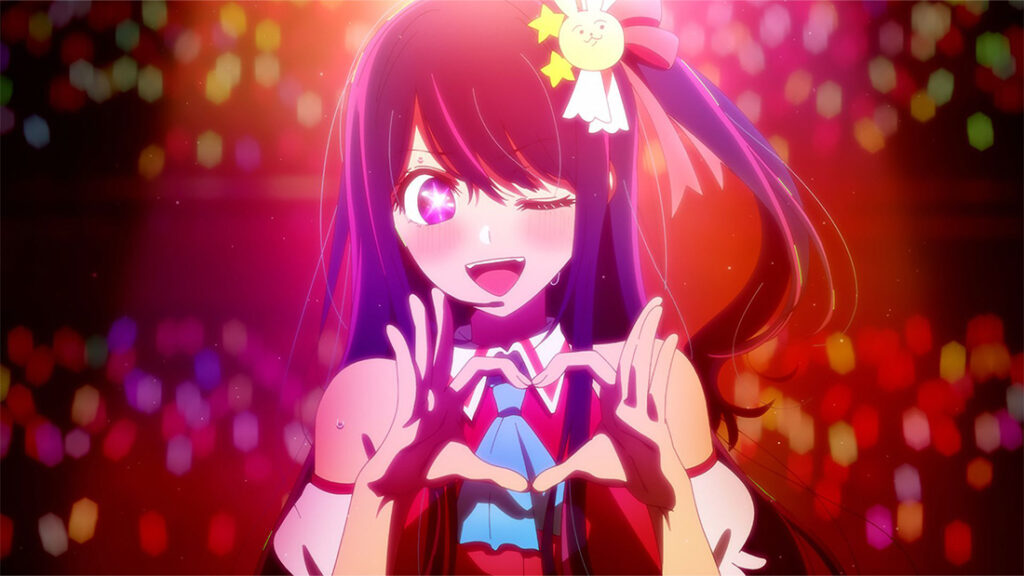
Our visual reading: Ai is shown under vivid stage lighting in the selected episode-one still. Her pose faces an audience, so the frame makes performance immediately visible. It does not reveal private thoughts or establish that a later public account of her is accurate.
Verification boundary: this check uses official descriptions and the identified image. It is not a complete page-by-page or shot-by-shot comparison. A numbered continuation requires the last licensed screen scene and the corresponding named source edition to be checked together; promotional art cannot establish that handoff.
Why this opening matters
Our reading of the premise is that being a fan gives Goro familiarity with an image, not complete knowledge of a person. Moving Ai into his workplace changes the kind of access he has. This gives the guide a useful split between a performed identity and an encounter outside the stage. Entertainment-industry analysis is stronger when it tracks who controls each account and who is allowed to challenge it.
How to compare the editions
Compare one public presentation with one private exchange. Note the intended audience, what is visibly performed, and what only a character knows. Color or music can intensify a stage image, while manga layout can hold that image beside a reaction. Neither technique proves sincerity by itself. Financial claims about the franchise also need dated, attributed figures; a convincing industry drama is not a production-budget source.
Reader discussion and reference shelf
A participant in the linked premiere thread praises the extended opening for reaching its major turn within one presentation. This is a viewer’s response to structure, not evidence that every viewer benefits from the same length. Read the thread after the premiere: its discussion reveals much more than the premise used in our case check.
- Selected Reddit discussion — reader responses; spoiler scope depends on the thread.
- Find the named edition on MyAnimeList — catalog navigation and user reviews; ratings are not evidence for canon.
- Fan wiki reference shelf — character and terminology navigation; expect later-story spoilers.
Publisher and production records support the factual route above. Community pages supply reader perspectives and reference navigation. Any future installment-level comparison will be dated here when the licensed material has been checked.
What is worth comparing?
The work often asks whether an image made for an audience can coexist with a private self. An adaptation comparison should track what the viewer sees on stage and what a character knows behind it.
Questions to take into the story
Who controls the public story of an event? When does a character perform a feeling rather than state it?
Separate the main manga from related prose
The Yen Press manga line is the central reading route by Aka Akasaka and Mengo Yokoyari. Spica: The First Star is a separately listed light novel. A new reader should not mistake its presence in a catalog for a replacement for manga volume one. The manga opening establishes knowledge that later stage, studio, and family scenes build upon. Start there, or at the anime’s opening if choosing screen first, before adding related prose as a side branch.
Performance versus private knowledge
The series makes an audience’s image of a performer part of the plot. A useful analysis asks who is producing that image, who benefits from it, and what the performer knows that the public does not. The same scene can look triumphant from a seat in the crowd and exhausting from backstage. A manga can place those views in adjacent panels; a screen adaptation can contrast them through camera position, sound, and a cut to silence. Our visual route shows the publication branches. A later chronology should mark the order in which characters learn a secret separately from the order in which readers learn it, because collapsing those timelines would spoil the central dramatic tension.
Two audiences watch the same performance
A public image is designed for people inside the story and for us as readers or viewers. When a character performs, ask what the fictional audience is meant to believe and what private pressure the scene lets us see. The difference can turn a convincing stage moment into an uncomfortable one. This is a useful way to compare manga framing with anime performance without reducing the work to a list of industry facts.
The main manga begins the central route; the official anime story index organizes screen episodes. Spica: The First Star is related prose. Its relationship to characters does not make it a substitute for volume one or a universal continuation after an episode. Mark the format and the point of view before recommending a switch.
Verified creators
Aka Akasaka (Manga story), Mengo Yokoyari (Manga art)
Community discussion
Compare reader interpretations in Reddit discussions about [Oshi No Ko]. Community posts are individual opinions; use the official sources below to verify release and edition facts.
Official sources
Independent editorial commentary. Thematic illustration is original and unofficial; source links lead to publishers, production sites, or licensed platforms. Availability varies by region.
Games and live-action adaptations
Explore these additional versions of this work.
- OSHI NO KO — Live action: Drama + film · 2024
- Oshi No Ko: Puzzle Star — Game: Match-three puzzle
- Oshi No Ko: The Final Act — Live action: Film · 2024