Start the original 2021 TV anime with episodes 1–13. Watch In the Woods afterwards as a reconstruction with post-finale material. The five-volume manga and Japanese screenplay-derived novel are alternate reading formats; RoOT live action stays outside this roadmap.
Reviewed 1 October 2026 · Opening premise and format relationships; major ending revelations withheld. Linked publisher summaries and discussions may reveal later events. · Licensed access varies by country.

The source and screen branches

The anime is the original. The movie revisits events and adds after-finale material; it is not an entirely new second season. RoOT live action and any game coverage remain separate.
- WATCH · main and optional revisit: 2021 TV · episodes 1–13 Optional reframe + aftermath 2022 In the Woods film
- READ · manga adaptation: Adaptation volume 1 → Continue through final volume 5
- READ · Japanese prose adaptation: Wakui / Konomoto novelization Publication identity One book · screenplay-derived
- READ · separate RoOT manga: Reina / Sato detective story · own volume 1 through completed volume 6; not volume six of the earlier adaptation.
A taxi makes a city’s separate lives meet
ODDTAXI is an original thirteen-episode 2021 anime about taxi driver Odokawa and the unusual passengers who move through his daily life. Start with episode 1 and continue through episode 13. The manga and Japanese novel are adaptations of that screen project, not earlier source works that must be completed before the television story.
The 2022 film In the Woods reconstructs television material and adds a perspective on what follows the finale. Watch it after the series, with the expectation of revisiting events rather than receiving an entirely new second season. The related RoOT live-action project is separate coverage and remains outside our anime, manga and prose route map.
Choose this if you enjoy conversation, intersecting motives and a mystery built out of details that initially seem ordinary. Its animal-shaped cast should not be read as a promise of children’s entertainment: crime, violence and adult problems are central. This guide keeps the major ending explanation hidden, including the meaning of its visual viewpoint.
The television introduction comes before the film’s reconstruction
TV Tokyo’s episode archive identifies the 2021 main run from episode 1 through episode 13. Its opening record introduces Odokawa transporting passengers and visiting his regular clinic. The simple daily routine matters because it supplies connections before the viewer knows which of them will be important.
Continue through the numbered television episodes in release order. A first-viewing chronology assembled from later explanations would remove the gradual recognition on which the mystery depends. Our diagram is a practical route rather than a spoiler chart of every concealed event.
IRIS’s official 18 March 2022 film collaboration announcement records In the Woods opening in Japan on 1 April 2022. It explicitly describes both restructuring the television series and depicting material after its finale. The movie therefore belongs after TV for a beginner, with its recap-and-aftermath scope stated rather than mislabeled as a wholly new season.
| Format | Start or placement | Relationship |
|---|---|---|
| TV anime | Episodes 1–13 | Original main production |
| In the Woods film | After episode 13 | Reconstruction plus post-finale material |
| Manga | Adaptation volume 1 | Separate five-volume presentation |
| Novel | Single Japanese novelization | Derived from Konomoto’s screenplay |
| RoOT manga | Own volume 1 through final volume 6 | Separate detective-centered reading branch |
| RoOT live action | Separate coverage | Excluded from this core roadmap |
The comic adaptation has additional material of its own
Shogakukan’s final manga volume 5 is dated 29 July 2022, ISBN 9784098613854, with 192 pages. It credits Kazuya Konomoto and P.I.C.S. for the original work and Takeichi Abaraya for the drawings. Its catalog explicitly identifies the comic adaptation as complete.
The publisher also identifies the inclusion of a Yano story titled 2019 that was not animated in the television series. That is a concrete adaptation distinction without requiring us to disclose its plot. The manga can therefore offer additional interest to someone who has finished the screen version rather than functioning only as a record of familiar scenes.
A complete comic route begins at volume 1 and proceeds to volume 5. The number 2019 is a side-story title, not an instruction to begin the whole property with a hidden prequel. We have not inspected a full licensed scene-to-page comparison to certify a chapter handoff or the exact extent of every added passage.
The prose is a screenplay-derived novelization
Shogakukan’s July 2021 new-book catalog records the ODDTAXI novel for 6 July 2021, ISBN 9784094070439, with 372 pages. It names Manabu Wakui and Kazuya Konomoto. The publisher’s electronic-book description identifies the novelization as based on Konomoto’s original anime screenplay.
That direction matters. The novel is not a lost source explaining why the anime omitted an earlier volume. It offers another way to encounter the story that began on screen. The publisher also advertises a character relationship chart and color scene material, which should be approached with a spoiler warning by someone who has not finished the mystery.
Our reading is that prose can shift attention from the timing of spoken exchanges to the construction of a viewpoint. The existence of a novelization does not, by itself, prove that it contains every audio extra or the film’s later addition. This guide has not verified an English licensed novel edition, so the reading branch is plainly labeled Japanese.
Revisiting the opening is more useful than an invented shortcut
The released main television story reaches episode 13. In the Woods is the next optional screen presentation, with its revised perspective and after-finale material. A manga or prose reader can begin that format at its own opening instead of trying to skip to a guessed point beyond the anime.
The comic publisher’s explicit additional Yano story is one reason the source-direction distinction matters. An adaptation can contribute material of its own even though it derives from an original anime. That does not make every new passage a mandatory replacement for a television scene or establish a complete combined chronology.
For a later comparison, keep a record of who says a detail, who hears it and what the viewer understands at that moment. The same information may have a different effect when it is placed in prose, panels or a timed conversation. This method supports a precise mystery analysis without assuming that a matching event means an identical audience experience.
The novel cover keeps Odokawa close and the city outside
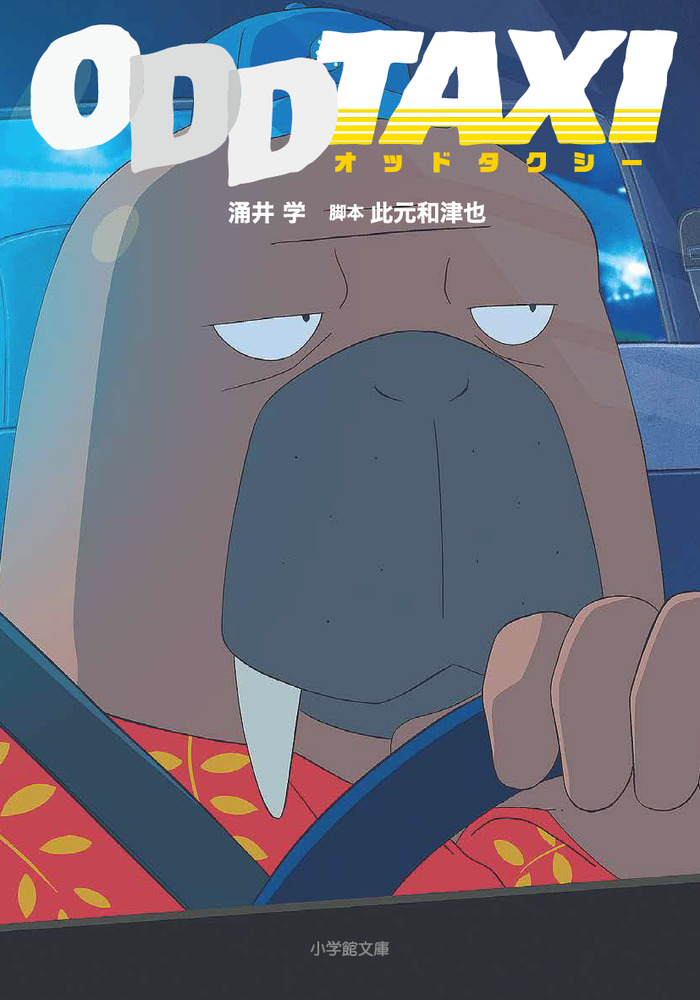
Shogakukan’s original novel cover shows Odokawa behind a steering wheel, wearing a red patterned shirt and seat belt, with cool blue light outside the cab. Its large title and Japanese creator credits remain intact. The supplied 700-by-1000 composition is publisher cover artwork, not an episode still or an Animeteor-generated portrait.
Our interpretation is that the steering wheel makes the occupation tangible while the half-lidded expression gives him reserve. We are near the driver, but proximity does not guarantee that we understand everything he sees. The cab creates a boundary between an individual viewpoint and the city moving around it.
The broadcaster’s opening premise confirms the taxi routine, and the publisher confirms the cover belongs to the screenplay-derived novelization. The image supports observations about expression, object placement and color. It does not prove a particular dialogue exchange, a panel correspondence or the late explanation of the visual world. That ending interpretation is deliberately outside this opening case check.
Original visual reference
An ordinary remark can have more than one destination
A taxi conversation is temporary, but it does not occur outside a person’s life. Our reading is that ODDTAXI’s premise makes apparently casual remarks portable: a passenger carries motives into the cab and takes information away from it. The driver becomes a point of contact between stories he does not fully control.
That creates suspense through context rather than constant revelation. A statement can seem trivial on first hearing and become meaningful after another encounter. When watching, separate what is actually said from what you assume it means. A useful clue record should preserve the observation before attaching a theory to it.
The method also rewards attention to the speaker’s purpose. Someone seeking attention, avoiding a subject or performing confidence can shape a conversation without lying in every sentence. That makes dialogue enjoyable as behavior as well as information. A mystery discussion becomes richer when it asks why the person chose that moment to speak.
Work connects people who would not choose the same social circle
Odokawa’s occupation brings him into contact with passengers unlike his small circle of friends. Our interpretation is that the taxi provides a plausible meeting mechanism: the characters do not need to all belong to one school, family or club. Their paths can intersect for practical reasons while their motives remain separate.
The premise also places private conversation inside paid work. A driver may be present for an emotional disclosure without becoming responsible for every part of it. That boundary is useful when considering Odokawa’s reserved demeanor. Listening closely and volunteering to solve somebody’s problem are different actions.
The animal-shaped presentation can make the cast immediately distinguishable, but visual familiarity should not substitute for attention to the character’s conduct. Keep an observation about design separate from a theory about what the design means. This beginner guide does not resolve that question, because a confident explanation would remove an important part of a first viewing.
A distinctive style has named writers, designers and musicians
TV Tokyo credits P.I.C.S. for planning and original work, Baku Kinoshita as director, and Kazuya Konomoto for the screenplay. Kinoshita and Hiromi Nakayama handle character design; animation is P.I.C.S. with OLM. Music is credited to PUNPEE, VaVa and OMSB. These roles make the original screen identity more precise than calling it an adaptation of the later comic.
In the first-episode r/anime discussion, littleman1988 describes the backgrounds as having a watercolor quality, while masoaoki responds to a sinister atmosphere and the lead’s negative disposition. These are individual observations. They suggest two different interests—visual texture and personality—without establishing a unanimous judgment of the whole series.
The score above belongs to AniList’s original 2021 thirteen-episode TV entry only. It excludes In the Woods, the manga, novel and live-action project. Community interpretation is useful for comparing what a viewer noticed, but it is not a substitute for a production record or a reason to reveal a later answer in an opening guide.
A taxi promotion is a specific commercial case
IRIS’s March 2022 release describes a collaboration with taxi signage service Tokyo Prime and taxi app GO around the theatrical film. It promoted commercials and special material inside actual taxis. The connection is concrete: a story built around a cab was advertised through the same kind of everyday space.
Our interpretation is that this is a good example of a medium-specific promotion rather than a generic poster campaign. The release documents the collaboration and historical window. It does not reveal film profit, the amount paid for the advertising or a current offer in every taxi, so those financial and availability claims are not invented.
RoOT is linked through TV Tokyo’s official live-action project page for separate exploration. It remains outside the core reading and viewing map under Animeteor’s format rule. Begin with the thirteen TV episodes, then choose the film, complete manga or Japanese novelization according to what you want to revisit. The small-clues collection below offers other mysteries with their own independent routes.
Primary sources and useful navigation
- Official anime project and artwork
- TV Tokyo · original staff roles
- TV Tokyo · premise
- TV Tokyo · main episode archive
- TV Tokyo · opening episodes
- Shogakukan · final manga volume 5 and added material
- Shogakukan · Japanese novel and cover
- Shogakukan eBooks · screenplay-derived novelization
- Shogakukan · July 2021 new-book catalog
- IRIS · film release and taxi collaboration record
- TV Tokyo · separate RoOT live-action project
- AniList · named TV audience score
Community and catalog routes
- MyAnimeList · named television catalog
- Reddit · first-episode visual and atmosphere reactions
- ODDTAXI Wiki · episode-one navigation; spoilers
- Wikipedia · format navigation; spoilers
The production and publisher links support project facts. Catalog and community pages are secondary navigation and may reveal later events.
Find this work in our thematic collections
Original series imagery is reproduced under permission asserted by the site owner; the source and rights credits are retained. The route diagram is Animeteor’s own explanatory graphic.
Games and live-action adaptations
- RoOT / Route of Odd Taxi — Live action: Series · 2024
A separate completed RoOT manga
Shogakukan identifies RoOT / Route of Odd Taxi as a completed six-volume manga by Kazuya Konomoto / P.I.C.S. and Takeichi Abaraya. It follows Reina and Sato as a separately numbered detective-centered story. Begin at its own volume one; this is not a continuation numbered volume six of the earlier five-volume manga adaptation. The live-action drama has its own original-story presentation and separate guide.