Read the completed ten-volume source in a chosen binding, or begin the twenty-six-episode 2005 anime. Later animation has named specials; the English collector rollout is not resumed main serialization.
Reviewed 2 October 2026 · Opening premise and format relationships; major ending revelations withheld. Linked publisher summaries and discussions may reveal later events. · Licensed access varies by country.

The source and screen branches

The source is complete. English collector bindings have their own rollout; animated specials are named separately. Live action is excluded and no source novel or exact chapter shortcut is invented.
- READ · source / binding: Japanese standard source · 1–10 → English collector · check contents
- WATCH · first adaptation: 2005 television series → Twenty-six episodes
- WATCH · later production: Shadow special → Next Passage → Twenty episodes + Path of Thorns
- WATCH · named special: Bell Droplets → Separate animated release
A completed ten-volume source has several English bindings
MUSHI-SHI begins with Yuki Urushibara’s manga. The Japanese main source concludes in standard volume ten. Start a chosen source edition at its own first book. An English collected binding can contain more than one Japanese volume, so a visitor should not assume that every product numbered eight contains only standard volume eight.
For animation, begin the twenty-six-episode 2005 series. The later route includes The Shadow That Devours the Sun, the twenty-episode Next Passage series and its Path of Thorns special, then Bell Droplets. This guide groups those named productions in a first-viewing release route, rather than forcing every episodic case into a speculative internal chronology.
The live-action film is another adaptation and remains outside the core map. No source novel was verified for this guide. Bell Droplets is a separately named animated special presented theatrically, not an announcement that the manga restarted. It does not supply a new prose lane or an invented chapter after the completed main source.
| Route | Start | Distinction |
|---|---|---|
| Japanese source | Standard main book 1 | Complete main sequence 1–10 |
| New English collector edition | Collector book 1 | Contains Japanese books 1–2 |
| Original anime | 2005 series, episode 1 | Twenty-six episodes |
| Later animation | Shadow special, then Next Passage | Twenty episodes plus named specials |
| Final named companion | Bell Droplets | Animated special, not new serialization |
A new translation is an edition, not a source sequel
Kodansha’s Collector’s Edition begins with a hardcover containing Japanese volumes one and two. Its print release is dated 4 November 2025, ISBN 9798888776346, while the same-day digital edition has ISBN 9798894787671. The series description identifies a new translation and cover treatment; that product work does not add new main-story chapters.
Collector book three is listed with a 22 September 2026 release, now past at this review. The English distributor schedules book four for 15 December 2026, ISBN 9798888776377, and says it contains Japanese volumes seven and eight. Book four is forthcoming, and its number does not mean it concludes the ten-volume source.
The Japanese final standard volume has a 21 November 2008 print record and a separate 29 July 2009 digital date. Those dates establish the source’s conclusion. A current English collector series labeled ongoing describes that edition’s rollout, not a claim that Urushibara’s main manga is newly continuing.
A bright substance can look inviting before its nature is understood
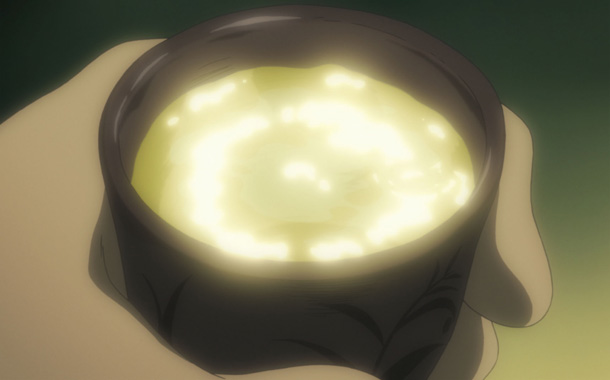
The selected original Next Passage first-episode reference shows a hand holding a dark cup filled with a glowing, pale-yellow substance. The official story gallery places it within the opening case of the later animated series. It is original episode imagery rather than an AI illustration of an invented mushi.
Our visual reading starts with the contrast between an ordinary vessel and an extraordinary light. The cup gives the object a familiar scale, while the glow makes its contents difficult to classify as an everyday drink. The image alone does not prove it is safe, identify a real substance or explain the case outcome.
That uncertainty introduces the property’s mode of attention. A phenomenon can be compelling without fitting the categories a person normally uses to understand it. The guide keeps this observation bounded by the selected frame, separating visible detail from explanations that require the actual licensed episode and avoiding a claim about an unseen character’s intention.
Original visual reference
An encounter need not revolve around an enemy’s defeat
Our central interpretation treats mushi as presences whose effects can be harmful without being reducible to human malice. The publisher’s premise identifies entities outside ordinary plant and animal categories. Ginko’s work therefore asks a different question from simply finding a villain: what arrangement might allow people to live with a phenomenon they do not fully control?
A close reading can distinguish intention from consequence. A person suffering from an effect needs help even if its source is not choosing to punish them. Preserving that distinction prevents every case from becoming a conventional battle whose resolution must be the elimination of a morally evil creature.
This does not make the fictional ecology a scientific account. The guide reads a narrative system in which observation and adjustment matter. A reviewer should name the particular case before deciding whether intervention, departure or acceptance is presented as useful, rather than declaring one response the rule for every encounter.
Expertise can recognize limits without making help meaningless
Our analysis asks what an expert can offer when a problem is unfamiliar and its consequences personal. Explanation may relieve uncertainty without reversing everything that has happened. The story’s quieter stakes emerge from the distance between understanding an effect and possessing the ability to remove it completely.
A close reading should follow how Ginko communicates a limit. Does the affected person receive information with which to decide, or only an instruction? An encounter can change somebody’s relationship with their circumstances without making grief, fear or practical difficulty disappear. The person receiving help remains part of the decision.
That gives supernatural-work an ethic of attention. Moving on from a case need not mean every life is restored to an identical normal state. The guide does not turn fictional remedies into health advice or claim an animated cure corresponds to a real treatment; its concern is the responsibility attached to narrative expertise.
A place can retain its history after the traveler leaves
MUSHI-SHI’s traveling premise allows individual settings to occupy the center of a case. Our interpretation asks how the people who remain experience what the traveler encounters briefly. A village, household or landscape carries a history that does not begin when Ginko arrives and does not end when he departs.
An episodic structure can consequently sustain depth without a continuously escalating central antagonist. One case can alter the viewer’s understanding of a particular life, and the next can offer another relationship between environment and human expectation. Variety lies in those relationships rather than only in the number of named phenomena.
Source and animation establish duration differently through page spacing, stillness, sound and movement. A detailed comparison should inspect a named chapter and episode. The guide does not assert a complete adaptation concordance or make every quiet shot proof of one universal intention. It offers a way to examine how attention is directed.
The later visual reference and the earlier score have separate scopes
Kodansha identifies Urushibara as source creator. The Next Passage staff record names Hiroshi Nagahama directing, Yoshihiko Umakoshi for character design and principal animation supervision, and Artland for animation. The selected glowing-cup frame belongs to that later production, while the displayed score belongs to the earlier series.
The official archive distinguishes the twenty-episode Next Passage, Path of Thorns, The Shadow That Devours the Sun and Bell Droplets. Keeping those titles visible helps viewers find missing specials when a service groups them differently. A soundtrack or recorded reading event is not silently added as another animated episode.
The displayed AniList 8.4 out of 10 concerns the twenty-six-episode 2005 entry only. It excludes Next Passage, specials, source books and live action. Community and secondary catalogs support edition and favorite-case discussions, with spoilers possible, but publisher records control collector-edition dates rather than a remembered preorder discussion.
Returning to print changes access while the source conclusion stays fixed
The English hardcover rollout matters for readers who could not find older print products. It is a documented new edition with its own translation, bindings and schedule. That does not prove every regional stock shortage has ended, and it should not be confused with new main-story serialization or a newly announced animated season.
No audited title-level profit or complete screen-production budget was verified. A collectible resale price, current hardcover price and publisher-wide revenue measure different things. Future commercial coverage should identify the reporting source, territory and period before describing sales, circulation or income, keeping a distribution announcement separate from receipts.
Choose one source binding or begin the 2005 series, then follow the named later productions. Upcoming collector books can be updated as their releases occur. The completed Japanese source remains the root, and no fabricated prose continuation or exact post-anime page shortcut makes the map appear more complete than the evidence permits.
Primary sources and useful navigation
- Kodansha · source premise and creator
- Kodansha · Japanese final standard book
- Kodansha · first English collector binding
- Kodansha · collector rollout
- English distributor · collector four forthcoming December 2026
- Official later production and named specials
- Official later episode gallery
- Official Next Passage credits
- AniList · named adaptation audience score
Community and catalog routes
- MyAnimeList · named adaptation catalog
- Reddit · case discussions, spoilers possible
- Wikipedia · secondary edition navigation
The production and publisher links support project facts. Catalog and community pages are secondary navigation and may reveal later events.
Find this work in our thematic collections
Original series imagery is reproduced under permission asserted by the site owner; the source and rights credits are retained. The route diagram is Animeteor’s own explanatory graphic.
Games and live-action adaptations
- MUSHI-SHI — Live action: Film · 2007
- MUSHI-SHI: Amefuru Sato — Game: Life simulation