MUSHI-SHI: Amefuru Sato — game guide
GAME GUIDE · Sources checked 05 October 2026 · Opening-premise spoilers; original promotional screenshots can reveal creatures and environments.
The 2008 MUSHI-SHI DS game casts the player as a novice mushishi in an original village. Collecting mushi, making reports and encountering residents form an optional interactive route beside the manga, anime and film.
- Original title
- 蟲師 ~天降る里~
- Publisher
- Marvelous Entertainment; now Marvelous
- Japanese release
- 31 January 2008
- Platform / players
- Nintendo DS / one player
- Genre
- Life simulation
- Story identity
- Original novice protagonist and village; Ginko also appears
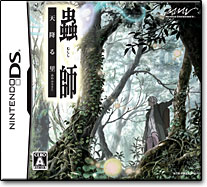
Product and edition
Nintendo’s manufacturer description identifies a game-original novice mushishi, with a selectable male or female protagonist, living in a village created for this product. It advertises collecting mushi, recording findings and helping residents, alongside freely spending time in the landscape. Experience gained through collection and reports leads into an original story involving a threat to the settlement and Ginko. These facts distinguish the DS game from an attempt to turn all ten manga volumes into a numbered episode sequence. The credited cooperation of the anime staff describes production involvement, rather than making the game an additional television season.

Gameplay and story
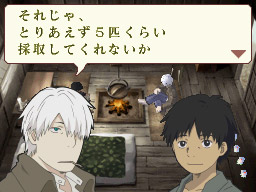
The collection interface makes observation into an action. One original image gives an instruction beside the landscape; another shows a drawn circle around a mushi with a completion control and a progress-style bar. The paired screens clarify the advertised use of the DS touch interface without requiring a claim about how easy collection feels. As an editorial lens, the interaction asks the player to notice and identify something before moving on. That is a useful point of contact with the source’s interest in attention, while remaining a different activity from reading Ginko’s encounters.
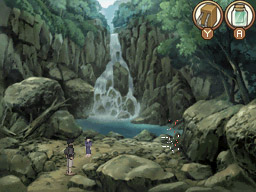
A village simulation can give ordinary movement and conversation room beside a central story. The waterfall screenshot and the dialogue encounter with Ginko show two different forms of that participation. Nintendo’s description explicitly allows different ways to spend time, but it does not supply a measured playtime or promise a particular outcome for every choice. The game-original setting also matters: the presence of familiar characters is evidence of a licensed encounter, not evidence that the village maps onto one exact manga chapter. Its original scenario should be followed under the game’s own identity.
Choosing this route
Choose this route for a simulation organized around collecting, reporting and meeting people in a particular place. For the source’s complete collection of cases, use the manga; for the screen presentation, follow the named television seasons and specials in the main analysis. The 2007 live-action feature is another separate route. None of those format choices makes the DS game compulsory. Completing its village story does not supply a verified post-anime reading chapter, and the game stays outside the core manga/anime road map.
Platforms and access
The archive documents the original Japanese DS release, not current stock or a modern port. Check the exact cartridge, language and compatible hardware through an authorized source. Original DS publicity images are small and are kept at their native aspect ratio. This guide describes fictional game systems and makes no real-world treatment claim or hands-on performance judgment.
Sources and credits
- Nintendo — exact product and manufacturer explanation
- Nintendo — original collection screenshots
- Nintendo — original Ginko encounter screenshot
Facts are drawn from the identified publisher and developer records. The story lens is editorial interpretation, not a hands-on review, performance test or audience rating.