Start the seven-part OVA at installment 1. The Day the Earth Burned is a separately titled comic beginning at volume 1; other franchise productions are not extra OVA installments.
Reviewed 3 October 2026 · Opening premise and adaptation relationships. Major endings withheld; linked catalog summaries and discussions may contain spoilers. · Licensed access varies by country.

The source and screen branches

Shared characters and creators do not certify an exact post-OVA chapter handoff. Wider Yokoyama works are optional discovery, not chronological prerequisites.
- WATCH · original named OVA: The Day the Earth Stood Still → Installments 1–7
- READ · separate later comic: The Day the Earth Burned · volume 1 → Yokoyama / Imagawa / Toda
Begin the seven-part OVA, with no live-action prerequisite
Giant Robo: The Day the Earth Stood Still is the animated OVA project beginning in 1992, with seven installments identified by the named anime catalog. Begin at installment one and continue through seven. The licensed introduction brings together a giant machine, its young operator Daisaku Kusama and an international police organization confronting the BF group.
The animation is a particular presentation within Mitsuteru Yokoyama's wider creative territory. Bandai Channel explicitly promotes characters and robots appearing across the boundaries of his works. That all-star arrangement does not require watching every earlier adaptation as chronological preparation. It invites recognition while supplying this production's own premise and sequence.
The older live-action production and game-related products remain outside the core anime-and-reading route on this site. A similar title or robot design does not make them extra numbered OVA installments. This guide concentrates on the animated story and names a separate later manga discovery route without claiming that it resolves an exact unfinished OVA chapter.
The Day the Earth Burned is a separate named manga route
Akita Shoten's first-volume record identifies Giant Robo: The Day the Earth Burned, credits Yokoyama, Yasuhiro Imagawa and Yasunari Toda, and dates that book to March 20, 2007. Its opening description introduces Daisaku amid a murder case and competing organizations. Begin it at volume one; a familiar protagonist does not certify an exact continuation point after OVA installment seven.
The difference between Stood Still and Burned matters in a catalog search. A translated title shortened simply to Giant Robo can hide whether a listing refers to this OVA, the later comic or another franchise production. Compare medium, credited creators and actual contents before following an edition recommendation.
For animation, look for the seven named OVA installments in the package or streaming entry. Extras, character spin-offs or another Giant Robo series should be identified separately. We have not verified a scene-to-chapter handoff between the OVA and the later comic, so the reading map starts at the latter's opening instead of promising a skip to a supposed continuation chapter.
| Presentation | Start | Check before substituting |
|---|---|---|
| The Day the Earth Stood Still OVA | Installment 1 → 7 | Named seven-part animation |
| The Day the Earth Burned manga | Akita Shoten volume 1 | Later separately titled comic |
| Other Giant Robo productions | Their own opening | Not automatically OVA installments |
| Creator’s wider manga catalog | Choose the particular work | Recognition is not chronological preparation |
The robot’s face can become a monument before it becomes a moving weapon
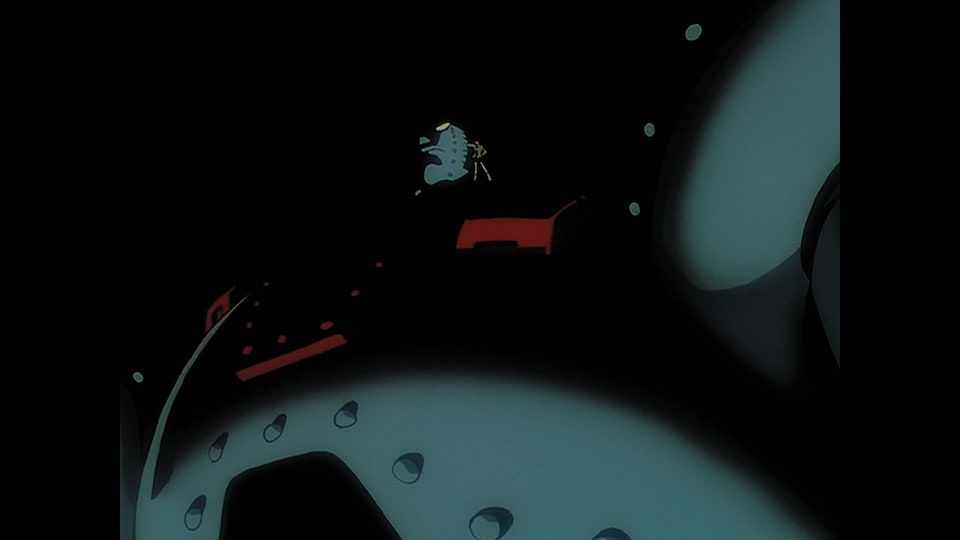
The licensed promotional artwork places the large blue-gray robot among human figures against deep black and red areas. Daisaku's much smaller body establishes a visible contrast in scale. The opening-installment reference below is darker: riveted mechanical surfaces surround a comparatively small, illuminated face, with much of the body swallowed by shadow.
Our interpretation concerns recognition and concealment. The promotional composition lets a viewer identify the ensemble and the machine at a glance; the reference image withholds more of the machinery while drawing attention to a face embedded within it. That difference can make a robot feel at once familiar and imposing. The still does not establish its complete motion or the surrounding dialogue.
Follow how the OVA changes that relationship between human and mechanical scale. A vast body can promise protection while also making its operator's responsibility seem disproportionate to his physical size. The inspected images give a concrete starting contrast, without claiming that the poster's arrangement is a literal scene or disclosing how the machine is used in the final confrontation.
Original visual reference
A universal energy solution creates a universal point of dependence
The licensed premise describes a world enjoying the benefits of the Shizuma Drive, presented as clean and recyclable energy, while the BF organization threatens to stop its systems. Our reading asks how widespread confidence in one infrastructure can produce widespread vulnerability. The danger is not only the arrival of an enemy machine; it is the withdrawal of something society already relies on.
That premise changes what scale means. A robot battle has a visible location, while failure of an energy system can affect people who never see the combatants. Ask whether a sequence treats the crisis as a duel, a rescue or a threat to ordinary collective life. Those perspectives can assign different importance to the same action.
The guide does not treat Shizuma Drive as a real technical design or calculate its output from fictional claims. The analytical interest is social dependence: how a celebrated solution shapes expectations, and what happens when those expectations become leverage. The production's own investigation supplies later answers; the entry guide preserves those discoveries rather than reducing them to a complete plot synopsis.
A child’s authority over a giant body creates an uneven responsibility
The licensed introduction names Daisaku as the operator of Giant Robo within an international police conflict. Our interpretation follows the mismatch between the operator's visible size and the machine's potential reach. The promotional image makes that mismatch immediate, placing the boy against machinery and adult figures whose own experience and priorities are not interchangeable with his.
A command in that situation can be personal and institutional at the same time. A viewer can ask whether Daisaku is acting from trust, instruction or a sense of duty, and whether the surrounding adults treat him as someone to protect or as someone needed for an operation. These are questions for the story's handling of responsibility rather than assumptions that every adult has the same motive.
The opening reference's concealed machinery adds another useful tension: the body performing the work can be much harder to apprehend than the face through which viewers recognize it. A future scene comparison should examine a particular command and response with actual footage. The still supports a reading of visual scale and visibility, not an invented account of every mechanism or decision.
Yokoyama’s all-star cast is a discovery bridge rather than one universal timeline
Bandai Channel's presentation explicitly highlights appearances across Yokoyama's works. That gives the animation a different kind of connection from a direct one-book-to-one-season adaptation. A recognizable figure can invite a reader toward another manga without making that other manga an episode that must be inserted into this OVA's sequence.
The later Akita Shoten comic credits Yokoyama, Imagawa and Toda separately. Those names help identify a relevant creative connection while preserving the comic's own title and beginning. The named AniList OVA record supplies its production-studio identities, including Phoenix Entertainment. A studio field should not replace a reader's ability to follow particular creators or distinguish later editions.
The licensed animation page also highlights performance by the Warsaw Philharmonic. That musical contribution offers another lens on scale: orchestral presentation can frame mechanical action as expansive drama. The claim comes from the licensed project introduction; assessing how a particular cue works would require the moving sequence, not the silent reference image reproduced here.
Seven installments and an extensive world are different measures
The AniList audience figure displayed here belongs to the seven-part OVA entry, not to every Yokoyama story or Giant Robo production. A short installment count does not tell a visitor that the cast or implied world will be equally small. The named scope helps set expectations without pooling unrelated presentations into one franchise average.
The optional Giant Robo encyclopedia and mecha discussion links can help a viewer identify a familiar character or a particular edition. Their histories often explain late motivations and relationships quickly. First-time viewers can use the opening energy-system premise and the route table, then return to character cross-references after the chosen animation has introduced its own cast.
Community enthusiasm for the all-star arrangement is a prompt to explore its creative connections, not an official requirement to read an enormous preparatory syllabus. If a discussion recommends another manga, ask whether the recommendation offers context, a different portrayal or a genuine sequel. This guide only draws continuation arrows where the available evidence supports the sequence shown.
The linked May 2020 weekly anime discussion provides a work-specific route into reader conversation and an episode-discussion archive. It is optional after the OVA, rather than an official chronology record. Discussion of particular motivations may disclose later events, so the opening premise and edition table remain the safer starting points for a first viewing.
Identify the OVA contents before treating a package as complete
The first practical buying check is whether the product contains this seven-part animation rather than a separately titled series. Confirm subtitles, dub, disc region or territorial access, and whether a listing's extras are distinct productions. A poster with the same robot is not enough to certify the contents or restoration specifications of an edition.
No audited OVA production budget or net-profit total was verified for this guide. Orchestral participation, elaborate imagery and later collector editions demonstrate creative and product choices; they do not permit an invented financial total. The reader's useful comparison remains the presentation, contents and language actually offered by a named distributor.
Finish the OVA, then begin The Day the Earth Burned at its first volume if you want a related comic route. Explore other Yokoyama works as creative discovery after that. Gunbuster supplies another compact older OVA with a different human-to-machine scale, while VOTOMS offers an institutional view of military equipment outside Giant Robo continuity.
Primary sources and useful navigation
- Bandai Channel · licensed animation premise and original images
- Akita Shoten · The Day the Earth Burned volume one
- AniList · named anime audience score
Community and catalog routes
- MyAnimeList · named anime catalog
- Giant Robo Wiki · franchise navigation, spoilers possible
- Reddit · 2020 weekly Giant Robo discussion, spoilers
- Reddit · mecha discussion
The production and publisher links support project facts. Catalog and community pages are secondary navigation and may reveal later events.
Explore related story guides
Original series imagery is reproduced under permission asserted by the site owner; the source and rights credits are retained. The route diagram is Animeteor’s own explanatory graphic.
Games and live-action adaptations
- Giant Robo (1967–1968 tokusatsu) — Live action: Series · 1967–1968
- Giant Robo: The Animation (PS2) — Game: Versus action · Japanese 2004 edition
The OVA-related Japanese PlayStation 2 game
D3’s catalog identifies Giant Robo THE ANIMATION: The Day the Earth Stood Still for Japanese PlayStation 2, released on 3 November 2004. Its versus-action product code is SLPM-62526. This optional OVA-related game is separate from the older performed television series and is not another OVA episode.