Start with Full Metal Panic! (2002), then Fumoffu, The Second Raid and Invisible Victory in our recommended first-viewing order. Read the twelve main novels for the complete original prose route; Short Stories and later Family material are separate branches.
Reviewed 1 October 2026 · Premise and machine-image analysis; Family and other source pages contain later spoilers · Licensed access varies by country.
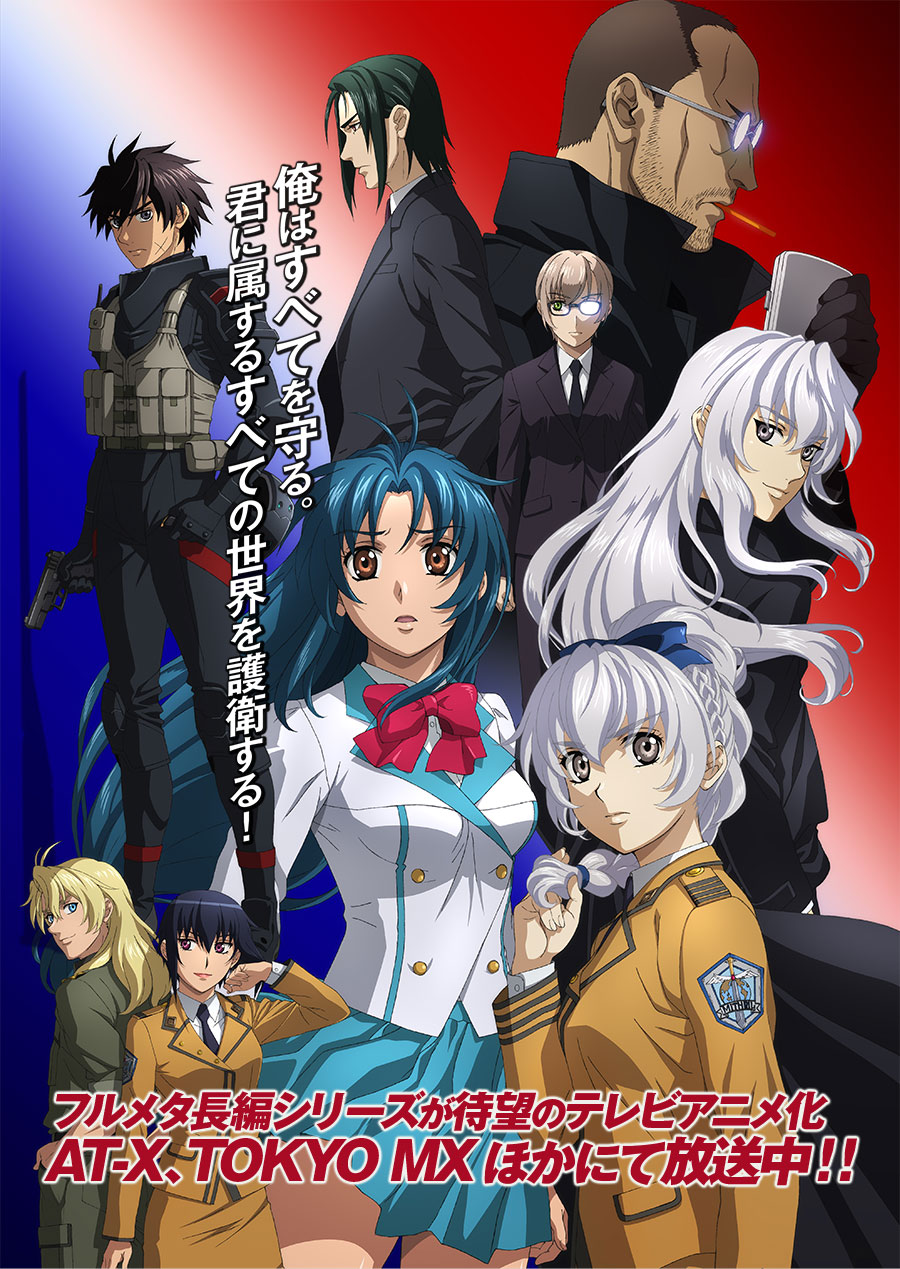
The source and screen branches

Our first-viewing order inserts Fumoffu after the 2002 series. It is labeled separately for tone. Audio drama, episode 000 and OVA are supplements; no exact novel/chapter handoff is asserted.
- Original prose: Main novels 1–12: complete → Later Family prose: separate sequel
- Military screen route: Full Metal Panic! (2002): 24 episodes → The Second Raid: 13 main episodes → Invisible Victory: 12 episodes
- Separate branches: Short Stories / Fumoffu: comedy OR Tateo / Sigma / Family: named comic editions
A soldier protects a schoolgirl, with two different kinds of trouble
Full Metal Panic! pairs school comedy with military suspense. Sousuke Sagara, a mercenary belonging to Mithril, is sent to protect Kaname Chidori and enters her school as a transfer student. His combat training does not equip him to interpret every ordinary encounter correctly. The premise creates danger around Kaname while also making Sousuke’s approach to civilian life a source of disruption.
For a first viewing, start with the 2002 Full Metal Panic! series. Our recommended sequence then includes Fumoffu for its school-comedy material, followed by The Second Raid and Invisible Victory for the military storyline. The original source is Shouji Gatou’s prose, illustrated by Shikidouji. Manga versions form their own adaptation branches.
The main source novels and the inspected screen sequence have different endpoints. J-Novel Club identifies the twelfth main novel as the final volume of that series. Do not transfer that completion label to the anime or assume that finishing Invisible Victory provides the same source conclusion. Readers choosing between media should be told what is complete in the particular format they are selecting.
Use the project titles, not ambiguous season numbers
GONZO’s original-production record lists twenty-four episodes broadcast in 2002. The Second Raid is a later Kyoto Animation production; the licensed complete-set record identifies thirteen main episodes, plus episode 000 and the Tessa’s Eventful Day OVA. Invisible Victory is the 2018 continuation, whose official disc sequence ends with episodes nine through twelve in its third box.
Services and viewers sometimes count Fumoffu as a season, producing different numbers for The Second Raid. The titles are a clearer navigational system: Full Metal Panic!, Fumoffu, The Second Raid, Invisible Victory. Follow the numbered story episodes within the selected project; separately labeled previews and bonuses should not silently inflate its main count.
Our recommendation to place Fumoffu after the first production follows release order and gives the school setting room before returning to suspense. A visitor seeking the military route can use the separate comedy label to make a choice. This is an editorial viewing recommendation, not a claim that every comedy installment must be completed to unlock the next main episode.
| Project | Role | First-viewing use |
|---|---|---|
| Full Metal Panic! (2002) | 24-episode first adaptation | Begin here |
| Fumoffu | School-comedy production | Recommended after first series |
| The Second Raid | 13 main episodes; separately packaged bonuses | Continue military route |
| Invisible Victory | 12-episode continuation | After The Second Raid |
| 2002 director’s-cut films | Reworked earlier television material | Optional alternative presentation |
| Christmas audio drama | Disc-associated adaptation in audio | Optional; not new TV episodes |
Fumoffu’s school comedy has a source branch
Kyoto Animation’s Fumoffu introduction identifies the school-comedy premise and Yasuhiro Takemoto’s direction. J-Novel Club separately publishes Full Metal Panic! Short Stories, with nine volumes and the ninth identified as final. That gives readers a verified prose branch for the franchise’s shorter material rather than a reason to dismiss comedy as unrelated filler.
The main novels and short-story collections have different numbering. Short Stories volume one is not main volume thirteen, and the ninth collection does not become a new military ending because it is final in its own set. Keep the series subtitle attached to a recommendation or purchase link.
Our interpretation of the comedy focuses on mismatched rules. A behavior that makes sense during an armed operation can be disproportionate in a classroom. The contrast works best when the ordinary setting has its own constraints and people react to the disruption. Calling every gag evidence of tactical genius would miss the civilian perspective that makes the encounter funny.
The twelve main novels are a complete prose route
J-Novel Club credits Gatou, Shikidouji, translator Elizabeth Ellis and editor Dana Allen for the inspected English main series. Its catalog contains twelve numbered volumes and explicitly describes volume twelve as final. The anime project’s Japanese source directory also separates those twelve main books from nine short-story books.
Begin with main volume one to experience the source presentation. Prepublication parts on a publisher page divide a book for release or subscription reading; they are not extra collected novels. Likewise, a print collection can package material differently from a digital volume. Inspect the edition’s contents before assuming a store’s book number matches the source number.
This guide does not assign an exact chapter after Invisible Victory. The source and screen material require an edition-specific comparison before that shortcut can be dependable. Starting at one preserves the novel’s own perspective and intervening material. A reader who wants only unseen events should still know what was skipped or rearranged before accepting a chapter recommendation.
Tateo, Sigma and Family should retain their artist and subtitle
KADOKAWA records Retsu Tateo’s original Full Metal Panic! manga, whose first Japanese collected book appeared in August 2000. The publisher also lists Comic Mission editions by Tateo. Its seventh Comic Mission book carries a different subtitle and packaging from the original first volume; this is a reason to check an edition rather than merge every listing into one numerical sequence.
Full Metal Panic! Sigma is a separately titled comic by Hiroshi Ueda. KADOKAWA maintains its nineteenth-volume record, alongside the credited source creators. Place it on the manga route with its own opening and numbering. A source novel called volume nine and a Sigma book called volume nine do not establish equivalent chapter coverage.
The current Family comic is another distinct product, credited to artist 神反ヲ鬚 in the inspected publisher record. Its volume one is not the first book of the original Tateo adaptation. These named branches help visitors choose a legitimate publisher route without linking to unauthorized scans or presenting an unverified English license as an existing edition.
Family is later material with a spoiler-bearing premise
The official Fantasia Bunko Family page describes a story roughly twenty years after the original final conflict. It lists Family four with an August 2026 release announcement, alongside earlier volumes. We identify it as a later Japanese prose branch, while leaving its detailed character and household descriptions behind the linked page’s spoiler warning.
The later setting is not a reason to begin a first reading there. Our recommendation is to complete the original main prose route before exploring Family, so its changed circumstances can be understood in relation to the earlier story. That recommendation does not imply a currently licensed English Family edition.
Family also has its own comic adaptation and associated model products. A new comic or plastic model announcement does not establish a new television season. New entries should be classified by medium and project title before being added to the calendar or adaptation map.
Three animation studios, with project-specific responsibilities
The first television adaptation is GONZO’s production, directed by Koichi Chigira, with Osamu Horiuchi for character design and Toshihiko Sahashi for music. The Second Raid and Fumoffu are Kyoto Animation productions directed by Takemoto; The Second Raid lists Gatou for series composition and Horiuchi for character design and chief animation direction.
Invisible Victory credits Katsuichi Nakayama for direction, Gatou for composition and scripts, Horiuchi for character design and chief animation direction, and XEBEC as production company. Its mechanical designs credit Kanetake Ebikawa and Toshiaki Ihara. Sahashi is again credited for music, while the opening and ending songs have separate performer credits.
The Japanese leads are Tomokazu Seki as Sousuke and Satsuki Yukino as Kaname. A returning cast or designer gives the productions a connection, but should not erase changes in studio and direction. Those changes are verified credits, not proof of a specific budget, production dispute or commercial motive.
Case check: a mechanical face in the Invisible Victory opening
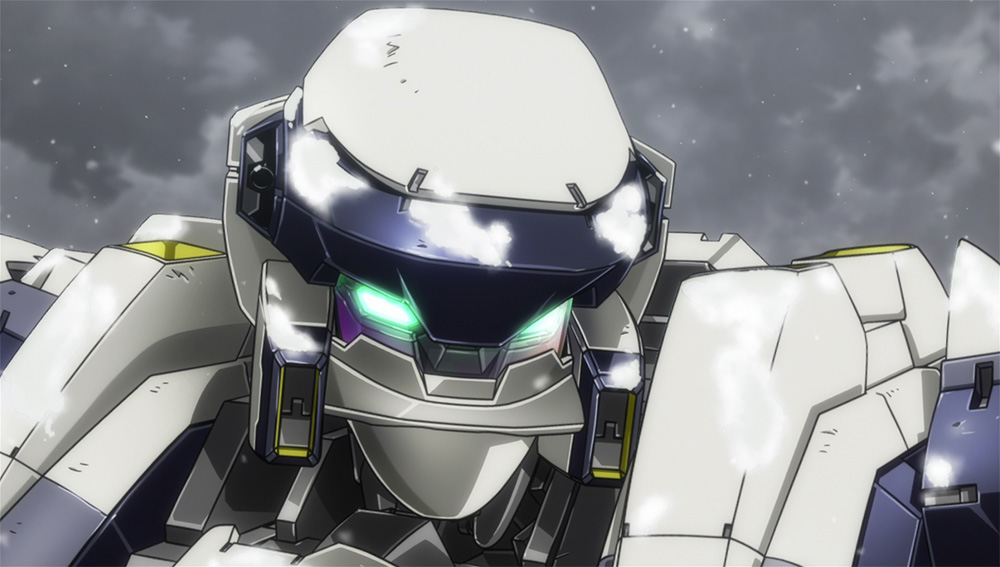
The original image below comes from Invisible Victory’s first episode page, not the franchise’s 2002 premiere. It shows a pale Arm Slave head and shoulders against a gray, snow-filled background. Green optical elements stand out beneath a dark brow, while angular armor fills much of the frame. We used the full 1000-by-567 official image linked behind the site’s smaller thumbnail.
Our reading focuses on the contrast between the machine’s hard surfaces and the surrounding weather. A mechanical close-up can give an encounter presence without displaying the operator’s face. The lighting and framing organize attention around the optical area, but they do not reveal a character’s thoughts or establish that the machine acts independently.
The image therefore supports a bounded visual analysis of machinery and environment. It cannot prove performance, identify the entire battle situation or measure a weapon’s strength. Keeping that boundary makes the visual useful to a reader: its project and episode are clear, and the interpretation stays with visible form rather than invented technical specifications.
Original visual reference
Protection can become control when the civilian has no say
Our central analytical question concerns the protection assignment. Sousuke has skills for anticipating threats, but a person being protected also has a school life, relationships and preferences. The story’s premise lets us ask when a precaution increases safety and when it removes someone else’s ability to participate in decisions.
In an early interaction, separate the actual danger from Sousuke’s interpretation of it. A cautious response can still be inappropriate to the setting. Conversely, a comic misunderstanding does not mean the danger surrounding Kaname is imaginary. The two modes can coexist, and an analysis should identify which problem a particular scene is addressing.
This is why the pilot-burden collection highlights more than the Arm Slaves. The burden includes the judgment required when an operator moves between institutions with different expectations. Combat competence, social understanding and respect for another person’s autonomy are distinct abilities; the presence of one does not guarantee the others.
A twelve-part audio adaptation is not twelve additional TV episodes
The official Invisible Victory first-box record lists the twelve-part Dancing Very Merry Christmas audio drama among its supplements, alongside booklets, commentary and video extras. The medium matters: it is audio material connected to an existing prose title, not a fifth television production or twelve additional Invisible Victory episodes.
GONZO’s October 2017 notice separately announces a director’s-cut theatrical presentation of the earlier series. Treat that as a reworked screen product. Neither its later release nor its new packaging makes it a sequel to The Second Raid or a substitute for Invisible Victory’s separate opening.
These catalogs show a commercial range involving prose, comics, animation, audio and models. They do not disclose title-specific production costs or profit. This guide has no inspected financial record sufficient to calculate a return, so edition prices and company-wide results are not converted into invented franchise earnings.
Readers need clear titles before detailed coverage charts
The reviewed r/fullmetalpanic watch-order thread asks what follows Fumoffu and whether an episode labeled zero is required. Replies provide the named project sequence, then move into source coverage, bonuses and expectations of a future conclusion. We use it as a concrete example of navigation confusion, not as authority for unpublished production plans.
The guide answers the practical question through named productions and separately marked supplements. The licensed Second Raid set verifies that episode 000 and the OVA are packaged alongside thirteen main episodes. A catalog’s inclusion of a bonus does not make that bonus main episode one; a service’s numbering should be checked against its title.
Future maintenance should review new Family editions, update regional licensed access and compare actual books and episodes before adding an exact handoff. Keep the finished main-prose status separate from expectations about new animation. That allows the guide to serve both a visitor seeking a complete story and someone choosing a particular screen route.
Primary sources and useful navigation
- GONZO original 2002 production, staff and 24-episode record
- Kyoto Animation Fumoffu premise and credits
- Kyoto Animation The Second Raid staff and premise
- Licensed Second Raid set: 13 main episodes, episode 000 and OVA
- Official Invisible Victory episode-one imagery and credits
- Official Invisible Victory staff/cast
- Official IV third box: episodes 9–12
- Official first-box supplements and twelve-part Christmas audio drama
- J-Novel Club complete main prose series
- J-Novel Club separately numbered Short Stories
- Official Japanese main and short-story book directory
- KADOKAWA Tateo original manga first book
- KADOKAWA Comic Mission 7: distinct edition and subtitle
- KADOKAWA Ueda Sigma 19; ending spoilers
- Official Japanese Family project and dated volumes; major premise spoilers
- KADOKAWA separately credited Family comic first book; premise spoilers
- GONZO dated director’s-cut theatrical announcement
Community and catalog routes
- Reviewed watch-order and bonus discussion; later spoilers
- MyAnimeList original 2002 production
- Full Metal Panic fan wiki; secondary navigation and later spoilers
The production and publisher links support project facts. Catalog and community pages are secondary navigation and may reveal later events.
Find this work in our thematic collections
Original series imagery is reproduced under permission asserted by the site owner; the source and rights credits are retained. The route diagram is Animeteor’s own explanatory graphic.
Production and edition updates
Full Metal Panic Who Dares Wins — English PS4 edition
Bandai Namco’s Singapore PlayStation listing identifies Full Metal Panic! Fight! Who Dares Wins, English version, for PS4, developed by B.B. Studio. Its systems combine a story scenario with tactical Arm Slave battles; action order and equipment choice matter. The separately inspected Japanese PS4 entry dates its release to 31 May 2018.