Quick answer: The completed manga is the original reading path. The anime gives food, creatures, and dungeon spaces movement and sound; start at the beginning of either before choosing a precise chapter handoff.
Spoiler scope: opening premise and format relationships. Fan wikis, official volume catalogs and discussions may reveal later events. Case sources checked 30 September 2026; access varies by region.
Edition and adaptation map

Check each lane: Original manga, Television anime. Follow the numbering within the chosen edition. An exact screen-to-page handoff needs a scene comparison; optional branches are not mandatory next chapters.
Edition details and access
The completed manga is the original reading path. The anime gives food, creatures, and dungeon spaces movement and sound; start at the beginning of either before choosing a precise chapter handoff.
Start with an official edition: Yen Press manga. Availability and chapter access can vary by region or subscription.
Publication and edition check · 2 October 2026
Yen Press’s complete English box set contains all 14 manga volumes. The box-set package and individual volumes are alternative purchase formats of Ryoko Kui’s completed source story. Source record →
The official 5 July 2026 notice places anime season two in October 2027. This is a month-level window, not a confirmed premiere day or a guarantee that every territory starts together. Source record →
Choose a route before you continue
Choose the completed main manga for the full source path or the television opening for the audiovisual route. Keep companion books labeled as extra material, not sequel volumes. For a post-season continuation, identify the last rescue event and check the licensed manga before publishing a numbered chapter jump.
Case check: Food is part of the rescue plan
Confirmed by primary sources: The official English introduction says Laios returns to the dungeon after his sister is eaten by a dragon, with food and money left below. The group’s decision to obtain food inside the dungeon is therefore attached to the rescue’s resource problem. TRIGGER is credited for animation production on the same official site.
Official image and premise source · Yen Press manga · Official anime information
Look at the original presentation
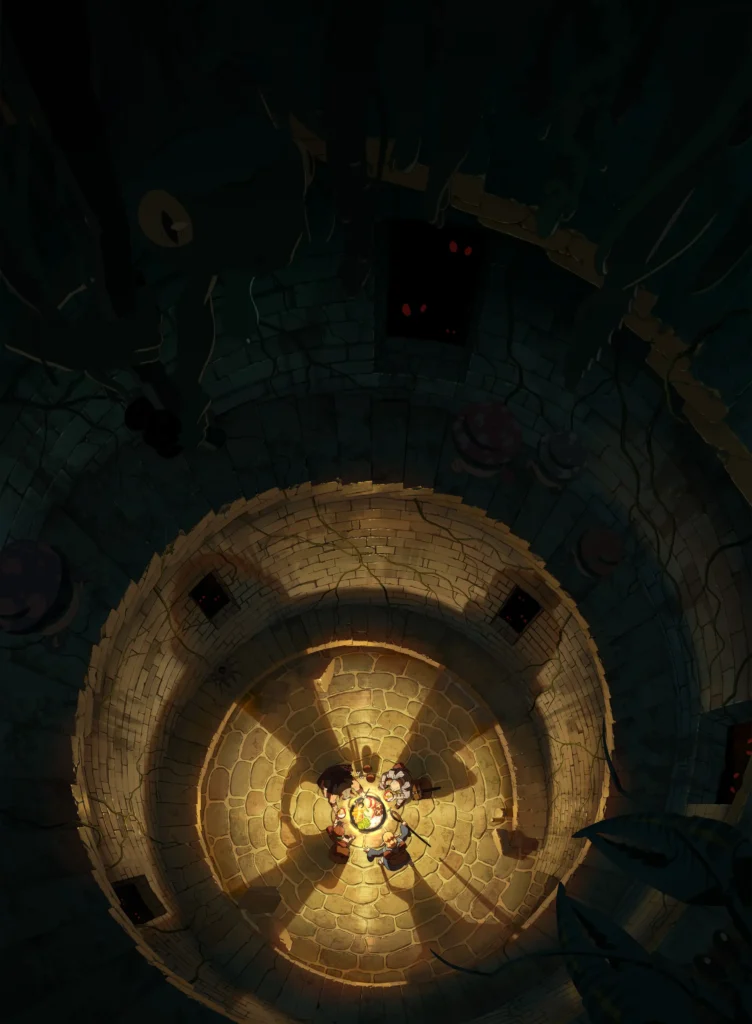
Our visual reading: The selected first-season key visual places the party in a tall dungeon space under warm light. It visually connects exploration with a shared pause. It is promotional art rather than a still from a named recipe scene, so it cannot prove how a particular dish is prepared in an episode.
Verification boundary: this check uses official descriptions and the identified image. It is not a complete page-by-page or shot-by-shot comparison. A numbered continuation requires the last licensed screen scene and the corresponding named source edition to be checked together; promotional art cannot establish that handoff.
Why this opening matters
Our reading of the opening is that cooking is a logistical response before it becomes a fascination. Food affects whether the group can continue, who does the work, and what they must learn about the creatures around them. This gives the dungeon an ecology rather than a decorative list of monsters. A scene can therefore advance the rescue while spending time on preparation and disagreement at a meal.
How to compare the editions
For a recipe comparison, note the creature’s behavior, the practical obstacle, the preparation choice, and each companion’s response. Animation can show texture and motion; a manga page can place an explanation beside a diagram. Check the complete licensed sequence before calling a detail realistic, omitted or added. The series is fiction, and a depicted preparation is not real-world food-safety instruction.
Reader discussion and reference shelf
The author of the linked January 2024 discussion praises the dungeon as a living place and appreciates receiving world information through relevant story events rather than an opening exposition dump. That is an individual interpretation. Our recipe-led comparison offers a concrete way to examine the connection between ecology, preparation and the rescue.
- Selected Reddit discussion — reader responses; spoiler scope depends on the thread.
- Find the named edition on MyAnimeList — catalog navigation and user reviews; ratings are not evidence for canon.
- Fan wiki reference shelf — character and terminology navigation; expect later-story spoilers.
Publisher and production records support the factual route above. Community pages supply reader perspectives and reference navigation. Any future installment-level comparison will be dated here when the licensed material has been checked.
What is worth comparing?
Cooking is worldbuilding here: an ingredient tells the group how a creature lives, and a meal shows how companions negotiate care. A guide should track those discoveries alongside the rescue journey.
Questions to take into the story
What ecological fact does a recipe reveal? Does the screen version make a creature appetizing, threatening, or both?
Food as a route through the dungeon
In the Yen Press manga, an ingredient is rarely a decorative detail. It can explain a creature’s behavior, the party’s limited supplies, or how a character learns to trust another person’s expertise. A route guide should therefore pair a floor or encounter with the meal it makes possible, while keeping the rescue goal in view. The official anime site presents the screen adaptation, where movement and sound can make a creature’s ecology immediately clear. The manga can instead let a diagram or page composition deliver the same observation at the reader’s pace.
Where to begin after watching
The full manga is a coherent source route from volume one. A viewer who wants the original version of a favorite cooking sequence can search for the creature or recipe in the manga before jumping to a later volume; an episode number is not the same as a manga chapter number. Our visual map identifies the manga and anime as related lanes, but it does not claim a precise handoff without comparing the final scene of the specific episode. For an adaptation comparison, note whether a meal changes the group’s plan, changes one member’s view of a monster, or simply restores strength for the next descent. Those are different narrative jobs hidden inside the same cheerful cooking format.
A recipe is also a field note
Cooking a monster asks the party to learn something about how it lives, what can be used, and what remains dangerous. A meal also reveals how companions divide work and show care while under pressure. In a reading notebook, pair an ingredient with the ecological fact it implies and the decision the group makes because of it. That connects the apparent detour of a recipe to the rescue journey.
The manga establishes that sequence on the page; the anime can give food texture, creatures motion and a shared rhythm to preparation. Compare when the group understands a creature versus when the audience does. A satisfying visual dish is not the whole adaptation question if the reasoning that made it possible has shifted.
Verified creators
Ryoko Kui (Manga story and art)
Community discussion
Compare reader interpretations in Reddit discussions about Delicious in Dungeon. Community posts are individual opinions; use the official sources below to verify release and edition facts.
Official sources
Independent editorial commentary. Thematic illustration is original and unofficial; source links lead to publishers, production sites, or licensed platforms. Availability varies by region.
Monster Eater is a physical tabletop branch
Arclight’s Monster Eater — Delicious in Dungeon Board Game (Japan, 15 September 2022) is a competitive physical card game designed by Seiji Kanai from Ginichiro Suzuki’s Monster Maker concept, with Ryoko Kui’s source and illustrations. Its monster-cooking and food-recovery systems make a useful separate lens on survival. It is not a digital game or an extra step in the manga/anime order.