Start the manga at its opening, or choose a Golden Age screen presentation. The trilogy and Memorial Edition overlap; they are not consecutive story arcs. Adult-content and edition guidance below.
Reviewed 2 October 2026 · Opening premise and format relationships; major ending revelations withheld. Linked publisher summaries and discussions may reveal later events. · Licensed access varies by country.

The source and screen branches

Parallel presentations share source material. The double arrow means alternate presentations, not a sequel. No exact chapter handoff is certified.
- READ · source: Manga · opening volume → Standard / collected contents
- WATCH · classic entry: 1997 television · 25 episodes · Independent screen presentation
- WATCH · Golden Age: Film trilogy ↔ 2022 Memorial presentation
- WATCH · later television: 2016 television production → 2017 second season
Choose a source route before an animated presentation
Read Kentaro Miura’s manga from its opening for source continuity. Dark Horse’s catalog identifies the English manga and its products. An adaptation’s starting frame is a presentation choice, not a replacement for the source’s opening. If your purpose is to understand the complete source, choose its own sequence rather than splice together screen endings.
Distinguish the 1997 television entry from the Golden Age film trilogy and its Memorial Edition. STUDIO4℃ identifies the 2022 production as a revisited presentation of that trilogy. Choose a Golden Age presentation; watching both packages is a comparison exercise, not two consecutive arcs that advance the same story.
The 2016 television production and its 2017 second season form a later screen branch, separately identified by their official sites. A release-order list identifies productions but cannot restore omitted manga material. This guide does not certify an exact chapter after any animated ending. Games remain outside the manga and animation roadmap.
Binding and restoration do not create a new story
Compare standard and collected manga by their included contents. A hardcover’s number need not match a paperback’s number: a larger collected book can gather earlier standard volumes. Check language, binding and product description together, especially when a retailer mixes Japanese and English editions in one search result.
The official Memorial site describes remastered material and additions to the Golden Age presentation. Restoration, additional scenes and television subdivision change the viewing package. They do not establish that a new arc follows the original film ending. Product chronology and story chronology answer different questions.
Dark Horse’s Official Guidebook is a reference product with stated coverage through the first thirty-eight manga volumes. It is not the next manga installment and can disclose later characters. Read its catalog description before treating it as a spoiler-free introduction. A source collection, an adaptation and a reference book each serve a different purpose.
An ensemble image makes belonging visible before explaining it
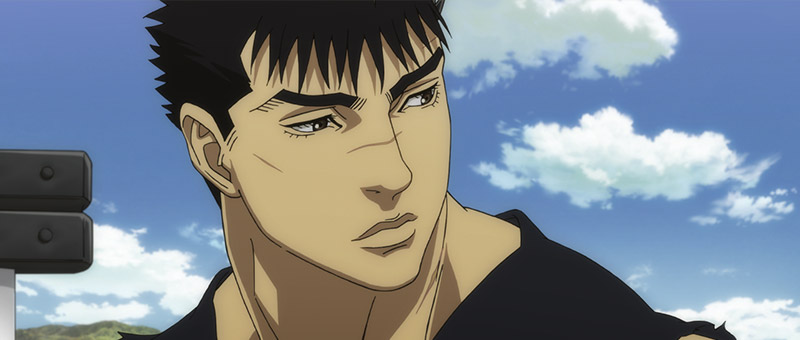
STUDIO4℃ identifies the Golden Age as the subject of its earlier trilogy. The selected official Memorial artwork belongs to that production. It supports a discussion of the campaign’s presentation, without proving that every pictured figure appears in every episode or that the composition records a literal event.
Our visual reading considers the relationship between individually emphasized figures and their shared group identity. Promotional art can suggest allegiance while withholding the conditions of attachment. For a newcomer, that raises a useful question: what makes a person stay with a company whose aims are not entirely their own?
This case concerns production artwork and the studio’s stated scope. It withholds the major turning point. A panel-to-frame comparison needs a named licensed manga edition and a specific animated scene; a promotional montage cannot demonstrate exact adaptation coverage. The illustration is original property imagery, not an Animeteor reconstruction.
Original visual reference
Being useful to a group is different from being known
Our interpretation treats belonging as a tension rather than a prize automatically earned through strength. A fighter may be valued for usefulness while struggling to be recognized as a person. Shared danger can create reciprocal care, but it can also make continued service feel like an unpayable debt.
Ordinary exchanges therefore deserve attention alongside battles. Who may refuse a request? Who is heard when a plan changes? Who can imagine a future outside the company? These questions make allegiance visible as a relationship instead of reducing every decision to combat ability.
For adaptation comparison, examine the time granted to those exchanges before a major action sequence. Duration affects the feeling of attachment. Film compression creates a different rhythm from serialized manga without settling which interpretation is stronger. A specific claim that material was removed still requires inspection of the corresponding source, rather than inference from a synopsis.
A shared dream can conceal an unequal bargain
Our reading of ambition asks when a private goal starts to justify conduct that would otherwise be unacceptable. Charisma can make an uneven bargain feel like collective destiny, especially to people with few other places to belong. A leader’s confidence and the group’s freedom to choose are separate issues.
Distinguish admiration from consent. Someone may admire a leader while misunderstanding what the leader expects others to sacrifice. Loyalty becomes more interesting when it is not treated as unlimited permission to decide another person’s future. That question can be considered without revealing the decisive events of the Golden Age.
Chronology is only part of a useful guide. A route shows where material sits; analysis asks how context alters a relationship. Returning to an earlier conversation may expose a different imbalance after later information, although its words have not changed. This is a reading lens, not a claim about an undocumented authorial intention.
Survival and recovery are different kinds of progress
A person can survive an event without recovering from it. Physical force may resolve an immediate confrontation without rebuilding trust, reducing isolation or helping somebody feel safe. Our interpretation uses that distinction to examine resilience beyond the next weapon, opponent or victory.
Track the people around a protagonist. Can help be accepted? Does a defensive habit protect somebody in danger but make ordinary closeness difficult? Does companionship become possible without requiring the person to erase what happened? These questions allow development to include uncertainty rather than demand constant visible improvement.
Berserk contains adult material, including graphic violence and sexual violence. The selected campaign images avoid explicit imagery and this introduction withholds major plot revelations. A favorable audience score is not a content advisory. Readers should decide separately whether the work’s intensity suits them; this guide does not turn fictional trauma into a diagnosis or medical advice.
The displayed score belongs to one television adaptation
Dark Horse credits Kentaro Miura as the manga’s creator. The Memorial production has separate staff and studio records. Original manga creation, animated interpretation and a later edition’s production work should not collapse into a single studio label. The source links below let readers follow those responsibilities independently.
AniList’s displayed score concerns the named 1997 television entry only, observed on 2 October 2026. It does not rate the manga, trilogy, Memorial Edition or property as a whole. The hundred-point audience average is converted to ten; it is not Animeteor’s own review score.
The linked Reddit discussion asks what to explore after the 1997 series. Its replies are individual suggestions, not certified manga handoffs or a representative survey. Use official catalogs to identify products. Treat audience disagreement as a reason to compare named editions and scenes, rather than a consensus that one thread cannot establish.
Catalog longevity does not establish a profit figure
A maintained English manga catalog and a remastered screen presentation show different ways an older property remains accessible. They are not the same commercial measure. A product’s shop listing confirms that it is listed, not how many copies sold or how much income reached the creator.
No audited title-level net profit or complete screen budget was verified here. Retail prices, audience scores and the number of catalog products cannot be converted into a reliable financial success estimate. A future business section can add a figure only with its reporter, date, territory and definition.
Choose the manga’s opening for source continuity or a clearly named Golden Age edition for viewing. Keep guidebooks and games as optional products. Publisher changes can be incorporated without changing this page’s permalink or presenting a repackaged release as a newly written sequel. Exact continuation advice remains open to a later licensed comparison.
Primary sources and useful navigation
- Official · 2016 television project
- Official · 2017 second-season announcement
- Dark Horse · English manga catalog
- Official Golden Age Memorial production
- STUDIO4℃ · trilogy and Memorial relationship
- Dark Horse · official guidebook coverage
- AniList · named adaptation audience score
Community and catalog routes
- MyAnimeList · named adaptation catalog
- Reddit · after-1997 viewing and reading discussion
- Wikipedia · secondary franchise navigation
The production and publisher links support project facts. Catalog and community pages are secondary navigation and may reveal later events.
Explore related story guides
Original series imagery is reproduced under permission asserted by the site owner; the source and rights credits are retained. The route diagram is Animeteor’s own explanatory graphic.
Games and live-action adaptations
- BERSERK and the Band of the Hawk — Game: Warriors-style action / hack and slash
Manga continuation and Japanese edition
Hakusensha identifies Kentaro Miura, Studio Gaga and Kouji Mori in its Japanese volume-43 record, released on 29 August 2025 with ISBN 9784592166931. Its 26 June 2026 Young Animal publisher notice separately credits Miura’s original work, Studio Gaga’s manga production and Mori’s supervision. These continuation roles should remain visible alongside the original authorship credit. A Japanese collected-volume number is not interchangeable with a Dark Horse deluxe binding or an anime season.
Hakusensha — Japanese Berserk volume 43 · Hakusensha — 2026 continuation production credits