Quick answer: The manga provides the original chapter order. The anime follows the central story, but its later installments use several season and special labels; use the official episode listing instead of assuming a single numbered season contains everything.
Spoiler scope: opening premise and format relationships. Fan wikis, official volume catalogs and discussions may reveal later events. Case sources checked 30 September 2026; access varies by region.
Edition and adaptation map

Check each lane: Original manga, Television anime. Follow the numbering within the chosen edition. An exact screen-to-page handoff needs a scene comparison; optional branches are not mandatory next chapters.
Edition details and access
The manga provides the original chapter order. The anime follows the central story, but its later installments use several season and special labels; use the official episode listing instead of assuming a single numbered season contains everything.
Start with an official edition: Kodansha English manga. Availability and chapter access can vary by region or subscription.
Publication and edition check · 2 October 2026
Kodansha marks the manga series complete. Standard books, omnibus, Colossal, box-set and full-color products are different editions; catalog product counts should not be treated as the original manga’s chapter count. Source record →
The 9 September notice schedules Crimson Bow and Arrow for Japanese ScreenX, 4DX and ULTRA 4DX screenings on 23 October 2026. THE LAST ATTACK follows in those formats in 2027, with no day specified. These are cinema presentations, not a new television season. Source record →
Edition records and release calendar
Choose a route before you continue
Use the main manga for the source sequence. For screen viewing, check the exact labels of the final-season installments and specials before starting a catch-up. On a first experience, retain discovery order. A historical chronology compiled from the ending can spoil the questions that the opening deliberately leaves unresolved.
Case check: Inside the walls, before the revelation
Confirmed by primary sources: The official premiere summary introduces Shiganshina beneath a wall over fifty metres high, Eren’s interest in the outside world, and the returning Scouts. Its setup is a society organized around separation from the outside. It is not a complete explanation of the world’s history.
Official image and premise source · Kodansha English manga · Kodansha licensing information
Look at the original presentation
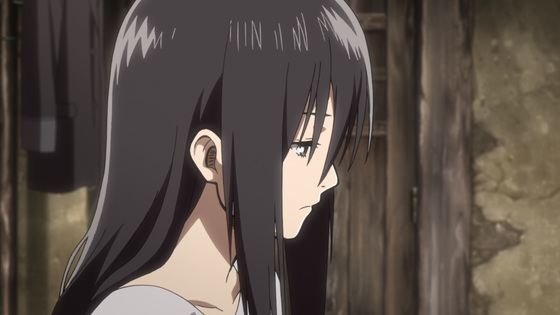
Our visual reading: Mikasa is shown in profile in the selected premiere still, with dark hair and a red scarf against a worn interior. This is a character-focused image from the opening rather than a graphic battle frame. Her expression supports a close reading of atmosphere, not a conclusion about later motives.
Verification boundary: this check uses official descriptions and the identified image. It is not a complete page-by-page or shot-by-shot comparison. A numbered continuation requires the last licensed screen scene and the corresponding named source edition to be checked together; promotional art cannot establish that handoff.
Why this opening matters
The walls perform two jobs in the premise: they keep a threat outside and define what the people inside can imagine. Our reading is that Eren’s curiosity puts those jobs into tension. The opening gives the viewer an immediate environment before a full account of its causes. That makes a chronology guide unusually sensitive to knowledge: an event can be earlier in history while its meaning should remain later in the reading experience.
How to compare the editions
Keep an event timeline beside a revelation timeline. In the first, put only events whose place you can justify; in the second, record the installment that confirms the information. When comparing a manga reveal with an anime reveal, check the lead-in and aftermath, not just the final image. A change in emphasis may come from how long an unanswered question is held, even when the revealed fact is shared.
Reader discussion and reference shelf
The linked reader question asks how the Final Chapters presentations and The Last Attack fit into a viewing order; a reply favors release order. This illustrates why installment labels deserve checking. It is community advice, not an official ruling on required viewing or a substitute for the production catalog.
- Selected Reddit discussion — reader responses; spoiler scope depends on the thread.
- Find the named edition on MyAnimeList — catalog navigation and user reviews; ratings are not evidence for canon.
- Fan wiki reference shelf — character and terminology navigation; expect later-story spoilers.
Publisher and production records support the factual route above. Community pages supply reader perspectives and reference navigation. Any future installment-level comparison will be dated here when the licensed material has been checked.
What is worth comparing?
Early mysteries change meaning when later information arrives. A chronology page needs to separate the order events happened from the order the reader learned them, especially for memories and revelations.
Questions to take into the story
What did a character reasonably know at this point? Which reveal changes an earlier scene without changing the event itself?
Choose an edition before following a chapter number
Kodansha’s English catalog lists the original manga by Hajime Isayama as complete, alongside print, digital, omnibus, box-set, and other editions. These are ways to collect or read the same central manga; an omnibus number is not an original single-volume number. If a guide points to a chapter, check the table of contents of the edition in your hands. The anime is an adaptation of this manga, as Kodansha’s licensing page confirms.
Event order versus discovery order
The opening places Eren’s desire to see beyond the walls next to an immediate breach of his known world. As later information arrives, the meaning of earlier choices changes. A useful chronology therefore has two tracks: when an event happened inside the story, and when readers or viewers were told about it. Spoiler-free watch order follows release and revelation order. A full historical timeline is useful only after the relevant arc, because it can disclose an answer before the story asks the question.
When comparing manga and anime, look for the evidence available to a character at that moment. A later revelation can explain a choice without making the character suddenly all-knowing in an earlier scene. This distinction is more reliable than a “who was right” recap, and it prevents a chronological map from flattening the story’s central uncertainty.
Make two columns for every revelation
An event’s position in the story is different from the point at which the audience learns its cause. A useful spoiler-conscious notebook has two columns: “what happened” and “what this character could know now.” Fill the second column only with information available at that moment. Later revelations can change the interpretation of an earlier decision without making the earlier character omniscient. That distinction is essential before drawing a historical timeline.
For a first reading, follow the manga’s published sequence or the anime’s released installment sequence. A complete in-universe chronology is a different, spoiler-heavy tool. When comparing manga and anime, focus on when a clue becomes legible to the audience and whether the scene gives a character the same evidence. This is a stronger test than asking which version reveals the “true” event first.
Verified creators
Hajime Isayama (Manga story and art)
Community discussion
Compare reader interpretations in Reddit discussions about Attack on Titan. Community posts are individual opinions; use the official sources below to verify release and edition facts.
Official sources
Independent editorial commentary. Thematic illustration is original and unofficial; source links lead to publishers, production sites, or licensed platforms. Availability varies by region.
Games and live-action adaptations
- Attack on Titan Part 1 — Live action: Film · 2015
- Attack on Titan: End of the World — Live action: Film · 2015
- Attack on Titan 2 – A.O.T.2 — Game: Action · base game
- Attack on Titan 3 — Game: Action · forthcoming 2026
Attack on Titan 3 is a forthcoming interactive branch
KOEI TECMO and Omega Force schedule Attack on Titan 3 for 10 December 2026 on PS5, Nintendo Switch 2, Xbox Series X|S and Windows via Steam. Its custom-Scout route spans the story from beginning to end, but the product remains forthcoming and is not presented as tested. The MAPPA opening described by the anime site is planned for a later update rather than launch content.