Start with Part 1 Volume 1 of the light novel or manga, or the original anime’s episode one. Read the main prose Parts 1 through 5 in order; Part 5 Volume 12 concludes the main story. For screen viewing, follow seasons one, two and three before Lord’s Adopted Daughter; the two Chapter 14.5 OVA stories fit as optional early supplements.
Reviewed 1 October 2026 · First-episode book scarcity and family setting; later project labels disclosed for navigation, major outcomes withheld. · Licensed access varies by country.

The source and screen branches

Novel Part, printed Volume and anime Season are different identifiers. Manga story Parts are read in order even when their adaptations publish in parallel. The main novel conclusion does not mean every manga or screen adaptation has reached it.
- READ · main light novels: Part 1 Volume 1 · source-print beginning → Part 2 · continue its own volume sequence → Parts 3 and 4 · successive story stages → Part 5 Volume 12 · main-story conclusion
- READ · manga adaptation: Part 1 Volume 1 · Suzuka → Part 2 · Suzuka → Part 3 · Ryo Namino → Part 4 · Hikaru Katsuki → Part 5 · Suzuka · separate volume numbering
- WATCH · television route: Season 1 · opening 14 chapters → Optional Chapter 14.5 · two OVA stories → Season 2 · chapters 15–26 → Season 3 · chapters 27–36 → Lord’s Adopted Daughter · 2026 WIT project → Royal Academy · WIT continuation announced · date unannounced
A book lover’s starting point is Part 1, not the newest Part
Ascendance of a Bookworm begins with a book-loving college student reborn as Myne, the frail young daughter of a poor soldier. Books in this unfamiliar society are difficult to obtain. Her response is to try making them. J-Novel Club’s licensed opening places that personal desire at the center of a fantasy about production and access, rather than beginning with a noble title or an academy.
Miya Kazuki’s original Japanese web serialization is linked alongside the illustrated print light novels, whose source illustrator is You Shiina. English readers can begin the J-Novel Club light novel at Part 1 Volume 1. The manga has its own Part 1 Volume 1; television has its own first episode. Those are three presentations of an opening, not three consecutive chapters of one mixed-format checklist.
The main prose story proceeds through five story Parts. The publisher’s Part 5 XII record and the English catalog identify its main-story conclusion. Companion books and ongoing adaptations have separate purposes. Completion of the prose does not tell a viewer that the newest anime project covers everything, or make a later manga Part an appropriate place for a newcomer to begin.
Case check: even finding writing is an access problem
The official first-episode archive follows Myne looking for books at home, then going into town with her mother and finding written language scarce. Its second episode makes movement itself difficult: a trip strains her weak body, and an old slate gives her the pleasure of being able to write. These small obstacles place resources and physical capacity between desire and action.
Our reading is that Bookworm makes literacy tangible rather than treating it as a skill automatically available to anyone with modern memories. A book requires material support, a script someone can understand and permission or money to reach it. Myne’s remembered love of reading does not immediately supply those conditions. That gap gives ordinary errands a larger meaning.
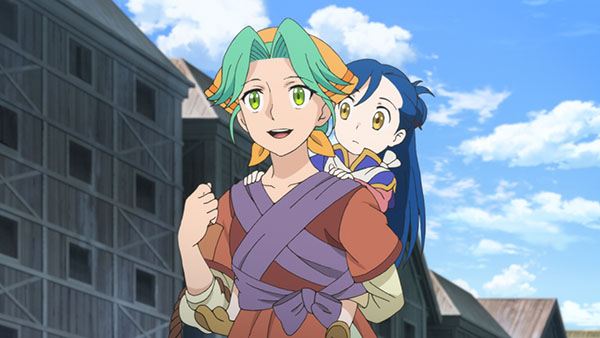
The original episode-one image below shows Myne being carried by Tuuli through the town. Its support relationship offers a useful visual counterpoint to the solitary wish to read. The promotional image near the top is explicitly from the later Lord’s Adopted Daughter project; it is not mislabeled as the first-season opening or used as proof of an early scene.
Original visual reference
Making a book changes more than the reader’s leisure
The book-making goal can be followed as a chain of dependencies: suitable material, tools, time, people and a way to circulate the result. Our preferred lens asks which obstacle is technical and which is social. Knowing that an object can exist does not establish who will help make it, who may own it, or who is allowed to use it.
That distinction is why the story belongs in both our crafting and economics selections. A production method can have value before it becomes widely accessible. The moment another person recognizes that value, a private goal can turn into negotiation. Follow what Myne needs from others and what they expect from her rather than measuring progress only by the finished object.
The same premise also makes Bookworm useful for the palace-skills shelf. A person’s knowledge can change their position without removing the rules around that position. This is our thematic interpretation, not an assertion that every institution exists only to oppose her. The interest lies in watching expertise enter relationships that already have power and obligations.
Three meanings of Part that should never be collapsed
The durable reading identifier is the story Part followed by the volume within that Part: Part 1 Volume 1, for example. Later Parts restart their volume numbering. Volume one of a later Part therefore carries prior-story context. Do not choose the first number you see on a newly released cover and assume it represents the beginning of the whole series.
J-Novel Club also displays smaller prepublication installments called Parts beneath a volume. Those weekly reading pieces are not new top-level story arcs. An ebook volume and one temporarily available translation installment are different access packages. Use the named volume record to keep a personal reading checklist consistent.
Manga Parts likewise cover successive story stages, but more than one adaptation can be produced in parallel. That means publication freshness is a poor reading-order rule. The source catalog credits Suzuka for manga Parts 1 and 2, Ryo Namino for Part 3 and Hikaru Katsuki for Part 4. Follow story order while treating each adaptation’s volume numbers as its own sequence.
Earlier seasons, optional 14.5, then the later project
The maintained earlier-series archive separates three seasons and numbers their main stories consecutively: one through fourteen, fifteen through twenty-six, then twenty-seven through thirty-six. TO Books’ separate OVA portal identifies Chapter 14.5 as two supplementary stories. Its placement after the first-season introduction and before moving into season two is an accessible viewing recommendation based on that catalog identity.
Lord’s Adopted Daughter is a later project, not a restart of Myne’s earliest book hunt. The current portal links back to the first three seasons. Its creator commentary associates the new production with the third source Part. TO Books’ 26 September 2026 notice schedules this project’s finale for 3 October on the Yomiuri/Nippon network and 5 October on TOKYO MX. These are announced Japanese broadcast dates, not worldwide simultaneous release promises.
The studio change belongs in the project record
The earlier official staff archive credits Mitsuru Hongo for direction, Mariko Kunisawa for series composition and Ajia-do for animation production. Lord’s Adopted Daughter instead credits Yoshiaki Iwasaki as director, Kunisawa for series composition, Aiko Minowa for character design and WIT STUDIO for animation. These distinct records make a studio change understandable without erasing continuity of the source.
The later staff page also contains commentary from Kazuki and Minowa about the visual presentation of the new social setting. That is a useful primary creator route after reaching the relevant story stage. It does contain later context. A studio’s name is a production credit; it should not be turned into a numerical guarantee that one season will be better than another.
Companions are not extra volumes inserted at random
J-Novel Club’s Short Story Collection presents additional viewpoints spanning several main story Parts. Its first collection covers Parts 1 to 4; the second spans Parts 2 to 5. These ranges explain why a companion labeled volume one can reveal far more than the main series’ first volume. Check its coverage before opening it.
Hannelore’s Fifth Year at the Royal Academy is another licensed companion with later-story context and a different focal character. It belongs after substantial main-story reading, not before Part 1 as a shortcut. The Japanese official source catalog also distinguishes fanbooks, drama CDs, junior editions and manga anthologies. Those are different kinds of product, rather than a single mandatory canon queue.
A series-level milestone with a defined limit
TO Books’ Part 5 XII product page, checked for this guide, reports more than ten million cumulative series copies including ebooks. It does not allocate that total between individual novels, manga, territories or reader purchases. We attribute the claim to the publisher rather than assigning it all to one volume or one English edition.
The listed Japanese release date for this concluding source volume is 9 December 2023. The product page can be updated later, so that release date is not automatically the exact announcement date of its circulation figure. Neither a series milestone nor the existence of several adaptations establishes the anime’s budget, rights-holder profit or return on investment. A revenue calculation would require those separate records.
A numbering question is more useful than an unmarked ending thread
The inspected newcomer-guide discussion in the title-specific Reddit community explains the arc-Part, volume and publisher-installment distinction. Comments ask for clearer English release information. That is a practical example of audience confusion the route map should solve, rather than a claim that every fan chooses the same format.
For an opening-level conversation, ask whether access to books depends most on material scarcity, money or another person’s permission. The wiki is useful for identifying terms after they appear, but it also catalogs late-story identities. Keep a discussion’s spoiler label aligned with the Part or season you have actually completed; a thread marked as a later Part is not an introductory recommendation.
Keep the route stable as new editions arrive
Is manga Part 3 Volume 1 a new beginning? It begins a later story stage. Does the source prose continue indefinitely because a manga adaptation is still publishing? The main prose has a verified conclusion at Part 5 Volume 12. Is the WIT project the first TV season? It follows the earlier three-season route.
Where can I resume after the anime? This guide does not guess an exact chapter handoff from season names alone. A source-versus-screen comparison can later document coverage and omissions. For now, start from the named source beginning if you want the fullest print context, and use the separate source, manga and screen identifiers to avoid buying or viewing the wrong stage.
Primary sources and useful navigation
- J-Novel Club: English light novel, author/illustrator and main Part sequence
- J-Novel Club: English manga and adaptation artists
- Author’s original Japanese web serialization
- Official earlier-series story archive: beginning and three-season chapters
- Official earlier-series staff archive
- TO Books: Chapter 14.5 OVA project and two stories
- Lord’s Adopted Daughter: later screen project
- Later screen-project staff and creator commentary
- Official source catalog: prose, manga, younger-reader editions and extras
- TO Books: Part 5 XII conclusion and reported series circulation
- TO Books: dated 2026 finale broadcast announcement
- J-Novel Club: Hannelore’s Fifth Year companion series
- J-Novel Club: Short Story Collection and covered story Parts
Community and catalog routes
- Reddit: inspected newcomer guide and numbering discussion; check post spoiler labels
- Reddit: title-specific community
- Fandom: Bookworm wiki, later-story spoilers
- MyAnimeList: anime catalog lookup
- Wikipedia: secondary format overview
The production and publisher links support project facts. Catalog and community pages are secondary navigation and may reveal later events.
Find this work in our thematic collections
- 5 Building and Crafting Anime Where Progress Takes Work
- Fantasy economics: five anime about trade, access and resources
- Beyond royal titles: five anime about skills, secrets and court pressure
Original series imagery is reproduced under permission asserted by the site owner; the source and rights credits are retained. The route diagram is Animeteor’s own explanatory graphic.
Production and edition updates
Bookworm — Royal Academy anime announced
The official anime production announced on 3 October 2026 that 貴族院の自称図書委員 will receive a television anime, with WIT STUDIO continuing after Lord’s Adopted Daughter. “Self-Proclaimed Librarian of the Royal Academy” is an editorial rendering of the Japanese subtitle, not a verified localized English title. The checked announcement supplies no premiere date or episode count.
See the separate production record →
WIT STUDIO to continue Bookworm with Royal Academy anime
Bookworm’s official anime site confirmed the Royal Academy television continuation on 3 October 2026. WIT STUDIO will again handle animation. The production has announced the project, rather than a dated premiere; no season length is inferred. The Japanese subtitle is 貴族院の自称図書委員.
See the separate production record →
Bookworm — Lord’s Adopted Daughter television anime
Yomiuri TV’s 19 January 2026 announcement dates Lord’s Adopted Daughter to 4 April 2026 at 17:30 in Japan, with two consecutive cours. WIT STUDIO animates this later source-story stage. The separately announced Royal Academy project follows it and is not another name for this 2026 broadcast.
See the separate production record →
Bookworm Part 5 manga — Suzuka
TO Books’ Corona EX identifies the Part 5 manga with Suzuka as manga artist, Miya Kazuki as original author and You Shiina as original illustrator. Its source-story Part is a later starting point; the publisher also lists its first collected volume. Part 5 manga numbering is separate from the fifth prose Part and from the anime’s seasons.
See the separate production record →
Bookworm musical — Japan, August–September 2026
TO Books identifies the 2026 musical rerun at Tokyo’s Stella Ball from 22–30 August and Osaka’s COOL JAPAN PARK TT Hall from 19–20 September. The announced archive-streaming window ended on 4 October 2026 at 23:59 in Japan; this record does not advertise that expired window as currently accessible.