From an idea to a finished work: five anime about making art
Painting study, a student animation team, a manga partnership, costume craftsmanship and a professional animation workplace. Five creative routes defined by what must happen after inspiration.
Reviewed 2026-10-01 · Premise-level spoilers · Editorial selections, without a universal ranking.
The media and institutions differ. An art-school ambition, a cosplay costume and a studio deadline should not be reduced to one success formula. We compare creative relationships and constraints without inventing wages, production costs or guaranteed career outcomes.
Choose your starting point
Follow the branch that sounds most appealing. This is a selection map, not a shared universe or a chronology.
How we chose these five
Each selection needs a theme that shapes its premise, a distinct reason to choose it and a verifiable anime project. We distinguish films from television, explain tone differences and use official production, studio, publisher or licensed-distributor pages for project identity. The order groups viewing experiences; it is not a score based on popularity or a claim that one work is objectively better.
Blue Period
TV anime · An artistic ambition needs a learning route

The project and licensed source follow Yatora Yaguchi discovering a commitment to painting and pursuing art education, making study part of the creative premise.
Why choose it?
Choose this when wanting to create should lead to the question of how to learn. The art-education direction gives the collection its individual-study branch, rather than assuming that feeling inspired already produces the desired work. Compare Eizouken for a group dividing creative roles, or Bakuman for a partnership aiming toward publication. Our thematic interest is the distance between recognizing a desire and being able to express it through a medium. The television series is not a course syllabus or a complete account of every art-school pathway. Begin with the first encounter with painting and let the character’s aims develop without consulting later exam summaries.
Where to start
Begin the television adaptation at episode one or Tsubasa Yamaguchi’s manga at volume one. Live-action and animation are separate screen versions. The official episode archive opens on later exam material and is unsuitable as a spoiler-free introduction.
Tone & scope: Creative insecurity, competitive study and identity questions. Later examination summaries contain outcome spoilers.
Keep Your Hands Off Eizouken!
TV anime · Imagination needs a production partnership

The licensed anime synopsis brings together Midori’s world designs, Tsubame’s wish to animate and Sayaka’s organizing instincts in a school group trying to make animation.
Why choose it?
Select this when the joy of imagining a world should meet the work of getting something made. The three distinct starting interests make collaboration a central attraction: a vivid idea still needs movement, organization and a project other people can help finish. Compare SHIROBAKO for an established industry workplace, or Blue Period for an individual’s study route. Our lens is the productive friction between invention and the practical shape of a project. A school club allows a more exploratory beginning than employment at a studio. We recommend the anime for that creative partnership, without claiming that its fictional budgets or deadlines are verified figures for a real animation production.
Where to start
Begin the 2020 television adaptation at episode one. Sumito Oowara’s manga is the source reading route, with licensed Dark Horse editions. The live-action version is a separate adaptation; it is not a prerequisite for the anime.
Tone & scope: Creative disagreement, school-club logistics and imaginative comedy. Fictional project finances are not real studio accounting.
· Licensed original TV synopsis
· Licensed manga catalog
· Find in MyAnimeList
Read the full Keep Your Hands Off Eizouken! guide & visual adaptation map →
Bakuman.
TV anime · Drawing and writing become a shared professional aim
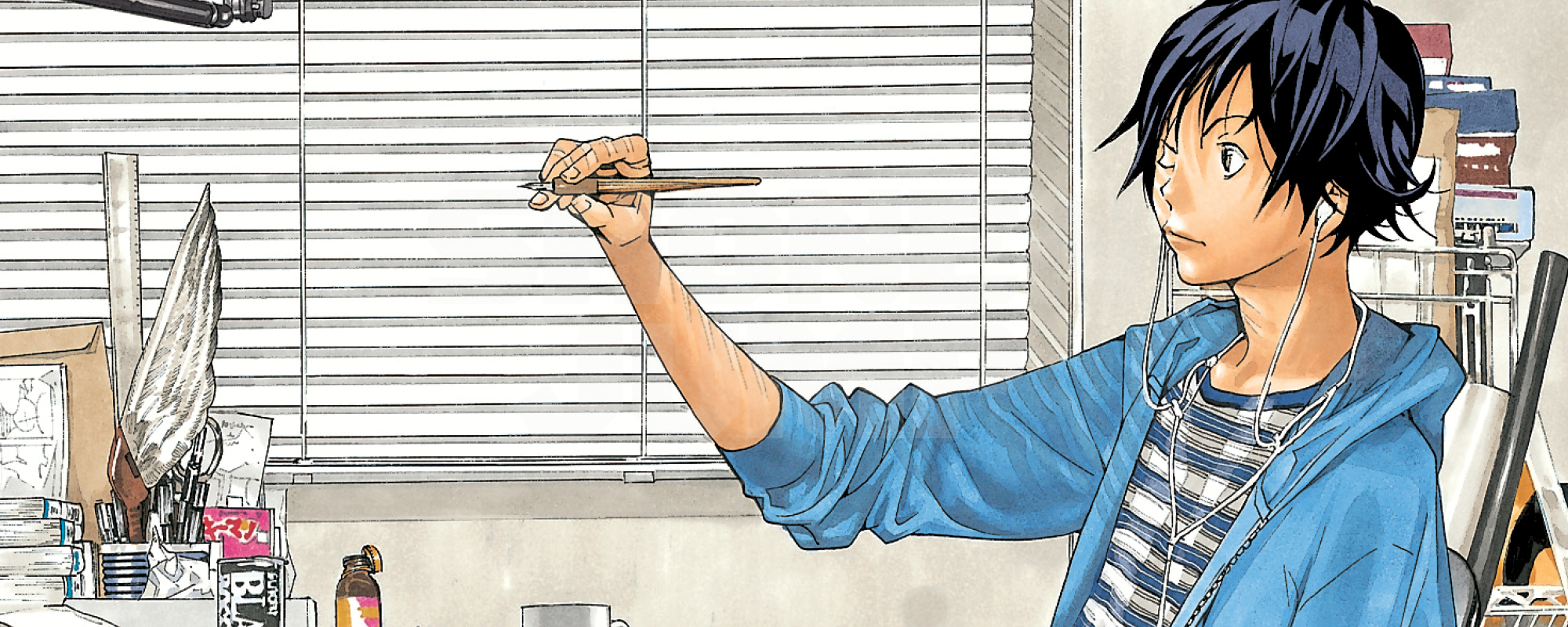
VIZ introduces Moritaka Mashiro’s drawing ability and Akito Takagi’s proposal to work together as a manga-creating pair, with professional publication as a difficult goal.
Why choose it?
Choose this when making art should be organized around a partnership and an external publication system. Having two complementary ambitions gives the work a different starting scale from Blue Period’s art-school pursuit or My Dress-Up Darling’s shared costume project. Our interest is the difference between enjoying a medium and deciding to seek a professional place within it. That makes it a useful branch for readers attracted to editorial relationships and sustained collaboration, while its romance and dramatic ambitions remain part of the experience. We do not treat a fictional publishing path as a universal account of how every manga creator works or earns money.
Where to start
Begin the first television season at episode one, or the manga at volume one. VIZ credits Tsugumi Ohba and Takeshi Obata. The separate live-action film is another screen route, and box-set packaging does not create an additional story arc.
Tone & scope: Professional pressure, romantic motivation and competitive ambition. Editorial outcomes and later career summaries are spoilers.
My Dress-Up Darling
TV anime · A craft skill becomes a shared costume project

Wakana Gojo’s interest in traditional doll craftsmanship meets Marin Kitagawa’s enthusiasm for cosplay, creating a practical and personal partnership around making costumes.
Why choose it?
Select this when a creative collaboration should begin with a skill someone has kept relatively private. A costume is a specific object that another person wants to use, so communication and craft can become part of the same project. Compare Eizouken for imagined moving worlds or Bakuman for a partnership aimed at publication. Our thematic reading concerns what changes when another person recognizes the usefulness of an interest, rather than assuming an artist must abandon it for a more fashionable one. Romance and sexualized presentation are substantial parts of the viewing choice, so this is not offered as only a neutral sewing documentary. Begin with the initial meeting before later cosplay or relationship coverage.
Where to start
Begin the first television season or Shinichi Fukuda’s manga at volume one. The current official portal carries second-season material, whose visuals are labeled here. Costume arcs and manga volume counts are not interchangeable with anime season numbers.
Tone & scope: Romance, fanservice, sexualized situations and body-related embarrassment. A craft premise does not make the series suitable for every age.
· Official television project and manga navigation
· Find in MyAnimeList
Read the full My Dress-Up Darling guide & visual adaptation map →
SHIROBAKO
TV anime · Finishing animation requires a whole workplace

P.A.WORKS describes an ensemble around five women’s aspirations and the troubles, disagreements and cooperation involved in completing animation within the industry.
Why choose it?
Choose this for the coordination side of making something, where individual ambition must work within a production involving many roles. The studio’s premise explicitly includes collective effort and friction, making it the professional-workplace branch beside Eizouken’s school experiment. Compare Bakuman for a smaller writing-and-drawing partnership, or Blue Period for a learning route before employment. Our attraction is the question of how an intention survives the practical work of completion. We describe the fictional industry setting without presenting each event as a verified account of an actual company. A completed screen product is the destination, not proof that every creative disagreement has a simple technical solution.
Where to start
Begin the original television series at episode one, then treat the later theatrical film as its separately labeled project. The studio identifies original Musashino Animation credits rather than a source novel requiring a prior read.
Tone & scope: Workplace pressure, missed expectations and creative frustration alongside comedy. It is a dramatized industry story, not a current employment manual.
Case check: the person with an idea may need someone with a different skill
The licensed Eizouken premise gives the three students distinct interests in world design, animation and organization. VIZ’s Bakuman opening pairs a prospective writer with someone who draws. Our interpretation is that collaboration can begin with a difference in what each person can contribute. SHIROBAKO widens that question to a workplace with many roles, while Blue Period follows a more individual learning goal. My Dress-Up Darling gives the shared project a tangible costume. The comparison supports a choice of creative experience; it does not turn fictional teamwork into a measured production model or claim that one arrangement guarantees professional success.
Confirmed: the linked primary descriptions establish project identity and starting premises. Editorial reading: the thematic fit and comparisons are our interpretation. Not established here: exact adaptation endpoints, production costs, complete viewing availability or a scene-by-scene source comparison.
Discuss and continue
Community and catalog links are secondary navigation. They can help you find contrasting responses, but they are not evidence of audience-wide agreement. Discussion threads and later-season pages may contain spoilers.
Use official source pages for project identity and check your licensed service for regional availability.
Find community discussions on Reddit · Watch-order guides · Reading routes · Visual adaptation maps
Another experience to explore
- Farming & countryside life
- Food at the heart of the story
- Build, craft & organize
- Time loops & changing the past
- Life after battle
Review and artwork notes
This selection was reviewed on 2026-10-01. Original official or licensed images identify each project; later-season art is labeled where used. Artwork is reproduced under permission asserted by the site owner, with attribution and source links retained. This is not an open-license claim. Future revisions can replace a pick, improve source routes or add a maintained Work guide while preserving the selection’s published purpose.